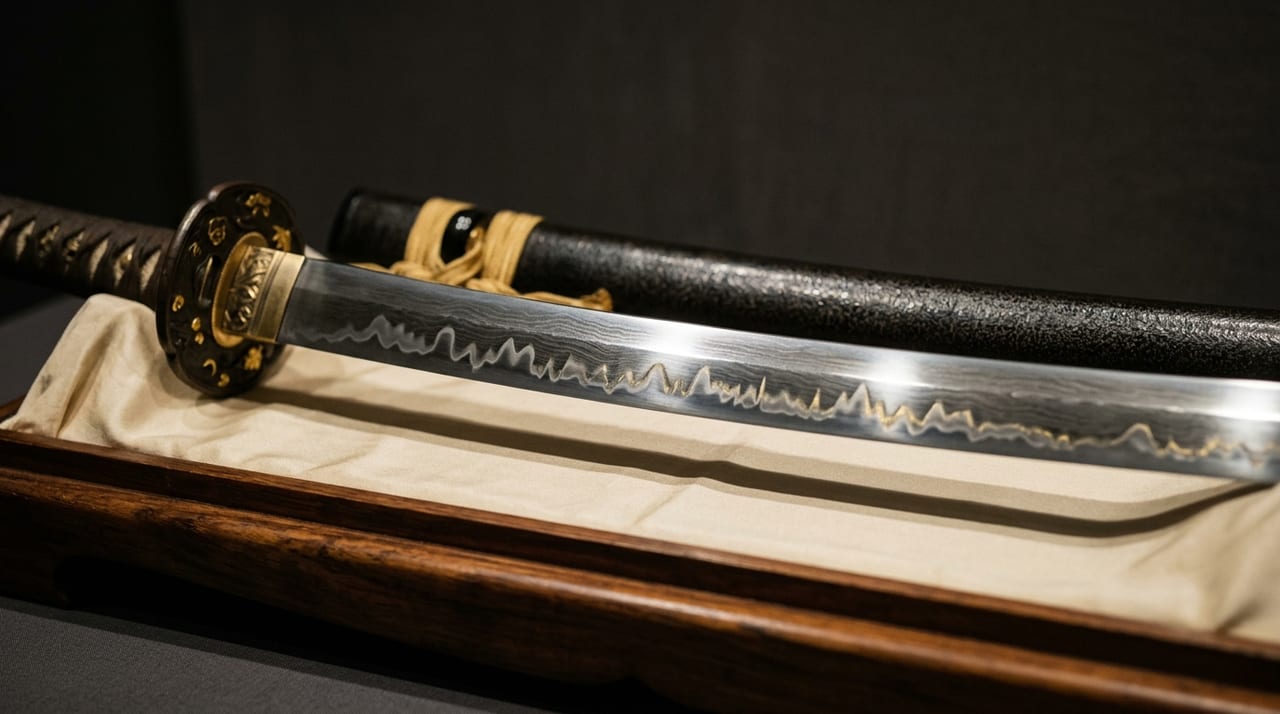
 * Image is for illustrative purposes only.
Kitano Yari Masamune
北野槍正宗
Also known as: Kitano Yari · Soshu Masamune-made naginata-naoshi · Former Miyoshi Clan Collection
Description
The Kitano Yari Masamune is a naginata-naoshi traditionally attributed to Okazaki Masamune, the preeminent smith of the Soshu school who flourished from the late Kamakura period through the Nanbokucho period. It derives its name from having been dedicated to Kitano Tenmangu Shrine in Kyoto.
A naginata-naoshi typically refers to a blade originally forged as a naginata, then reforged and reshaped into a katana or wakizashi. However, in the case of the Kitano Yari Masamune, the possibility of its being a yari-naoshi (reworked from a spear) is debated among experts, with some arguing that it was originally crafted as a weapon with a distinctive point shape, later polished and refined into its present form.
Masamune was active based in Kamakura, Sagami Province (present-day Kamakura, Kanagawa Prefecture), and was also known as Goro Nyudo Masamune. He is renowned in later ages as one of the "Tenka San-saku" (Three Greatest Smiths) mentioned in military chronicles and traditions of the Nanbokucho period, and produced many exceptional disciples who became known as the "Masamune Jittetsu" (Ten Masamune Disciples). His blades are characterized by strong nie, the hallmark of the Soshu school, with distinctive vigorous patterns in the edge including nie-kuzure, nie-ashi, kinsuji, and inazuma, imparting an overwhelming presence to all who behold them.
The Kitano Yari Masamune has been polished to a relatively short blade length. Its jigane displays the characteristic flowing itamehada distinctive of Masamune, with abundant ji-nie and jikei rising richly to the surface. The hamon is dominated by Masamune's characteristic notare, interspersed with oguni no me and togari ba, displaying a magnificent array of vigorous nie-kuzure and kinsuji running through the edge.
It is said to have been transmitted through the Miyoshi clan and later dedicated to Kitano Tenmangu Shrine, where it is recognized as a masterwork of exceptional provenance among the shrine's sword collection. While tradition associates it with Kitano Tenmangu Shrine, definitive records of its designation and custodianship are sparse.
Legends & Stories
Legend holds that the Kitano Yari Masamune was carried inseparably by Miyoshi Nagayoshi (1522–1564) in battle. Nagayoshi was a Sengoku daimyo who wielded actual power over the Muromachi shogunate and commanded considerable influence across the Kinai and Shikoku regions. The sword is said to have been his treasured blade symbolizing his martial prowess.
According to legend, during one particular battle when Nagayoshi found himself in a precarious position, the blade suddenly emitted an otherworldly light, causing enemy soldiers to flee in fear.
The circumstances of its dedication to Kitano Tenmangu remain unclear. One account suggests that following the Miyoshi clan's demise, family members or retainers made the offering as a spirit-pacifying rite; another claims it was dedicated during the Kitano Daichanoyu (Grand Tea Ceremony) in 1587 as a commemoration of Toyotomi Hideyoshi's unification of Japan. Nevertheless, since the shrine's enshrined deity, Sugawara no Michizane, also embodies aspects of a martial god, the Masamune has long been revered locally as 'a Masamune dedicated to the god of both learning and martial prowess.'
To this day, its blade rests in the deepest recesses of the shrine's treasure hall, commanding the reverence of all who visit and appreciate fine swords.