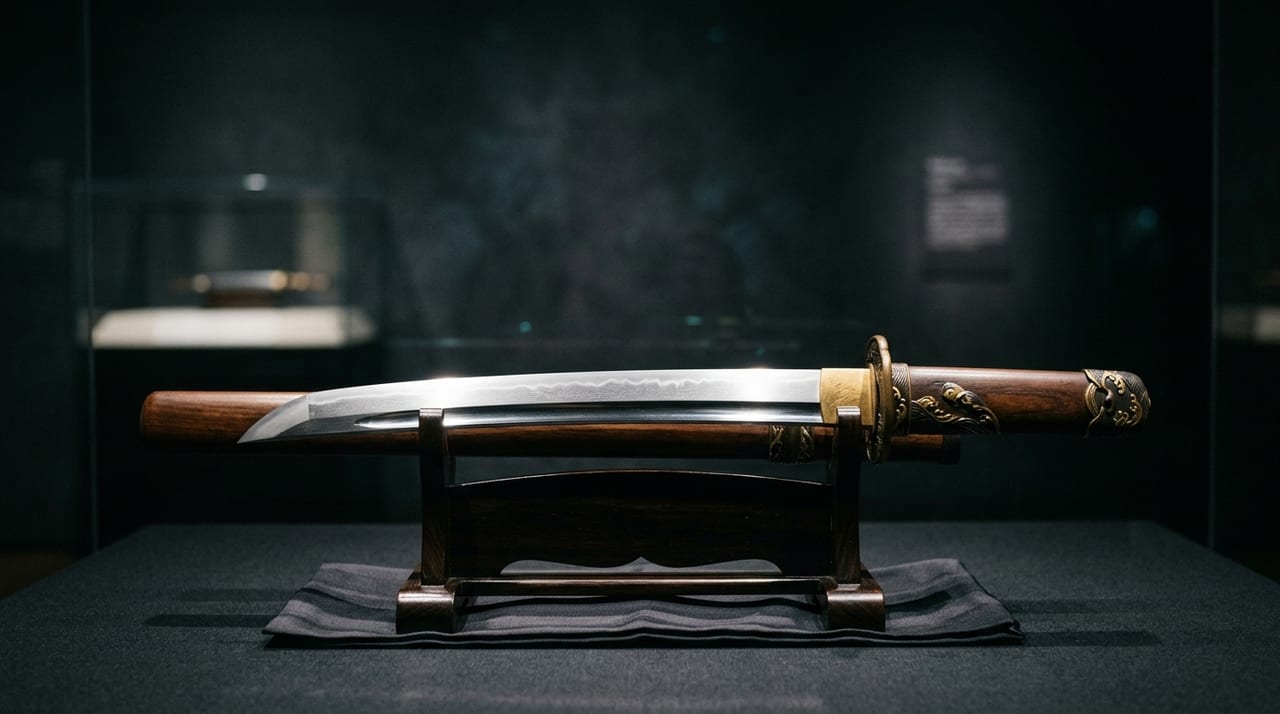
 * Image is for illustrative purposes only.
Mumei Masamune
無銘正宗
Also known as: The Unsigned Masamune — Masterpiece of the Sōshū Tradition
Description
Mumei Masamune is a tantō appraised as the work of Masamune (Gorō Nyūdō Masamune), the great master of the Sōshū tradition, but bearing no signature (mumei), designated an Important Art Object. Masamune seldom signed his blades throughout his life, and the majority of his works are either unsigned or bear only the two-character signature "Masamune." For this reason, it has long been said that "Masamune's true masterpieces are often found among the unsigned blades," and being unsigned has been regarded not as diminishing value but rather as proof of a genuine Masamune work, receiving the highest appraisal. Masamune (c. 1264–c. 1343) was a swordsmith active in Sagami Province (present-day Kamakura, Kanagawa Prefecture) from the late Kamakura shogunate through the Northern and Southern Courts period, and has been praised since ancient times as the greatest swordsmith in the history of the Japanese sword. His style is characterized by fierce yet refined "intense nie" and "dynamic jigane," establishing the Sōshū tradition and exercising an immense influence on later sword culture. The Tokugawa shogunal house also treasured Masamune's swords as the finest family heirlooms, placing Masamune first among the "Three Great Sword Traditions" (Masamune, Yoshimitsu, Yoshihiro). The blade of this Mumei Masamune displays the nie-deki hamon characteristic of Masamune in marked fashion. Within the notare (gunome) hamon, fierce ō-nie erupts, kinsuji and sunagashi run in all directions through the ha, radiating a fierce yet mysterious beauty. The jigane flows in itame-hada with abundant ji-nie and powerful jikei, directly conveying the awe-inspiring quality of Masamune's forging. The nakago is well-preserved in ubu-nakago condition but bears no signature. Authoritative Masamune appraisers have issued certificates of attribution (kiwame), and origami (appraisal certificates) from the Hon'ami family or other renowned appraisers of successive periods accompany the sword. Its deposit at the Tokyo National Museum was made in recent years, and as an unsigned Masamune tantō it continues to attract the close attention of sword enthusiasts and researchers.
Legends & Stories
Mumei Masamune is attended by many legends concerning the paradoxical reputation of the "unsigned supreme masterpiece." Since ancient times, the world of sword appraisal has held the saying: "Even without Masamune's signature, the blade itself speaks its maker's name." This means that the overwhelming individuality of a Masamune blade — the intense nie and dynamic jigane that no other swordsmith can replicate — is so powerful that it tells the appraiser the swordsmith's name without any signature. There is a legend that when Hon'ami Kōtoku appraised and presented to Tokugawa Ieyasu an unsigned Masamune tantō, Ieyasu declared: "Even without a signature, this is unmistakably one of Masamune's supreme masterpieces," and ordered it specially archived in his treasure vault. Furthermore, it is said that Ieyasu described this sword as "the unsigned blade as Masamune's true form" and intuited that Masamune may have believed that "engraving a signature defiles the divine patterns imprinted on the blade." The unsigned Masamune blades are said to embody the philosophy of sword appraisal: "Do not lament the absence of a signature. True treasure needs no words — its very existence speaks all." This Mumei Masamune too has been passed down as the embodiment of that philosophy. Appraisers have said, "Only one who possesses the eye to recognize an unsigned Masamune is a true sword appraiser," and this unsigned tantō has occupied a legendary position as the touchstone of sword appraisal.