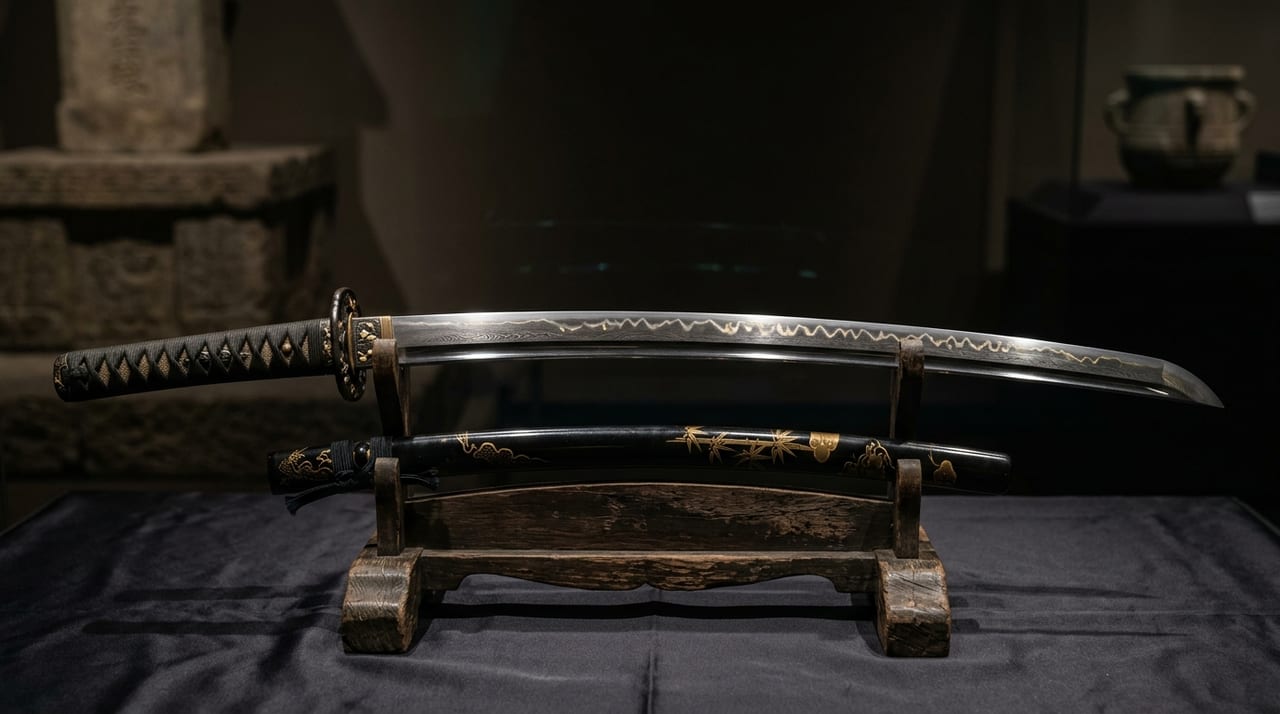
 * Image is for illustrative purposes only.
Matsukura-gō
松倉江
Also known as: Matsukura no Gō
Description
Gō Yoshihiro was a swordsmith active in Etchū Province (present-day Toyama Prefecture) during the Nanboku-chō period, counted among Masamune's Ten Great Disciples. Known as 'Kō' (as the cursive form of the character 'Gō' came to be written as 'Kō'), his swords are celebrated for the mysterious beauty of their jigane—particularly the deeply permeating ji-nie, described as profound and otherworldly, known as 'Yoshihiro's Skin' and revered as an aesthetic ideal by later swordsmiths. The jigane displays flowing ō-itame grain with deeply saturating ji-nie, revealing Yoshihiro's characteristic profound texture, with matsu-kawa-hada (pine-bark grain) and nashiji-hada (pear-skin grain) appearing throughout. The hamon is gunome-midare mixed with chōji, displaying rich activity throughout including kinsuji, uchinoke (striking marks), and nijūba (double-edge). Surviving works by Yoshihiro are extraordinarily rare, with each recognized worldwide as a supreme masterpiece of Japanese swordsmanship. The Tomita-Kō, a National Treasure, is preserved by the Maeda Ikutokukai.
Legends & Stories
Yoshihiro's blades are said to emit a spectral light when viewed at night, with the ji-nie in the jigane glowing like fireflies when caught in moonlight. The Maeda clan of the Kaga domain is said to have treasured the Matsukura-gō across generations as 'the sword that guards the house,' ceremonially opening its storage box for veneration each New Year. And since Yoshihiro is believed to have died young—accounting for the extreme scarcity of his surviving work—the legend persists among sword enthusiasts that 'his short life meant he poured his entire soul into each single blade.'
Related Famous Swords
同田貫正国
Multiple official designationsDōtanuki Masakuni
Dōda-tsuruba Masakuni (Higo Dōda-tsuruba School)
肥前忠吉
Important Cultural Property • Important Sword (multiple works)Hizen Tadayoshi
First Hizen Kuni Tadayoshi
一期一振
Gomotsu (Imperial Collection)Ichigo Hitofuri
Awataguchi Yoshimitsu
織田信長の愛刀
National Treasures and Important Cultural Properties (multiple)Oda Nobunaga's Beloved Sword
Awataguchi Tōshirō, Samonji, Yukimitsu, Hasebe (respective smiths)