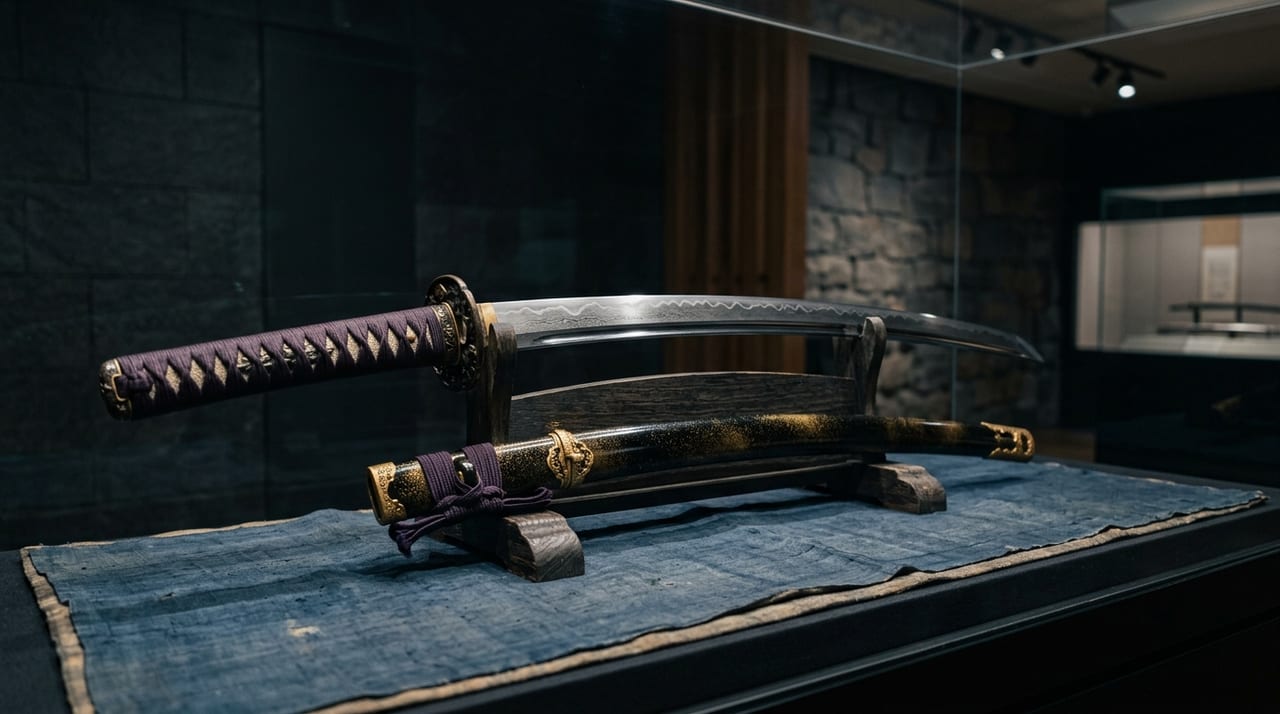
 * Image is for illustrative purposes only.
Matsui-Gō
松井江
Also known as: Matsui-Gō; Prized Blade of the Gō School
Description
Sword Overview
The Matsui-Gō is a blade forged by the legendary swordsmith Gō Yoshihiro (also known as Ko Yoshihiro; dates unknown), who was active in Etchū Province (present-day Toyama Prefecture) from the late Kamakura through the Nanbokuchō period. Signed "Yoshihiro / Honami (seal)," it represents a masterwork of the Gō school and exemplifies the finest "Go no Meibotsu" — Named Objects of the Gō tradition. Designated an Important Cultural Property, it is currently held at the Sano Museum in Mishima, Shizuoka Prefecture. "Gō" refers to the place name in Etchū Province where Yoshihiro resided, and works bearing this mark are collectively called "Go no Meibotsu" — they were prized in samurai society as the highest-class gifts and secret treasures.
Gō Yoshihiro: The Enigmatic Genius
Gō Yoshihiro ranks among the most mysterious geniuses in Japanese sword-making history. Much of his life remains unknown; he is said to have lived in Matsurakugō, Etchū Province (present-day Uozu City, Toyama Prefecture), yet documentary evidence is so scarce that some scholars doubt his very existence. However, the surviving works attributed to the Gō school are among the finest Japanese blades of the late Kamakura and Nanbokuchō periods, and their technical mastery is widely recognized by experts. Yoshihiro's swords demonstrate a distinctive aesthetic in both steel grain and blade pattern. The three elements of ji-nie, ji-kei, and reflection are incomparably rich, and the iron's texture unique to Gō — with its profound visual depth — leaves a striking impression on the viewer. Counted among the Ten Great Disciples of Masamune, Yoshihiro established his own distinct style while influenced by the Soshu school tradition, occupying an exceptionally important place in the history of Japanese swordcraft. It remains unclear under which master Yoshihiro trained, but given the strong Soshu influence, the prevailing theory holds that he either studied directly under Masamune or inherited the lineage of his disciples.
Form and Appreciation of the Matsui-Gō
The Matsui-Gō is a polished blade bearing the form typical of the late Kamakura through Nanbokuchō periods. The steel grain shows an itame pattern mixed with wood-figure; a thick coating of ji-nie and well-developed ji-kei produce an iron color with depth and moisture. This is the distinctive beauty of Gō iron — the ji-nie particles are uniform and abundant, creating an intricate landscape as if a microcosm were embedded within the steel itself, a defining hallmark of Yoshihiro's work. The blade pattern is a mixed representation of gunome and choji forms, deeply hardened with a boiling quality that is both intense and dignified. The three elements of nie, fragrance, and reflection achieve remarkable harmony; the relationship between blade pattern and steel grain creates a distinctive unity unlike that of other celebrated blades.
Lineage of the Matsui Family and the Hosokawa Clan
The name "Matsui-Gō" derives from its ownership by Matsui Okinage, a senior retainer of Hosokawa Tadaoki (Sansai), feudal lord of Kumamoto in Higo Province. The Matsui family held the position of chief elder of the Hosokawa clan and was entrusted with the stewardship of swords and blades. Later, in the second year of Jōkyō (1685), when Tsuruhime, daughter of Shogun Tokugawa Tsunayoshi, married Tokugawa Tsunanori of the Kii branch of the Tokugawa family, the blade was presented as a wedding gift along with Honami Mitsutune's authentication, entering the Kii Tokugawa family's collection. It remained a treasured Named Object preserved by daimyo houses throughout the Edo period.
Modern Evaluation and Legacy
Today it is held at the Sano Museum as a designated Important Cultural Property, continuing to be preserved and studied. Surviving works authenticated to Gō Yoshihiro are rare, and the Matsui-Gō occupies a special position as among the finest of these remaining examples. The title "Go no Meibotsu" carries particular weight in the world of Japanese sword appreciation, and the Matsui-Gō stands as its preeminent representative, spoken of today with deep respect by sword enthusiasts and scholars alike. This blade — having survived the upheavals of the late Kamakura period and the warfare of Nanbokuchō, passing through the Sengoku and Edo periods under the protection of great feudal houses, and reaching the present day — embodies in microcosm the very trajectory of Japanese cultural history.
Legends & Stories
The Mystery of Gō Yoshihiro—Genius or Legend?
Gō Yoshihiro is one of the most enigmatic swordsmiths in the history of Japanese swords, his legend a fusion of fact and imagination. No records of his birth or death survive; tradition places him in a place called "Gō" or "Go" in Etchū Province, but documented evidence of his life is extremely sparse. Some scholars once questioned whether Yoshihiro existed at all, proposing instead that "Gō" represented not a single swordsmith but a collective of multiple Etchū smiths. Yet the consistent style and exceptional quality of surviving works attributed to "Gō" powerfully suggest the work of a single outstanding genius, and Yoshihiro is now generally accepted as a real historical figure.
As for why Yoshihiro left so few records, various traditions claim he "died young," "retired to the mountains," or "had no disciples," but none can be verified. One theory holds that Yoshihiro was deeply introverted and refused to transmit his techniques to disciples; consequently, the "Gō" school allegedly died with him. The image of Yoshihiro as an enigmatic genius bestows special mystique upon blades attributed to "Gō," fueling veneration of "Gō masterpieces" such as the Matsui-Gō.
Hosokawa Fujitaka and the Matsui-Gō—A Warrior's Encounter with Beauty
The name "Matsui-Gō" derives from the Matsui family, retainers of the Hosokawa house; the circumstances by which the Hosokawa acquired the blade, however, remain uncertain. Hosokawa Fujitaka (also known as Yūsai, 1534–1610) was a Sengoku-period warrior who was equally accomplished in the civil arts—poetry, Noh, and tea ceremony. As a custodian of the Kokin Denshū lineage, Yūsai was a figure of profound cultural significance and is said to have possessed deep knowledge of and refined taste in fine blades.
Precisely when and how the Matsui-Gō entered the Hosokawa collection remains unclear, though it is believed to have been treasured as a heirloom during Yūsai's era or that of his successors. The Matsui family were trusted retainers entrusted with its safekeeping; the blade's being named "Matsui-Gō" may be understood as a tribute to their faithful stewardship. This rare instance of a blade being named not for its maker or owner but for the faithful steward entrusted with its care testifies to the profound and singular bond between the Matsui-Gō and the Matsui family. The martial honor and cultural refinement of both the Hosokawa and Matsui families have sustained the preservation and transmission of this great blade for nearly seven centuries.
What Yoshihiro's Steel Reveals about Etchū's Nature
Many connoisseurs perceive in the beauty of Yoshihiro's jigane—his iron—a resonance transcending mere technical mastery, suggesting a profound relationship with Etchū's natural environment. Etchū (Toyama), blessed with abundant water and iron deposits and dominated by the Tateyama range, is thought by some to have supplied Yoshihiro with tamahagane of a distinctive quality that produced a unique iron color unlike that of other regions.
The way jinie (fine granulation) wraps the blade like mist, the way jikei (ground patterns) run like mountain ridgelines—the breath of Etchū's nature dwelling in the Matsui-Gō enables a dialogue with the Japanese landscape that transcends the mere appreciation of swords. Steel nurtured by Etchū's crystalline waters and abundant iron sands, transformed by Yoshihiro's fire and hammer, speaks across a thousand years to the modern eye, evoking the mountains and rivers of Etchū—this is the wellspring of the Gō blade's singular allure.
Steel born in Etchū beneath the sacred peaks of Tateyama, passing through the hands of the genius Yoshihiro, transcended mere metal to become a work of art infused with the spiritual essence of nature.
The Matsui-Gō and the Sano Art Museum—Its Transmission and Preservation
The Matsui-Gō takes its name from Matsui Okitsugu, the Hosokawa house's chief retainer who possessed it. It was later given as a parting gift when Tsuruhime, daughter of Tokugawa Tsunayoshi (the fifth shogun), married into the Kii Tokugawa house, and subsequently passed down through that family. It is now housed in the Sano Art Museum in Mishima, Shizuoka Prefecture, and designated as an Important Cultural Property.
The Matsui-Gō, concentrating in a single blade both the mystery of Gō Yoshihiro and the storied lineage of the Matsui family, stands as an emblem of the depths of Japan's samurai culture.
The Significance of "Gō Masterpieces" in Modern Times
In modern sword appraisal, attributing a blade to "Gō"—that is, certifying it as a genuine work of Gō Yoshihiro—is considered one of the most difficult and authoritative of judgments. Extant works by Yoshihiro are extremely rare; owing to their scarcity and mystique, "Gō masterpieces" rank among the most coveted categories of blades for collectors and scholars alike.
Among these, the Matsui-Gō stands out for its documented location and clear provenance, making it one of the most trustworthy attributions to Gō and serving as a benchmark for sword scholarship. The steel art left by the enigmatic genius Yoshihiro, unchanged by seven centuries, continues to move the hearts of those who encounter it.
The enigmatic Yoshihiro epitomizes the fathomless depth inherent in the art of the Japanese sword; through the Matsui-Gō, we touch the spirit of a genius who lived in the turbulent Kamakura and Nanboku-chō periods. This is why the Matsui-Gō transcends the status of mere cultural artifact to become a "living legend."
Though Yoshihiro's name survives in few records, his blades have been revered for nearly a thousand years and his name shines as one of the most venerated in the history of Japanese swords. The Matsui-Gō stands at the pinnacle—an eternal masterpiece.