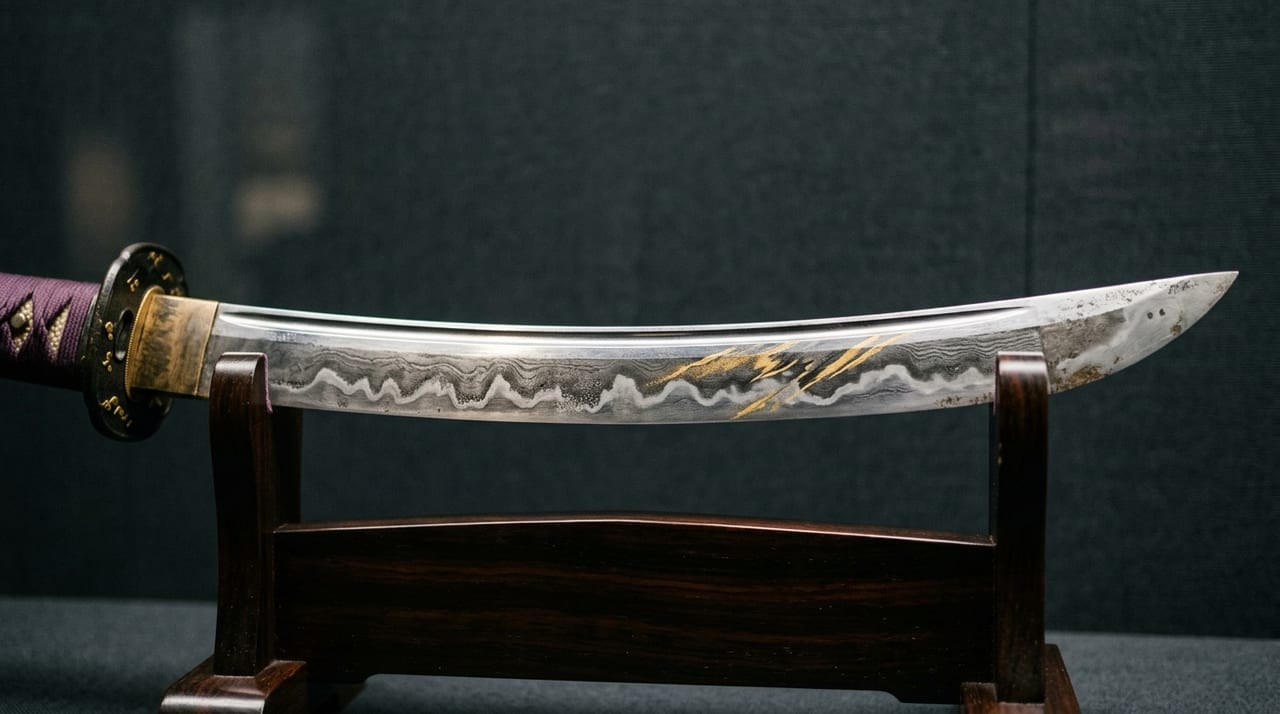
 * Image is for illustrative purposes only.
Kyōgoku Masamune
京極正宗
Also known as: Kyōgoku Masamune; Tantō signed Masamune
Description
A Signed Masamune
Kyōgoku Masamune is a tantō attributed to Sōshū Masamune, the celebrated master smith of the late Kamakura period, bearing the two-character signature "Masamune" on its tang. Because most of Masamune's surviving works are unsigned, blades with a reliable signature are few, and this piece is counted among the important reference works for the study of his oeuvre. The steel shows fine ji-nie and chikei activity, evidence of superb forging, and the file marks and chisel work on the tang are considered trustworthy, giving the blade considerable documentary value.
Masamune and the Soshu Tradition
Masamune worked in Kamakura, Sagami Province, at the end of the Kamakura period. Trained under Shintogo Kunimitsu, he brought to completion the Soshu tradition, a style built on the dramatic play of nie — ji-nie, nie-kuzure, kinsuji, and sunagashi — distinct from the earlier Yamashiro and Bizen traditions. He is counted among the "Tenka Sansaku," the three supreme master smiths, and his influence on later generations was immense; his students became known as the Ten Great Disciples of Masamune.
The Secret Treasure of the Kyōgoku of Sanuki Marugame
This blade takes its name from its descent through the Kyōgoku family, daimyo of the Marugame domain in Sanuki Province (present-day Marugame, Kagawa Prefecture). It is said to have been bestowed by Toyotomi Hideyoshi upon Kyōgoku Takatsugu, who restored the family's fortunes, and was thereafter guarded as a treasured heirloom for generations. Fearing that the Tokugawa shogunate might confiscate it, the Kyōgoku family is said to have kept the blade's existence secret, known only within the clan.
Presentation to the Imperial House
After being kept hidden for generations, the blade was presented to the Imperial House by the Kyōgoku family in 1928 (Showa 3), and has since been treated as Gyobutsu, an Imperial House treasure. It is today held by the Museum of the Imperial Collections, Sannomaru Shozokan. Swords held by the Imperial House are frequently classified as Gyobutsu and not subject to formal designation under the Law for the Protection of Cultural Properties, and this blade occupies that position. Long polishing has evidently reduced its width from the original, yet it remains a piece of particular note among Imperial House swords, combining the characteristic transformations of Masamune's steel with the documentary value of a genuine signature.
The Debate over Masamune's Existence and the Value of a Signed Work
Because the overwhelming majority of blades attributed to Masamune are unsigned, and contemporary documentary evidence is scarce, modern sword scholarship at times saw arguments questioning whether Masamune existed as a historical smith at all. Kyōgoku Masamune, hidden within a single family for nearly three hundred years and unknown to the wider world, was eventually made public and presented to the Imperial House as a reliably signed work bearing the name "Masamune" — becoming, in the process, an important piece of physical evidence in that very debate. That a single tantō contributed not merely as a work of art but as documentary proof in the history of swordsmithing is an aspect of its story that should not be overlooked.
Legends & Stories
The Kyōgoku family is said to have kept this tantō, reputedly bestowed by Toyotomi Hideyoshi, hidden for generations for fear that the Tokugawa shogunate would confiscate it, guarding it within the clan alone. Never displayed publicly during that time, the blade was finally presented to the Imperial House by the Kyōgoku family in 1928 (Showa 3), and has been kept as an Imperial treasure ever since.