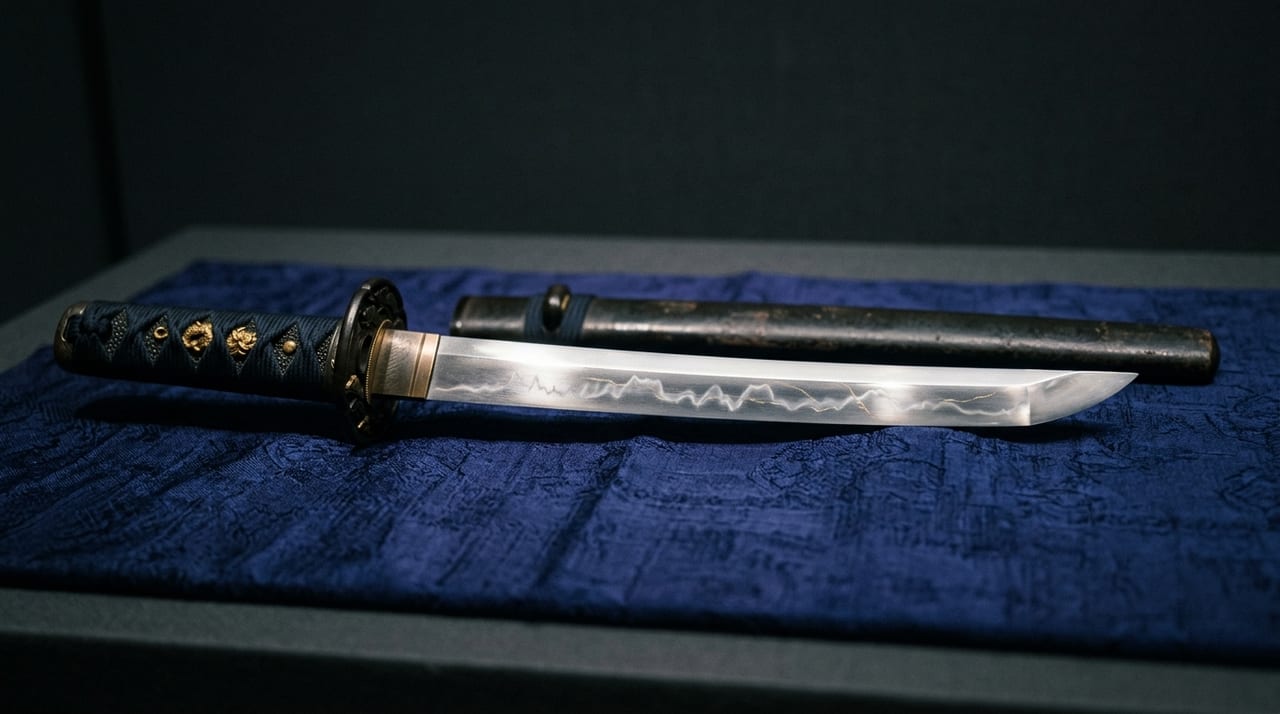
 * Image is for illustrative purposes only.
Kuwana-gō
桑名江
Also known as: Kuwana-gō; Tantō by Gō Yoshihiro
Description
Overview of the Sword
Kuwana-gō is an Important Cultural Property designated masterpiece forged by Gō Yoshihiro, a renowned swordsmith representative of Etchū Province (present-day Toyama Prefecture) during the Northern and Southern Courts period, and acquired its name from having been passed down through the lords of the Kuwana domain (present-day Kuwana City, Mie Prefecture) of Ise Province, which served as their base. The character "Gō" (江) is an abbreviation of Gō Yoshihiro's name, and as one blade among the group of Yoshihiro's works collectively known as "Gō-mono" (郷物), it bears the place name Kuwana. Gō Yoshihiro, one of the Ten Great Disciples of Masamune, was a master swordsmith who established a distinctive Etchū-style forging technique while receiving influence from the Sōshū tradition, and his works are extremely rare in survival, receiving the highest evaluation in terms of rarity.
Gō Yoshihiro and the Beauty of the Etchū Tradition
Gō Yoshihiro (birth and death dates unknown, active in the 14th century) was a swordsmith who resided in Etchū Province (present-day Toyama Prefecture), and is most frequently cited as the foremost of the Ten Great Disciples of Masamune, the greatest of master craftsmen. The greatest characteristic of Yoshihiro's works is the unique optical phenomenon called "utsuri" (映り) that appears in the steel, and the frequent appearance of intense "kinsuji" (金筋) and "inazuma" (稲妻) erupting within the hamon. These are phenomena that occur only at the ultimate limit of forging technique, and are highly treasured by connoisseurs. The authentic surviving works of Yoshihiro are said to number fewer than ten, and Kuwana-gō holds special value as one of these rare surviving examples.
The Place Name Kuwana and Its History
Kuwana (present-day Kuwana City, Mie Prefecture) is a castle town located in the northern part of Ise Province and played an important role throughout the Edo period as a strategic point on the Tōkaidō. As a celebrated work recorded in the Kyōhō Meibutsuchō, Kuwana-gō was recognized as a masterpiece of the realm throughout the Edo period. It is currently housed and preserved at the Kyoto National Museum and is open to the public as a rare surviving work of Gō Yoshihiro.
The Rarity of Gō-mono—The Special Significance of Yoshihiro's Works
One possible reason why so few authentic works of Gō Yoshihiro survive is that Yoshihiro may have had a short life, or that the number of blades he forged was itself limited. To see a work of Yoshihiro that has reached the ultimate in both rarity and quality is one of the highest experiences for those who deeply love the Japanese sword.
Legends & Stories
The Foremost Among the Ten Disciples of Masamune—Gō Yoshihiro, a Solitary Genius
Gō Yoshihiro is the most highly evaluated master craftsman among the "Ten Disciples of Masamune" and is said to have received direct instruction from Masamune himself. While Yoshihiro's works inherited the Soshu-den techniques of Masamune, they established their own distinctive style through the iron and forging techniques unique to Etchū, and are sometimes even evaluated as "a disciple who surpassed his master's technique." Because surviving works by Yoshihiro are extremely rare, a confirmed extant work such as Kuwana-gō is highly positioned as one of the most important primary sources in Japanese sword research.
"Gōmono"—The Cultural Influence That Yoshihiro's Short Blades Bestowed
Yoshihiro's works are collectively called "gōmono," and this term itself became an important concept in the sword appreciation culture of later ages. "Gōmono" became established as an art-historical term referring to works with specific technical characteristics—complex utsuri in the ground steel, intense kinsuji and lightning patterns, and a distinctive character in the nie—and Yoshihiro's name transcended that of a single swordsmith to become a conceptual term denoting an "aesthetic standard." As a genuine Yoshihiro work positioned at the source of this "gōmono" aesthetic, Kuwana-gō possesses immeasurable cultural and art-historical significance.
From Kuwana to Nagoya—The Blade's Journey
Kuwana was a strategic point on the Tōkaidō and a castle town with deep connections to the Tokugawa shogunal family. The fact that Kuwana-gō came to be transmitted through this place holds special meaning as the journey of a blade born within the geographic region of Tokai.