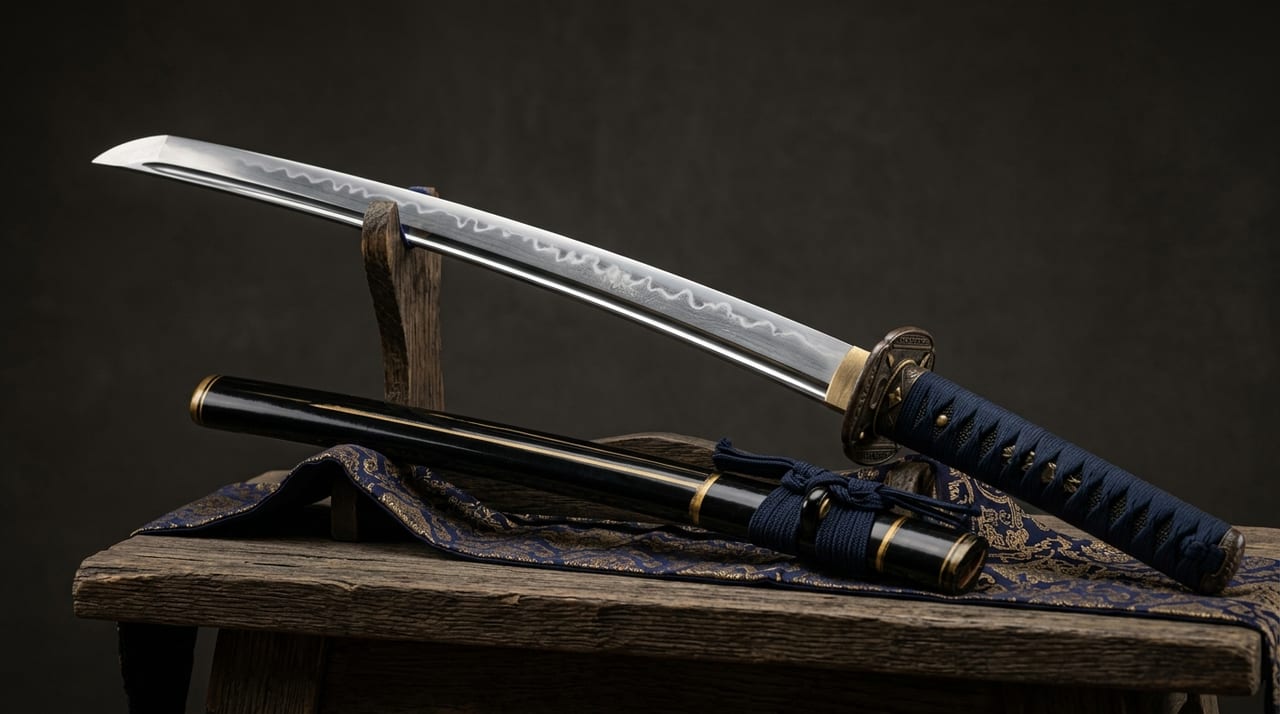
 * Image is for illustrative purposes only.
Kuji Kanesada
九字兼定
Also known as: The Kanesada that cuts kuji (nine-character mantra); masterwork of Aizu Kanesada
Description
Kuji Kanesada is a katana transmitted as a masterwork of the Aizu swordsmith lineage Kanesada, designated a Tokubetsu Hozon Tōken (NBTHK Special Preservation sword). "Kuji" refers to the nine-character mantra of Taoist and Onmyōdō origin — "Rin-pyō-tō-sha-kai-jin-retsu-zai-zen" — and the sword is said to have taken this name either because it was associated with a special ritual of cutting the kuji (nine-directional sword strokes), or because the jikei (surface patterns) and activity within the blade were observed to resemble the kuji character patterns. The Aizu Kanesada lineage traces its origins to the Kanesada school that arose in Mino Province (present-day Gifu Prefecture) during the Muromachi period, later relocating to Aizu in Mutsu Province (present-day Aizuwakamatsu City, Fukushima Prefecture), where it flourished throughout the Edo period under the patronage of the Aizu domain lords, the Matsudaira (Hoshina Masayuki's line). The ninth-generation Kanesada (Norisada) of the Bakumatsu period is particularly renowned as a master smith, and it is said that the Shinsengumi and Aizu domain warriors favored his blades. The blade of the present work displays the typical style of Aizu Kanesada: slightly wide mihaba, a somewhat extended kissaki, and the form characteristic of the late Edo to Bakumatsu period. The hamon is centered on gunome, with notare and pointed-ha elements mixed in — a richly varied midare, the nie bright and granular, the nioi deep. The jigane presents well-organized itame-hada, clear and crisp, clearly demonstrating the quality of the forging.
Legends & Stories
The most famous tradition associated with the origin of Kuji Kanesada's name concerns an experience of a Bakumatsu-period warrior during kenjutsu practice while wearing this sword. In the midst of a training session, the sword suddenly rang within its scabbard of its own accord, and the practice partner was startled, exclaiming: "The sword just cut the kuji." The phenomenon was said to have occurred without the blade leaving the scabbard, yet unmistakably as though the sword had released its ki — and from that time on, the sword was regarded with special reverence in the dōjō as "a sword that cuts the kuji with ki alone." Another tradition from the Aizu domain holds that when the lord had dedicated this sword before the castle shrine, on the very eve before the Boshin War (1868) the sword suddenly fell from the shelf of its own accord. The domain's retainers took this as a portent — "the sword announcing the coming of war" — and hastened their preparations for departure the following day. The Aizu domain fought fierce battles against the new government forces and ultimately surrendered, but this sword survived the fighting and was passed on to later generations. The saying "a sword that cuts kuji carries the protection of one life in nine deaths" is said to have been handed down among Aizu warriors ever since.