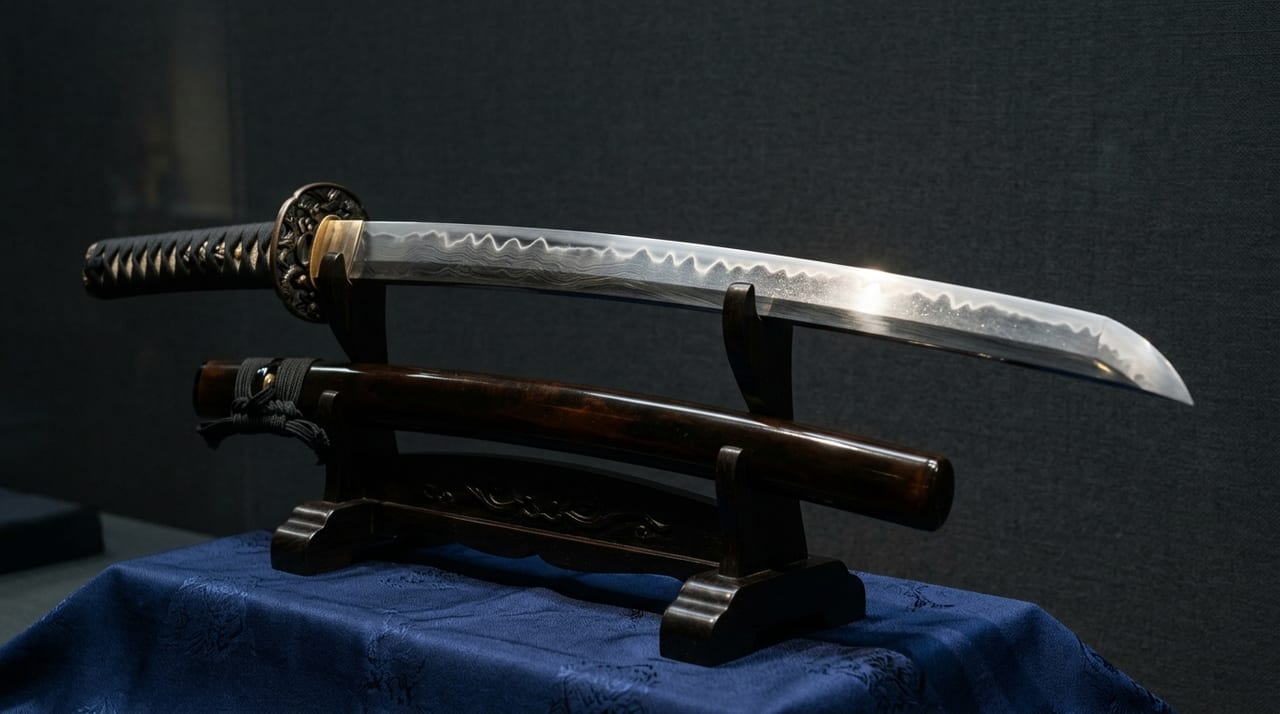
 * Image is for illustrative purposes only.
Kōsetsu Samonji
江雪左文字
Also known as: River Snow
Description
Overview of the Sword
Kōsetsu Samonji is a tachi (long sword) attributed to the master swordsmith Sa (Samonji), active in Chikuzen Province (present-day Fukuoka Prefecture) during the Nanbokuchō period, and is counted among the supreme masterpieces of the "Three Great Samonji Swords." These three blades—Kōsetsu Samonji, Sōzō Samonji, and Sayo Samonji—have been treasured as masterworks of the Samonji school. The name "Kōsetsu" (River Snow) is said to derive from the diplomat-monk Itabe-oka Kōsetsu-sai, a retainer of the Late Hōjō clan who wore this sword. That the name is taken from a figure who, while attending to a military commander, undertook diplomatic duties grants this sword distinctive dignity; the serenity and refinement embodied in the name "Kōsetsu" resonates deeply in the hearts of all who behold this blade.
Technical Characteristics of the Samonji School
The Samonji school was a community of swordsmiths based in Chikuzen Province (present-day Hakata, Fukuoka Prefecture) during the Nanbokuchō period, with the name deriving from the founder "Sa," commonly known as Samonji. The school's technical hallmark lay in establishing a distinctive, bold forging style through the use of iron sand and smithing techniques unique to Kyushu, while strongly influenced by the Sōshū tradition (the sword-forging technique of Sagami Province). The hamon (blade pattern) is characterized by a bold and intricate composition based on large gunome, nōtare, and gunome chōji designs, possessing a distinctive personality immediately recognizable as Samonji work. The jigane (steel grain) shows flowing large itame and itame with vivid, beautiful reflections. The hamon features a broad quenching width with vigorous nie (boiling effect), suggesting keen cutting ability and receiving the highest evaluation as a practical striking sword. Blades by Samonji craftsmen were widely favored by Sengoku-period warlords after the Ōnin War, with historical records showing that prominent generals such as Imagawa Yoshimoto, Uesugi Kenshin, Toyotomi Hideyoshi, and Tokugawa Ieyasu possessed swords by the Samonji school. The hamon of Kōsetsu Samonji, with its distinctly large undulating gunome pattern, displays a bold composition immediately recognizable as the finest masterwork of the Samonji school, yet simultaneously embodies the quiet refinement befitting the name "Kōsetsu," making it a dual-natured masterpiece.
Transmission to the Tokugawa Family
Kōsetsu Samonji is known to have passed into the possession of the Kishū Tokugawa family during the early modern period. That its name and provenance were carefully preserved through successive generations of ownership demonstrates that this blade was revered as a treasure transcending mere arms. It is currently designated a National Treasure and is held in the collection of the Fukuyama Art Museum (Fukuyama, Hiroshima Prefecture). Its designation as a National Treasure—the highest honor—attests to this sword's position at the apex of historical and artistic value in Japanese swordsmanship.
Touken Ranbu and the Modern Image of Kōsetsu Samonji
In the online game Touken Ranbu (2015–present), Kōsetsu Samonji is depicted as a gentle and compassionate character, with this characterization interpreted as deriving from the serene imagery of the name "Kōsetsu" and widely embraced by fans. The game's popularity has substantially elevated interest in the actual sword, leading many fans to visit exhibitions of Kōsetsu Samonji. The connection between contemporary pop culture and classical sword culture in this manner represents a phenomenon of note as a new form of transmission of Japanese cultural heritage. The poetic resonance of the name "Kōsetsu" reverberating through the sensibilities of contemporary people demonstrates that the "aesthetics of quietude," continuously woven throughout Japanese aesthetic consciousness, remains vitally alive.
The Rank of the Three Great Samonji Swords and Kōsetsu's Position
The Three Great Samonji Swords—consisting of Kōsetsu Samonji, Sōzō Samonji (Yoshimoto Samonji), and Sayo Samonji—are treasured as masterworks of the Samonji school and are the three supreme exemplars among swords elevated to exceptional rank through passage into the hands of renowned figures. The prestige of the Three Great Samonji Swords is grounded in the fact that each is highly esteemed and each possesses a provenance marked in the history of the Sengoku period. Among the three, Kōsetsu Samonji is distinguished by the particularly poetic origin of its name and the narrative of its naming after a diplomat-monk, bestowing upon it a rank transcending that of a mere masterwork.
Legends & Stories
The Fall of Odawara and Hōjō Ujimasa's Final Days
In Tenshō 18 (1590), Toyotomi Hideyoshi surrounded Odawara Castle with an army of one million troops. After three months of siege, the Hōjō decided to surrender. At this time, Itabeoka Kōsetsu-sai (板部岡江雪斎), who served the Hōjō as a diplomatic monk and scribe, found himself at a crucial crossroads of fate alongside his lord's house. The celebrated Samonji blade that Kōsetsu-sai wore would later come to be called "Kōsetsu Samonji," named after his epithet "Kōsetsu." Soon after, Ujimasa died by his own hand together with his brother Ujiteru, and the Hōjō perished. Meanwhile, Kōsetsu-sai, valued by Hideyoshi for his talents as a man of culture with a love of waka poetry and the tea ceremony, survived; and his beloved blade likewise passed through the generations following his lord's house's destruction.
The Blade and Buddhist Name—A Warrior's Spiritual Testament
The fact that the epithet of Itabeoka Kōsetsu-sai, a diplomatic monk and man of culture accomplished in waka poetry and the tea ceremony, persisted as the blade's very name carries meaning that transcends mere nomenclature. Though his lord's house, the Hōjō, perished, the blade bearing the name Kōsetsu endured. Because Kōsetsu-sai also served Tokugawa Ieyasu, this blade ultimately became a treasure of the Tokugawa house and has been cherished by people down to the present day, more than four hundred years later, as "Kōsetsu Samonji." The fact that one warrior-cultured man's epithet lives on eternally as a blade's name is the most symbolic episode, demonstrating the profound depths of Japanese sword culture.
Tokugawa Ieyasu and the Name-Sword of a Former Enemy
Itabeoka Kōsetsu-sai, who served the Hōjō, went on to serve Toyotomi Hideyoshi and then Tokugawa Ieyasu after his lord's house fell; his Samonji blade is said to have passed from Kōsetsu-sai to Ieyasu. Ieyasu must surely have known the blade's provenance—that it had been the beloved sword of Kōsetsu-sai, a diplomatic monk of the Hōjō, a former enemy state. Ieyasu's decision to preserve carefully a blade connected to his former enemies under its original name demonstrates profound respect for the celebrated blade. The name "Kōsetsu" was not erased by Ieyasu; instead, Ieyasu gave the blade to his tenth son, Yorinobu. When Yorinobu became the first daimyo of Kishū Domain, the blade passed to the Kishū Tokugawa house and has been preserved to the present day (it is now held as a National Treasure at the Fukuyama Art Museum). A hegemon treasured a blade bearing the name of a former enemy state—this historical paradox has made Kōsetsu Samonji a testament to profound human drama that transcends mere artistic objects.