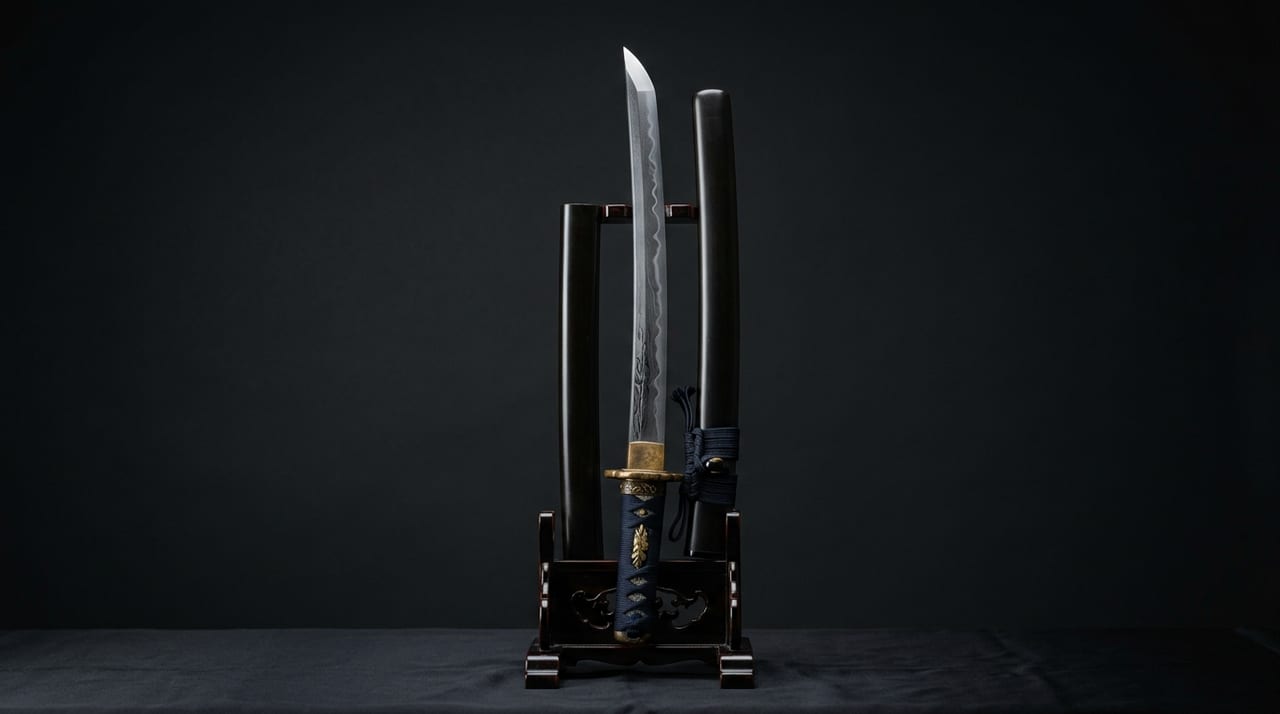
 * Image is for illustrative purposes only.
Kotegiri-Nakamura
籠手切江
Also known as: Kotegiri; the Gauntlet-Cutter Aoe blade
Description
Kotegiri-Gō—A Celebrated Wakizashi Forged by Master Craftsman Gō Yoshihiro
Kotegiri-Gō is a wakizashi forged by Gō Yoshihiro (郷義弘, also written as Gō), a renowned master craftsman active in Echū Province (modern Toyama Prefecture) from the late Kamakura period through the Nanboku-chō period. It is also known as Kotegiri-Gō. Recorded in the Kyōhō Meisui-chō, a catalog of celebrated swords compiled in the mid-Edo period, the blade measures approximately 48 cm in length. It is currently housed at the Kurokawa Institute of Ancient Culture in Nishi-Nomiya, Hyogo Prefecture. Gō Yoshihiro was a legendary swordsmith whose authenticated signed works are exceedingly rare. Works authenticated by the Honami family (本阿弥家) and attributed to Gō have long commanded the highest esteem in sword connoisseurship. Kotegiri-Gō is one such celebrated blade attributed to Gō Yoshihiro through Honami authentication.
The Name Kotegiri—Its Origins in Cutting Through Kote
The name Kotegiri (literally "kote-cutter") refers to the legendary account of this wakizashi cutting through an enemy's kote—the armor protecting the sleeves and forearms—attesting to its exceptional sharpness. Many celebrated Japanese swords bear names in the form of "◯◯-cutter"—such as Heshikiri-Hasebe, Honebami-Tōshirō, and Tonbogiri—and most derive their names from legendary accounts of what the blade actually severed. Similarly, Kotegiri-Gō has been celebrated as a wakizashi whose sharpness was legendary enough to sever even the armor of a samurai warrior.
The suffix "Gō" (江) serves in sword connoisseurship as a designation for works by Gō Yoshihiro, and Kotegiri-Gō exemplifies this naming convention.
Gō Yoshihiro—A Mysterious Genius
Gō Yoshihiro ranks among the most enigmatic and gifted smiths in Japanese sword history. Though he is said to have lived in Matsukura-Gō in Echū Province (present-day Uozu, Toyama Prefecture), much of his life remains obscure. Numbered among Masamune's Ten Disciples, he developed his distinctive style while drawing inspiration from the Soshu tradition. His jigane (base pattern) displays a complex interplay of itame and mokume grain, with thick jigane-nie (base martensite). His hamon (blade pattern) centers on gunome and notare motifs, with strong nie activity. His work, while appearing serene on the surface, conceals intense inner vitality—a quality well exemplified in wakizashi such as Kotegiri-Gō.
The Kurokawa Institute of Ancient Culture and Kotegiri-Gō
The Kurokawa Institute of Ancient Culture, which houses Kotegiri-Gō, is a research institution dedicated to ancient arts and cultural heritage located in Nishi-Nomiya, Hyogo Prefecture. It preserves an extensive collection of fine examples of swords, armor, paintings, calligraphy, and ancient tiles.
Kotegiri-Gō stands as one of the institute's masterpieces, displayed at special exhibitions and other public occasions. As a rare surviving example that conveys the artistry of Gō Yoshihiro to contemporary audiences, it commands considerable attention from sword connoisseurs and scholars alike.
In recent years, its appearance in the video game Touken Ranbu has brought it to the attention of younger audiences.
Legends & Stories
What Kotegiri's Name Reveals—The Role of the Wakizashi in Kamakura Warfare
The name "Kotegiri" eloquently speaks to how the wakizashi was wielded on Kamakura-period battlefields. While the long sword (tachi) served as the primary weapon for the sweeping cuts of mounted warfare, the wakizashi proved its worth in the closer quarters of hand-to-hand combat and grappling (kumichi)—situations where warriors fought with bodies pressed together. The kote, the protective gauntlet covering from elbow to wrist, was fortified with metal plates (kozane) and chain links (kusari), yet Kotegiri's recorded "sharpness" in severing even these defenses captures the reality of the battlefield itself—that the wakizashi made decisive cuts at decisive moments. Within Japanese sword nomenclature, where blade names preserve a fragment of history, Kotegiri stands as one of the most direct witnesses to "the actual combat of Kamakura warriors and the true function of the wakizashi."
The Steel Character of Go—Landscape Forged by Echū Masters
The maker of Kotegiri, Gō no Yoshihiro, was a swordsmith based in Matsukura village, Echū Province (present-day Uozu, Toyama Prefecture), counted among the "Ten Sages of Masamune" and honored alongside Masamune and Awataguchi Yoshimitsu as one of the "Three Master Smiths." Gō no Yoshihiro's distinctive style was marked by the clarity of his steel and the vigorous activity of nie—features that exemplified the pinnacle of the Sōshū tradition. The phenomenon whereby regional climate and a master's skill become inscribed in a blade's beauty represents one of the deepest dimensions of steel aesthetics. Kotegiri, as a monument to Yoshihiro's craft, stands as evidence that "the sword-making techniques of Echū smiths from the late Kamakura through the Nanboku-chō periods continue to live on in the grain of iron to this day."
The Provenance of a Named Blade—From the Inaba House to the Hosokawa House, and to the Kurokawa Institute
Kotegiri was recorded in the Kyōhō Meibustsu-chō, the catalogue of famous blades compiled under orders of Tokugawa Yoshimune, its name bestowed in acknowledgment of the sharpness with which it severed gauntlets. In the early Edo period it was owned by Inaba Massakatsu, the biological son of Kasuga no Tsubone, and was later presented to the Hosokawa, daimyo of Kumamoto Han. It now resides in the Kurokawa Institute for Classical Culture, a public foundation in Nishinomiya, Hyogo Prefecture. This chain of transmission embodies the fundamental pattern of Japanese sword culture—where families of warriors secretly preserved named blades across generations, a lineage that ultimately led from private possession into the collections of public research institutions. Thus the history of a single named blade becomes woven into the larger narrative of how Japan's cultural treasures are preserved and passed to future generations.