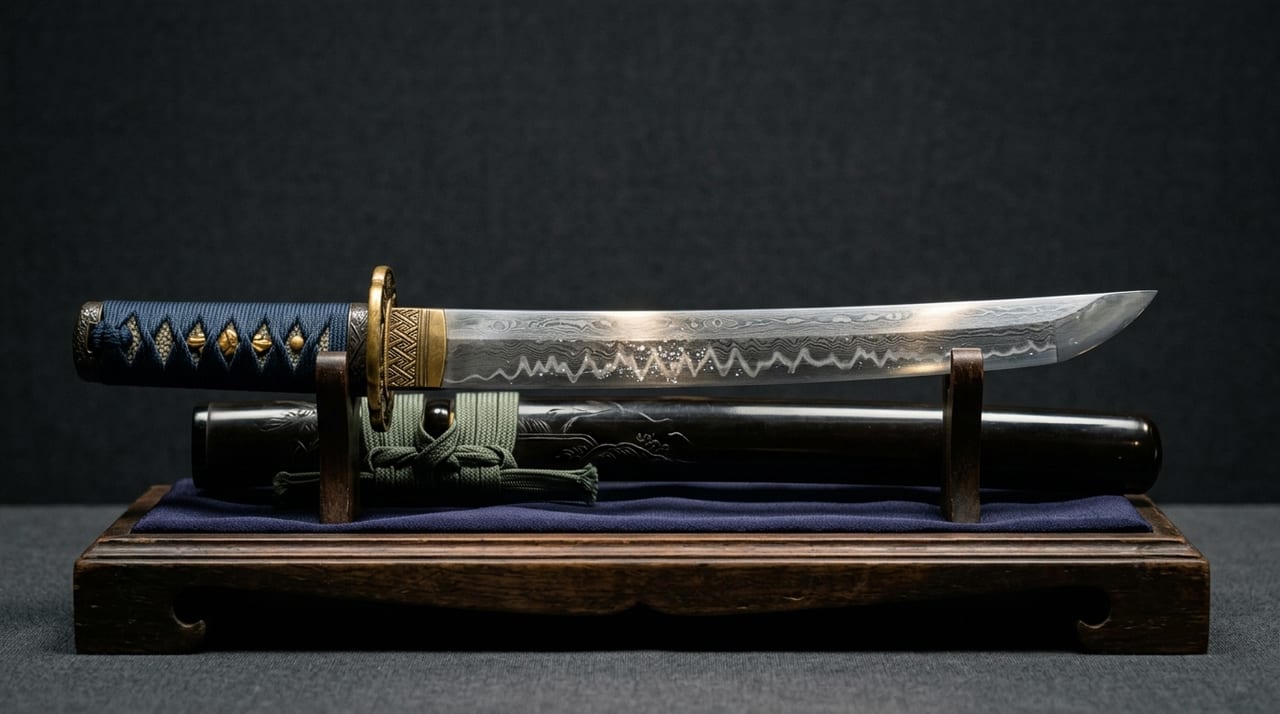
 * Image is for illustrative purposes only.
Kotegiri Masamune
籠手切正宗
Also known as: Kotegiri Masamune; the Gauntlet-Cutter
Description
Overview of the Sword
Koshikiri Masamune is a sword forged by Okazaki Masamune in the late Kamakura period. The name "Koshikiri" derives from a legend in which this blade cut through the kote—the part of armor protecting the wrist and forearm. Measuring approximately 2 shaku 2 sun 6 bu (roughly 68 cm) in blade length, it embodies the distinctive Soshu-den earth steel and blade patterns characteristic of Masamune, and is designated an Important Cultural Property. It was transmitted through the Echizen Asakura clan and Oda Nobunaga before coming to the Kaga Maeda clan, and is presently held at the Tokyo National Museum.
Manufacturing Method and Characteristics
In Koshikiri Masamune, the complex earth steel mixing itame and masame grain displays large ji-nie throughout, and the blade pattern shows an active, chaotic configuration mixing gunome and pointed-blade formations where the nie sparkles brilliantly—this is the condensed landscape of the Soshu-den tradition, synonymous with Masamune's work. The name "Koshikiri" demonstrates the blade's legendary capacity to sever the kote, the most durable component of armor, in a single stroke, testifying that Masamune's creations surpassed all others not only in artistic refinement but also in practical cutting performance.
Transmission from the Asakura to the Maeda Clan
Koshikiri Masamune is renowned as a celebrated blade transmitted to the prominent Asakura clan of Echizen. After the fall of the Asakura clan (Tenshō 1, 1573), it came into the possession of Oda Nobunaga, then passed through Otsu Denjurō, a Nobunaga retainer, before becoming the collection of Maeda Toshitsune, the million-koku lord of Kaga.
Current Location
In Meiji 15 (1882), it was presented to the Imperial Household Ministry by the Maeda clan and is currently held at the Tokyo National Museum (Taito Ward, Tokyo).
Legends & Stories
The Blade That Cuts Gauntlets—The Legend of Its Name
The anecdote that gave rise to the name "Kotegiri" is that this blade severed an enemy's gauntlet in a single stroke on the battlefield. A gauntlet is protective armor made of iron or leather, and cutting through it requires extraordinary sharpness of edge and quality of steel. The legend of Kotegiri is frequently cited as one of the bases for the claim that Masamune's blades possessed "cutting ability in the realm of the divine." Rather than whether it actually cut a gauntlet, it is thought that the overwhelming trust of people of that era in the cutting ability of Masamune's blades gave rise to such a legend.
Its Transmission as a Named Masterpiece
Kotegiri Masamune came into the possession of Oda Nobunaga after passing through the hands of the Asakura clan of Echizen, and it is said that Nobunaga had it polished and bestowed it upon his retainer Otsu Dentarō (Nagamasa). Thereafter, it passed through the Sano clan before entering the collection of the Kaga Maeda family (Maeda Toshitsune), and was presented to the imperial household during the Meiji period. It is one of the representative named masterpieces of Masamune recorded in the Kyōhō Meibutsu-chō.
The Succession of the Renowned Blade
Kotegiri Masamune is currently housed in the Tokyo National Museum, and its provenance—having passed through the hands of samurai society, then through the imperial household, and finally to a national museum—communicates the succession of renowned blades to the present day. This form of preservation, which allows one to feel historical continuity through the blade itself, stands as one of the ideal examples in Japan's cultural property protection.