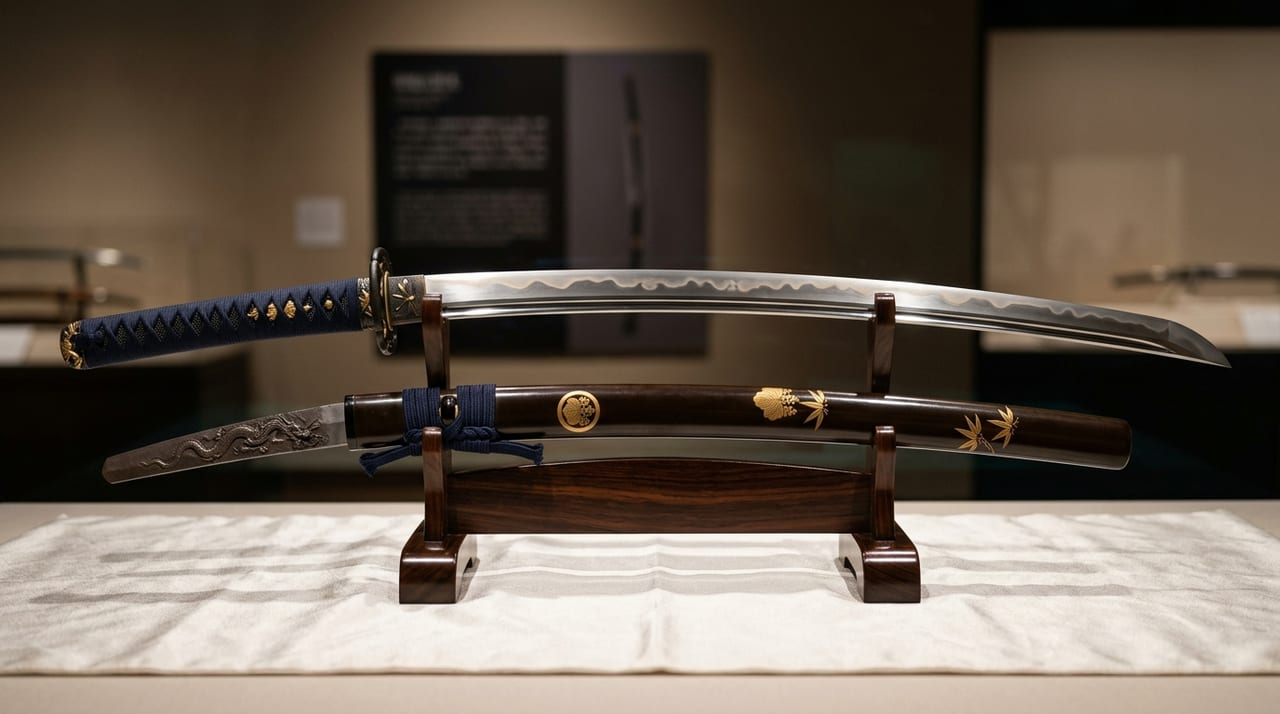
 * Image is for illustrative purposes only.
Koryū Kagemitsu
小竜景光
Also known as: Koryū Kagemitsu; Nankō Kagemitsu; Nozoki-ryū Kagemitsu (Peeping-Dragon Kagemitsu)
Description
Overview of the Sword
Koryū Kagemitsu is a national treasure tachi forged by Kagemitsu, a master smith of the Bizen Osafune school in the late Kamakura period. It is also called “Nankō Kagemitsu” because it is said to have been worn by Kusunoki Masashige, a loyal retainer of the Southern Court. Its blade length is about 73.9 cm and its sori about 3.0 cm, and in its refined Kamakura-period tachi form, Kagemitsu's outstanding forging skill is fully realized. The name “Koryū” derives from the small Kurikara dragon carving at the habaki-moto. Because the dragon can be seen peeking out from beneath the habaki, it is also called “Nozoki-ryū Kagemitsu.”
Kagemitsu, the Swordsmith
Bizen Osafune Kagemitsu was a master smith of Osafune in Bizen Province who was active from the late Kamakura period into the early Nanboku-chō period, and one of the smiths who carried on the lineage of Mitsutada. Kagemitsu's works are highly regarded as the perfected form of Bizen-den of the late Kamakura period. The combination of a finely textured ko-itame-hada jigane and a bright chōji-midare hamon with a clear nioguchi is praised by sword researchers as the peak of Bizen-den beauty. The hamon known as kataochi-gunome is particularly recognized as a hallmark of Kagemitsu.
Blade Details
The jigane of Koryū Kagemitsu is ko-itame-hada, fine and tightly packed, and midare-utsuri stands out vividly. The hamon is a varied chōji mixed with ko-gunome. The nakago was shortened by suriage of about 6 cm. The inscription on the haki-omote side reads “Bizen no kuni Osafune jū Kagemitsu,” and the haki-ura side reads “Genkō 2 (1322), 5th month.” The habaki-moto bears a Kurikara dragon carving, which gave the sword its name. The dragon carving is precise and realistic, and it is also a rare example of the high level of Kamakura-period metalworking. Although the blade was later shortened, the koshi-zori remains high.
The Tachi of Kusunoki Masashige
The greatest reason Koryū Kagemitsu holds a special position is the tradition that it was worn by Kusunoki Masashige (?–1336), a loyal retainer of the Southern Court, and that it has been called “Nankō Kagemitsu.” Kusunoki Masashige was a warrior who served Emperor Go-Daigo in overthrowing the Kamakura shogunate and supporting the Kenmu Restoration. As a sword worn in that turbulent age, Koryū Kagemitsu carries deep historical weight. However, there is no reliable historical record confirming Masashige's possession of it, and the sword researcher Fukunaga Suiken considers this legend highly doubtful.
Provenance and the Tokyo National Museum
It is said to have emerged from a farmhouse in Kawachi around the Tenpō era (1831–1845). It passed through the hands of Nakamura Kakudayū, a daikan (magistrate) of the Edo shogunate; Yamada Asaemon Yoshimasa, the official sword tester of the shogunate (osameshi goyō); and Ii Naoaki and Ii Naosuke, lords of the Hikone Domain. In Meiji 6 (1873), it was presented from the Yamada family to the Imperial Household Ministry. After World War II, it was transferred to the Tokyo National Museum, and in Shōwa 27 (1952) it was designated a national treasure.
Kagemitsu's Forging Skill — The Essence of the Bizen Osafune School
The maker, Kagemitsu, was a master of the Osafune school based in Osafune, Bizen Province (present-day Osafune-chō, Setouchi City, Okayama Prefecture), in the late Kamakura period (late 13th to early 14th century). Inheriting the techniques of his father, Nagamitsu, he perfected the hamon known as kataochi-gunome. Kataochi-gunome is a gunome in which the shoulder on one side drops, creating an asymmetrical form, and it is known as a representative style of Kagemitsu. The hamon of Koryū Kagemitsu is a varied chōji mixed with ko-gunome, and its jigane has tight ko-itame-hada with vivid midare-utsuri. The sword researcher Satō Kanzan rates it as the finest even among Kagemitsu's works, which are few in number but all famous blades. The nakago bears Kagemitsu's signature and the date “Genkō 2 (1322), 5th month.” As a rare example of a clearly dated work, it is highly valuable to sword-historical research. It is now held by the Tokyo National Museum and receives the highest evaluation as a national treasure.
Kusunoki Masashige and “Nankō Kagemitsu”
That Koryū Kagemitsu holds a special position as “the sword worn by Kusunoki Masashige” raises its historical value to the highest level. Kusunoki Masashige (?–1336) was a warrior who, in a turbulent period, served Emperor Go-Daigo and supported the overthrow of the Kamakura shogunate and the Kenmu Restoration. His deeds are among the most dramatic episodes in Japanese history. Seeking to restore the authority of the imperial court, which had long been held down by the warrior class since the establishment of the Kamakura shogunate, Kusunoki Masashige challenged the shogunate's overthrow through the Genkō Incident (Genkō 1, 1331) and the Genkō Rebellion. The sword he is said to have worn at his waist was Koryū Kagemitsu. A provenance in which a warrior wore it on the battlefield and in politics gives this sword a weight beyond that of a mere art object, as a historical and political artifact. Viewing it with full knowledge of the background of Kusunoki Masashige's eventful life—his rising against the shogunate, the defense of Chihaya Castle and Akasaka Castle, the Kenmu Restoration, his conflict with Ashikaga Takauji, and his death at the Battle of Minatogawa—the small dragon carved in the blade appears to carry special weight as a crystallization of a loyal retainer's life.
Kagemitsu and Genkō 2 — The Meaning of the Date of Manufacture
The date “Genkō 2 (1322), 5th month,” inscribed on the nakago of Koryū Kagemitsu, is also significant in research on this sword. The Genkō era (1321–1324) was the final period of the Kamakura shogunate, lying just before Emperor Go-Daigo's plan to overthrow the shogunate began to move. If the sword Kagemitsu forged before the Genkō Incident (1331) came into the hands of Kusunoki Masashige, then this sword adorned the waist of a loyal retainer during the anti-shogunate movement. The closeness between the sword's making and the historical events may be coincidental. Still, the story of “a sword made in Genkō 2, worn by a warrior who overthrew the shogunate,” has left a strong impression on later generations. At the time, Bizen Osafune was known throughout the country as Japan's finest sword-producing region, and Kagemitsu was a master rated among its highest. That warriors chose works by such a master as their worn swords shows that the warrior class of the time sought the highest-quality blades.
Legends & Stories
The Dragon Carving — The Spirit of the Dragon in the Blade
The small dragon carving that gave Koryū Kagemitsu its name is one of the most distinctive features of this sword. The carving is not on the nakago but on the blade at the habaki-moto, as a small Kurikara dragon. Because it can be seen peeking out from beneath the habaki, it is also called “Nozoki-ryū Kagemitsu.” In traditional Eastern belief, the dragon is regarded as a divine spirit governing water, thunder, and transformation. Carving a dragon into a blade was said to carry a wish for the protection of the warrior.
Kusunoki Masashige and Koryū Kagemitsu — Witness to a Turbulent Age
Koryū Kagemitsu is said to have been the sword of Kusunoki Masashige, a loyal retainer of the Southern Court who followed Emperor Go-Daigo in working to overthrow the Kamakura shogunate. Masashige later took his own life after being defeated by Ashikaga Takauji at the Battle of Minatogawa (Kenmu 3 (1336)), and so the sword is also called “Nankō Kagemitsu.” However, no reliable historical record confirming this has been found, and it remains within the realm of tradition attached to the sword. (Fukunaga Suiken also considers this legend doubtful.) Even so, as a sword that bears the memory of the turbulent Northern and Southern Courts era, Koryū Kagemitsu has continued to hold special meaning.
The Peak of Bizen-den Beauty
Kagemitsu's kataochi-gunome is known as one of the most distinctive hamon among Bizen-den. Chōji (also spelled with a different kanji) refers to a hamon shaped like a flower bud, and it is a representative hamon style of Bizen-den. Kataochi-gunome is an asymmetrical form in which the shoulder on one side of a gunome drops, and it characterizes Kagemitsu's style. The hamon of Koryū Kagemitsu is a varied chōji mixed with ko-gunome, and the sword researcher Satō Kanzan rates it as the finest among Kagemitsu's works.
Brilliance as a National Treasure
Designated a national treasure in 1952, Koryū Kagemitsu is one of the particularly important works in the sword collection of the Tokyo National Museum. Its provenance as a sword said to have been worn by Kusunoki Masashige, the dragon carving at the habaki-moto, and Kagemitsu's outstanding hamon all come together. Together these make Koryū Kagemitsu not only a masterpiece of Bizen-den but also the clearest demonstration of how a Japanese sword can function as a witness to history.
The Nanboku-chō Turmoil and the Whereabouts of Koryū Kagemitsu
Koryū Kagemitsu, said to have been worn by Kusunoki Masashige, is a sword told against the backdrop of the upheaval of the Nanboku-chō period (1336–1392). However, its reliable transmission before the Muromachi period is unknown, and no surviving historical record confirms the tradition of Masashige's possession. Even so, because the name of a loyal retainer of the Southern Court became attached to the sword as legend, this tachi has continued to hold special meaning as a “witness to history” embodying the memory of its age.
From the Early Modern Period to the Present — The Journey of a National Treasure
The reliable transmission of Koryū Kagemitsu before the early modern period is unclear. In Meiji 6 (1873), however, it was presented from the Yamada family through Ōkubo Ichiō, governor of Tokyo Prefecture, to the Imperial Household Ministry, and it became gyobutsu (imperial property). Its provenance as a sword worn by Kusunoki Masashige, its status as a masterpiece of Kagemitsu of Bizen, and the dragon carving at the habaki-moto combined to make it known early on as a famous sword. After World War II it was transferred to the Tokyo National Museum, and Koryū Kagemitsu came to be protected as a “national treasure of the people.” Now designated a national treasure, it occupies a particularly important place among the sword exhibits of the Tokyo National Museum, and many sword enthusiasts and history fans visit when it is displayed. Its three attractions—the provenance as Kusunoki Masashige's sword, Kagemitsu's outstanding forging skill, and the small dragon dwelling at the habaki-moto—together make Koryū Kagemitsu one of the most prestigious presences in the history of Japanese swords.
What the Dragon Carving Reveals
The small dragon carved at the habaki-moto is regarded as having charm beyond mere decoration. Since ancient times the dragon has been considered a divine spirit governing water, thunder, and transformation, and carving one into a blade carried the meaning of a wish for the warrior's protection. The dragon carving of Koryū Kagemitsu continues to be discussed among specialists and sword enthusiasts today, and it always draws attention at exhibitions at the Tokyo National Museum. Even after seven centuries, the small dragon at the habaki-moto remains vividly carved, conveying the value of this sword in which Kagemitsu's outstanding skill crystallized.