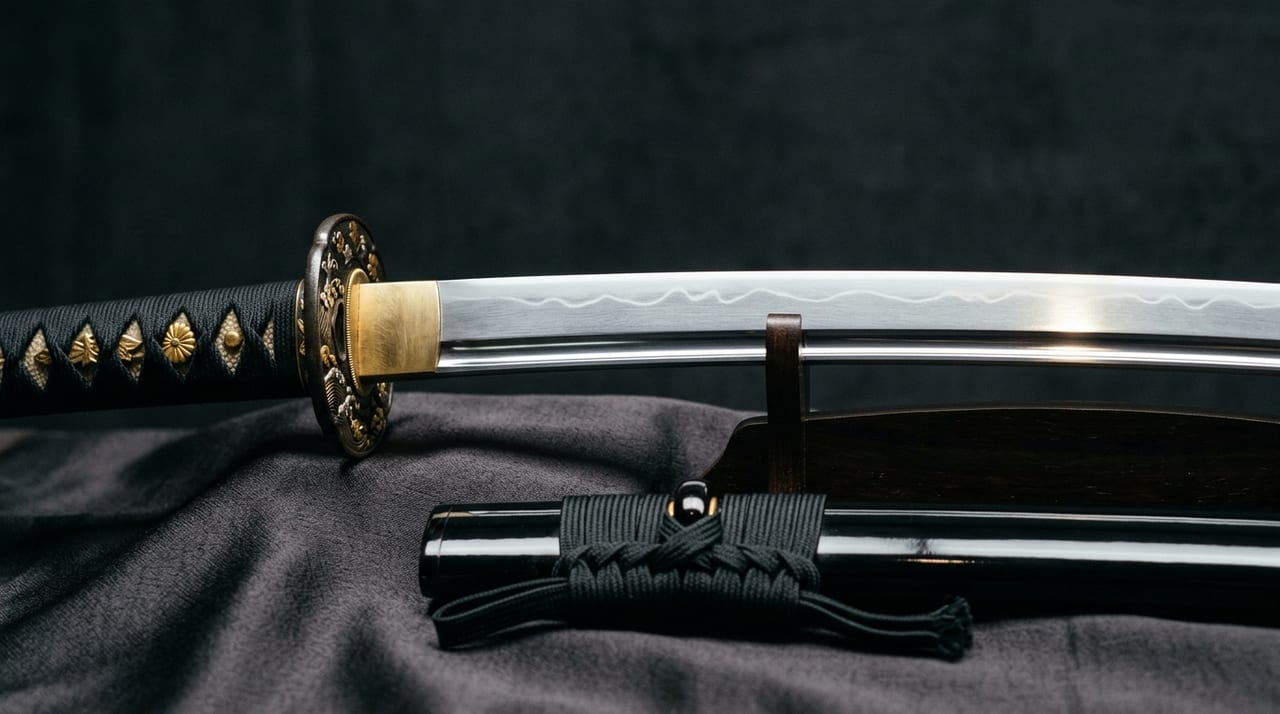
 * Image is for illustrative purposes only.
Kitsunegasaki
狐ヶ崎
Also known as: Kitsunegasaki Tametsugu — Ko-Aoe Tachi by Tametsugu, Foremost Treasure of the Kikkawa Clan
Description
Kitsunegasaki is a tachi (long sword) attributed to Tametsugu, a swordsmith of the Ko-Aoe school who worked in Bitchū Province (around Kurashiki in present-day Okayama) from the late Heian into the early Kamakura period. Designated a National Treasure, the blade is about 78.8 cm long with a curvature of roughly 3.4 cm. Handed down in the Aki Kikkawa family for some 800 years, it is renowned as one of the best-preserved blades of the Aoe school.
The smith Tametsugu and the blade's workmanship
Tametsugu belonged to the early "Ko-Aoe" phase of the Aoe school. Kitsunegasaki shows the high waki-zori curvature and graceful shape typical of late-Heian to early-Kamakura tachi. Its temper line is a ko-midare with well-formed ashi and yō, ko-nie, and a slightly subdued nioiguchi; the steel is a ko-itame grain with the crepe-like chirimen-hada distinctive of the Aoe school, thick ji-nie, and a midare reflection (utsuri). The tang is ubu (original), strongly curved, finished with large sujikai file marks, and bears the two-character signature "Tametsugu."
Origin of the name
In the first month of 1200 (Shōji 2), as the Kamakura retainer Kajiwara Kagetoki led his family toward the capital, fighting broke out with local warriors near Kiyomi Barrier in Suruga (present-day Shimizu-ku, Shizuoka). In this "Kajiwara Kagetoki Incident," Kikkawa Tomokane, second of the Kikkawa line, is said to have struck down Kajiwara Kagemochi (Kagetoki's third son) with this sword. Because Kagetoki and his sons were killed at a place called Kitsunegasaki, the sword was named after the locale and became a Kikkawa treasure.
Provenance and the Kikkawa family
The sword was handed down in the Aki Kikkawa family. In the Sengoku period the Kikkawa adopted Kikkawa Motoharu, second son of Mōri Motonari, joining the Mōri clan, and Kikkawa Hiroie played a notable role at Sekigahara—across which centuries Kitsunegasaki was guarded for some 800 years.
Designation and present location
Kitsunegasaki was designated a National Treasure on 9 June 1951. It is now owned by the Kikkawa Hōkōkai Foundation and held at the Kikkawa Archives in Iwakuni, Yamaguchi Prefecture, which preserve some 7,000 objects handed down in the Kikkawa family. It is shown to the public on the occasion of special exhibitions.
Legends & Stories
The name Kitsunegasaki is bound up with the early-Kamakura political upheaval known as the Kajiwara Kagetoki Incident. When Minamoto no Yoritomo died in 1199, Kajiwara Kagetoki — who had wielded great power as one of the foremost shogunal retainers — was impeached by his fellow vassals and driven from Kamakura, attempting to flee toward Kyoto with his clan. In the first month of 1200 (Shōji 2), his party met local warrior bands at Kitsunegasaki in Suruga Province (near present-day Shimizu Ward, Shizuoka City), and a fierce battle ensued.
In this fight, Kikkawa Kojirō Tomokane is said to have cut down a warrior of the Kajiwara side with this very tachi, distinguishing himself in battle. From that time the blade was given the name Kitsunegasaki and was handed down through Tomokane's Kikkawa line as the family's most prized treasure. The Kikkawa later joined the Mōri house, and after the Battle of Sekigahara they were granted a 30,000-koku fief at Iwakuni in Suō Province, surviving until the end of the Edo period, so the sword too was carefully preserved in Iwakuni.
The smith Tametsugu belonged to the oldest stratum of the Aoe school of Bitchū Province, the "Ko-Aoe," whose works are marked by a translucent ji-tetsu and a hamon of refined dignity. Kitsunegasaki stands as a representative masterpiece of Ko-Aoe and, as a securely signed tachi of the late Heian to early Kamakura period, occupies a position of exceptional importance in sword history.
It was designated a National Treasure under the old law in 1933 and again under the Cultural Properties Protection Law in 1951. It is now preserved in the Kikkawa Museum, which houses cultural assets associated with the Kikkawa family, and remains a celebrated blade that draws many sword enthusiasts during its special public viewings.