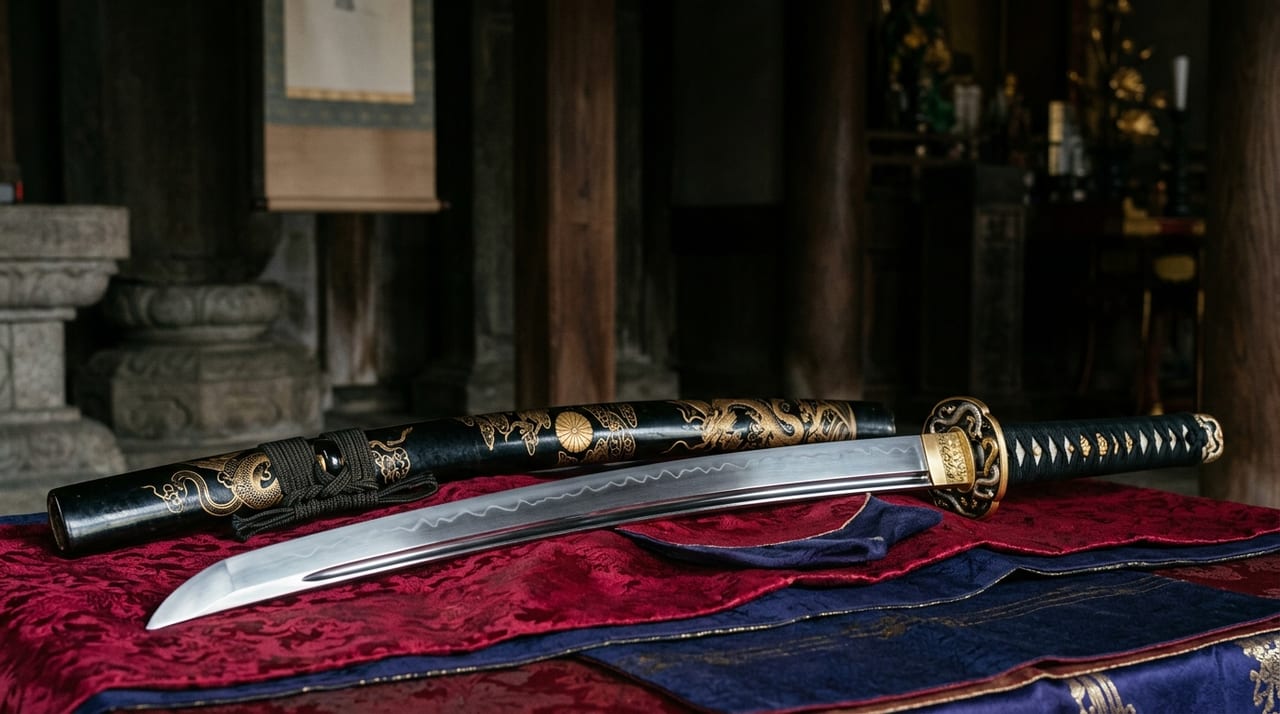
 * Image is for illustrative purposes only.
Kitano-Gō
北野江
Also known as: Kitano-Gō; attributed to Gō Yoshihiro
- Smith
- Attributed to Gō Yoshihiro (Etchū Province)
- Era
- Nanbokuchō period (14th century)
- Type
- Uchigatana
- Designation
- Unranked (no formal cultural-property designation)
- Location
- Tokyo National Museum
Description
Uchigatana Attributed to Gō Yoshihiro
Kitano-Gō is an uchigatana attributed to Gō Yoshihiro, a swordsmith of Etchū Province active in the Nanbokuchō period. No signed work by Gō Yoshihiro survives. This blade is also ō-suriage and mumei, and a gold-inlaid inscription reading "Kō suriage, Kōtoku [monogram]" is inscribed on the tang. The blade measures 69.8 cm in length with a curvature of 1.8 cm.
Provenance — From the Honami Family to the Maeda Family of Kaga
Honami Kōsa purchased the blade in Sakai, and it is said that Honami Kōtoku later shortened it. In 1614 (Keichō 19), Maeda Toshitsune, the second lord of the Kaga domain, is said to have bought the sword from Kōsa on his way to Edo. It was thereafter handed down to successive lords as a treasured heirloom of the Maeda family.
Origin of the Name
The name is said to derive from Maeda Toshitsune's test cutting with this blade at Kitano Tenmangu Shrine in Kyoto.
Designation and Present Location
The sword has not received formal government designation as an Important Cultural Property or National Treasure (not appraised). After the Meiji Restoration, it was presented by the Maeda family to Emperor Meiji, became imperial property, and is now held by the Tokyo National Museum.
Legends & Stories
The name is said to originate from an episode in which the Kaga domain lord Maeda Toshitsune test-cut with this blade at Kitano Tenmangu Shrine in Kyoto.
Related Famous Swords
姫鶴一文字
Important Cultural PropertyHimetsuru Ichimonji
Ichimonji School (Bizen)
同田貫正国
Kumamoto Prefecture Important Cultural Property (a Masakuni blade held by Honmyō-ji), among othersDōtanuki Masakuni
Dōtanuki Masakuni (Higo Dōtanuki school)
毛抜形太刀
National Treasure / Important Cultural Property (multiple designated examples)Kenuki-gata Tachi
Unknown (Heian period)
一期一振
Gomotsu (Imperial Collection)Ichigo Hitofuri
Awataguchi Yoshimitsu