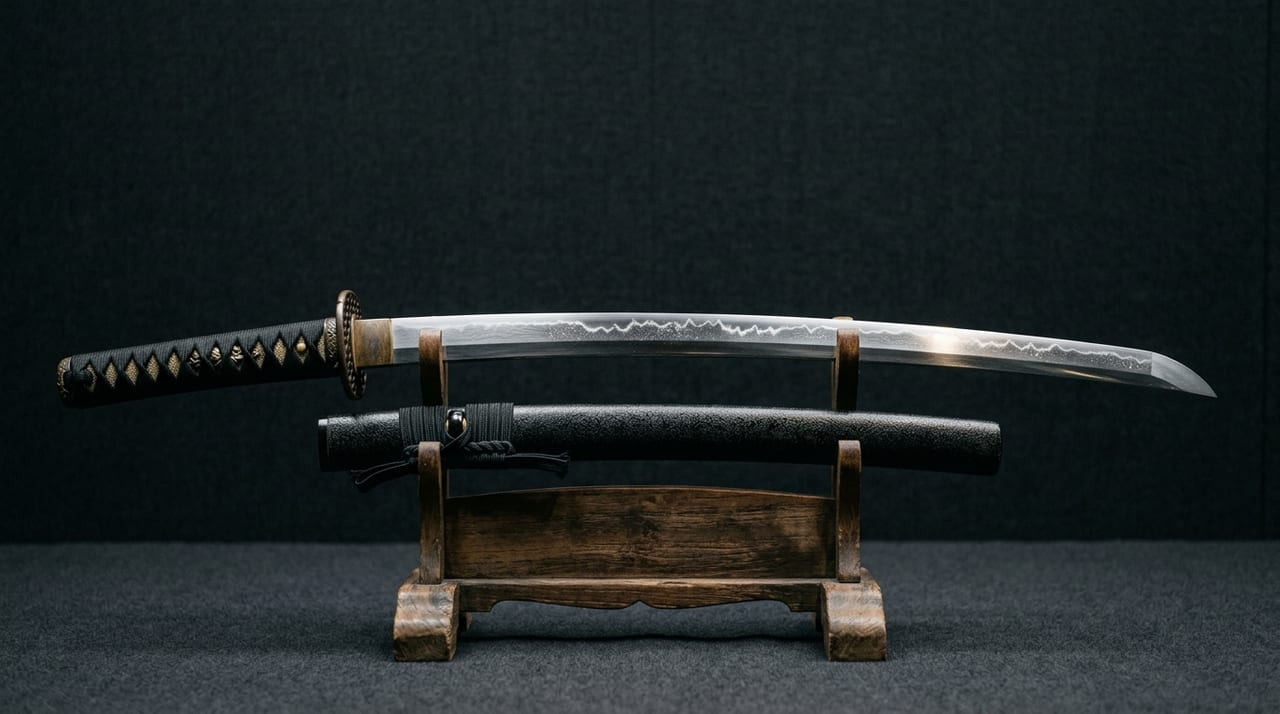
 * Image is for illustrative purposes only.
Kashiwagi Sadamune
柏木貞宗
Also known as: Sadamune of Kashiwagi — Masterwork Tantō by Sōshū Sadamune
Description
Kashiwagi Sadamune is a tantō forged by Sadamune (Hikoshirō Sadamune), a Sōshū swordsmith active from the late Kamakura through the Northern and Southern Courts period, designated an Important Cultural Property. The name "Kashiwagi" derives from this tantō's former transmission in a warrior, court noble, or landed family connected to the Kashiwagi clan or a place called Kashiwagi. The named tantō of Sōshū Sadamune are transmitted in rich variety, and Kashiwagi Sadamune is particularly highly regarded among them for its especially elegant hamon and clear jigane. Sōshū Sadamune, as Masamune's successor, inherited the Sōshū tradition while establishing an aesthetic distinct from Masamune's. While Masamune is known for "intense nie and dynamic jigane," Sadamune's characteristic is "tranquil, refined nie" and "clear, deep jigane," earning the description "the one who perfected the Sōshū tradition." His tantō are proportionally balanced in both length and width, refined in construction, and display an elegant beauty in both hamon and jigane. The blade of Kashiwagi Sadamune possesses a dignity worthy of Sadamune's finest works: moderately wide mihaba, clear hira-zukuri construction, somewhat thin kasane, and a refined uchi-zori profile. The hamon is a tranquil midare of ko-notare with gunome mixed in; the nie is fine and evenly distributed, with a soft, refined luminosity along the ha-edge. The nioi is deep, with a beauty that seems to radiate from within — embodying the refined hamon described as "Sadamune's nie resembles moonlight." The jigane presents densely packed ko-itame-hada with fine ji-nie and gently active jikei, displaying a serene beauty distinct from Masamune. Currently in private ownership, it is occasionally made available for viewing through sword exhibitions, and continues to be held in high esteem among sword connoisseurs as one of the representative masterpieces of Sōshū Sadamune tantō beauty.
Legends & Stories
The most widely told legend associated with Kashiwagi Sadamune concerns an elegant episode relating to this tantō's naming. It is said that the head of the warrior house that owned this tantō during the turbulence of the Northern and Southern Courts period, gazing upon the blade one autumn night in moonlight, drew the tantō and was moved to admire it — and the nie of the hamon, catching the moonlight, shone as though kashiwa (oak) leaves were covered with frost. Deeply moved by the sight, the lord exclaimed: "This is the sword of the frosted kashiwa in the eleventh month," and from that time it came to be called "the Kashiwagi Sadamune." Another tradition holds that this sword's lineage of transmission gave rise to master appraisers generation after generation. In that household, it is said, there was a family precept: "Only the child born with the eye to truly appreciate the Kashiwagi Sadamune is worthy to carry on the path of swords," and successive lords honed their connoisseurship through the appreciation of this tantō. Because Sadamune's tantō possesses an "inner serenity" in contrast to Masamune's fierceness, it has long been considered ideal for cultivating the eye that perceives inner beauty without being misled by outward appearances. In the sword world there is the saying "The moon of Kashiwagi Sadamune knows no clouds," expressing the faith that the beauty of this tantō does not change under any circumstances or conditions. It is believed that even through war, natural disaster, and the passage of ages, the beauty of Sadamune's nie alone continues to shine forever — and it has been passed down as a symbol of "eternal beauty."