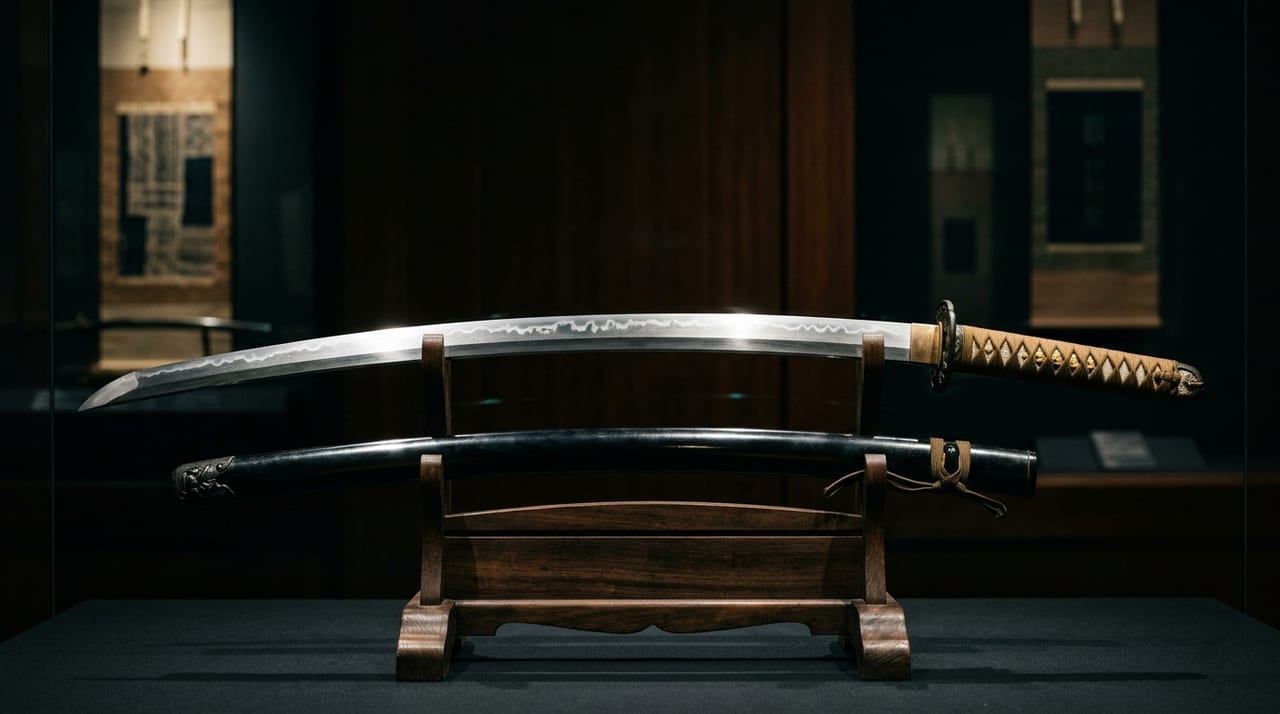
 * Image is for illustrative purposes only.
Kakitsubata
燕子花
Also known as: Tachi of the Iris
Description
Kakitsubata is a tachi from the late Heian period, transmitted as being in the Ko-Bizen style. The name derives from kakitsubata (swallow iris, Iris laevigata), which blooms in purple flowers at the water's edge in early summer; it is said to have been named so because the blade's dignified form and the graceful flow of its hamon evoke vivid flowers reflected at the water's edge in early summer. Since ancient times, it has been enshrined as one of the sacred treasures of Atsuta Shrine.
Although transmitted as an elegant tachi of Ko-Bizen, reliable records concerning its current designation and preservation are scant. At Atsuta Shrine, which enshrines the Kusanagi no Tsurugi as its divine body, Kakitsubata has been carefully preserved through the generations as a divine sword supporting the shrine's spiritual power. Shrine tradition suggests a connection with the Heian imperial court and aristocratic families, but official provenance is kept non-public.
The blade displays the typical form of a Ko-Bizen tachi from the late Heian period. Like Hatsukari, it possesses a deeply curved waist and slender form of elegant beauty, with an overall antique refinement. The hamon is centered on chōji-midare (clove-flower irregularity), with the heads of the chōji arranged in orderly, balanced succession—one of the most refined hamon forms shared by the Ko-Bizen and Bizen Ichimonji traditions, resonating with the aesthetic intent of the name "Kakitsubata." The nie is fine and refined, the nioi deep, and the ha-edge shines with soft luminosity. The jigane presents densely packed ko-itame-hada with fine, uniform ji-nie and a clear, profound surface.
A blade transmitted as conveying the refined beauty inherent in Ko-Bizen tachi.
Legends & Stories
The legend surrounding the name "Kakitsubata" is often told in connection with the ancient poem by Ariwara no Narihira — "Karagoromo / kitsutsu narenishi / tsumashi areba / harubaru kinuru / tabi wo shi zo omou" (Ise Monogatari, "Azuma Kudari," the Journey East) — composed at Yatsuhashi in Mikawa Province beside blooming kakitsubata irises. According to tradition, Narihira himself, or a person connected to him, was traveling east with this tachi, and upon visiting Yatsuhashi in Mikawa, was so moved by the beauty of the irises that he exclaimed, "The beauty of this sword is like the kakitsubata." This is said to have given the blade its name, and the sword is said to have subsequently been dedicated to Atsuta Shrine — which lies along the route of that journey. Another tradition holds that on a night in early summer, a priest of Atsuta Shrine sensed a floral fragrance drifting from the direction of the treasure hall. When he investigated, he found a purple light hovering around the box containing Kakitsubata, as though the iris flower itself had taken up residence within. From that time forward, the blade was believed to carry a poetic and artistic spiritual power as the "sword of beauty," the "sword of elegance," drawing the reverence of those who seek beauty and those who refine their arts. Among the many famous swords preserved as sacred treasures at Atsuta Shrine, Kakitsubata is positioned as bearing a particular spiritual significance as a symbol of Japanese aesthetic beauty — a famous sword deeply entwined with the worlds of painting and waka poetry, as its very name proclaims.