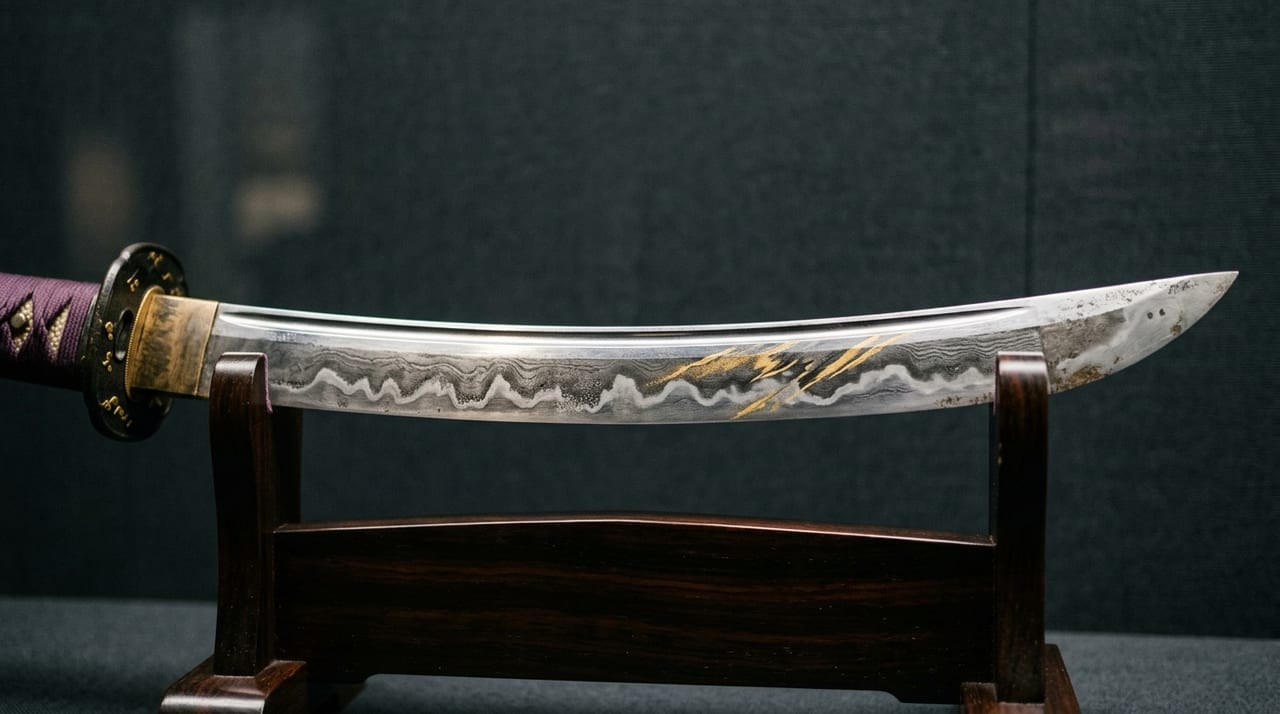
 * Image is for illustrative purposes only.
Kajigiri Hiromitsu
火車切広光
Also known as: Kajigiri — Sōshū Hiromitsu blade; Important Cultural Property, transmitted through the Hōjō clan
Description
Kajigiri Hiromitsu is a wakizashi forged by Hiromitsu, a master of the Sōshū tradition (Sōshū-den) of the Nanbokuchō period, and is designated an Important Art Object. Hiromitsu is counted among the disciples of Masamune (though some scholars identify him as a student of Sadamune), and while inheriting the characteristic features of the Sōshū tradition — dynamic ō-midare hamon and vigorous nie — he established his own bold and powerful style. Among Sōshū-tradition smiths, Hiromitsu is especially celebrated for the spectacular impact of his "ō-midare" hamon, and Kajigiri Hiromitsu stands as one of his masterpieces.
The nickname "Kajigiri" — meaning "Fire-Cart Cutter" — derives from the legend described below, and has long been cherished as an evocative alias among sword enthusiasts. The blade presents the robust, powerful silhouette typical of the Nanbokuchō-period Sōshū tradition: broad in width and thick in spine. The hamon — centered on a turbulent ō-gunome-midare characteristic of Hiromitsu — roils dramatically, with coarse, vigorous nie and kinsuji (gold thread-like lines) and inazuma (lightning flashes) racing through the hamon interior — a spectacular sight that overwhelms the viewer.
Transmitted to the Uesugi clan as one of the treasured "Thirty-Five Hand-Selected Swords" of Uesugi Kagekatsu, the blade passed through the Edo period into the modern era, eventually entering the collection of the Sano Art Museum in Mishima, Shizuoka Prefecture. As one of the few Hiromitsu wakizashi with clearly documented provenance, it is regarded as a primary surviving example of the bold Sōshū tradition. The blade is highly valued by sword researchers as the supreme expression of the Sōshū tradition of the Nanbokuchō period, and its spectacular hamon force remains undiminished to this day.
Legends & Stories
The name Kajigiri Hiromitsu derives from a supernatural tale preserved in the oral tradition of the Uesugi clan. The "kajya" (火車, literally "fire-cart") refers in Buddhist cosmology to the flaming wheel that drags the spirits of the dead to hell—or the demonic vehicle that tears apart the bodies of the deceased. In medieval Japan it was widely feared as a symbol of malevolent vengeful spirits and supernatural entities.
According to the tradition, in a certain region, a fire-cart began appearing, attacking people night after night and stealing the bodies of the dead. A retainer who was standing night watch encountered the fire-cart as it appeared amid flames. Drawing his sword—Hiromitsu's tachi—he charged at the fire-cart and slashed. In a single stroke through the raging supernatural flames, the fire-cart vanished with a dying shriek. The next morning, upon examining the blade, charred claw marks were found etched upon it—taken as evidence that "this sword cut down the fire-cart." Thereafter the tachi became known as "Kajigiri."
This legend is thought to have arisen naturally as the intense "boiling" and "great irregularity" of the blade—the hamon of the Sōshū tradition, a magnificent blade pattern that gives viewers the impression of raging flames—fused with the image of a divine sword capable of cutting through fire. The name Kajigiri transcends mere ghost story to embody the reverence and awe felt toward the supernatural cutting power believed to reside in Hiromitsu's blade.