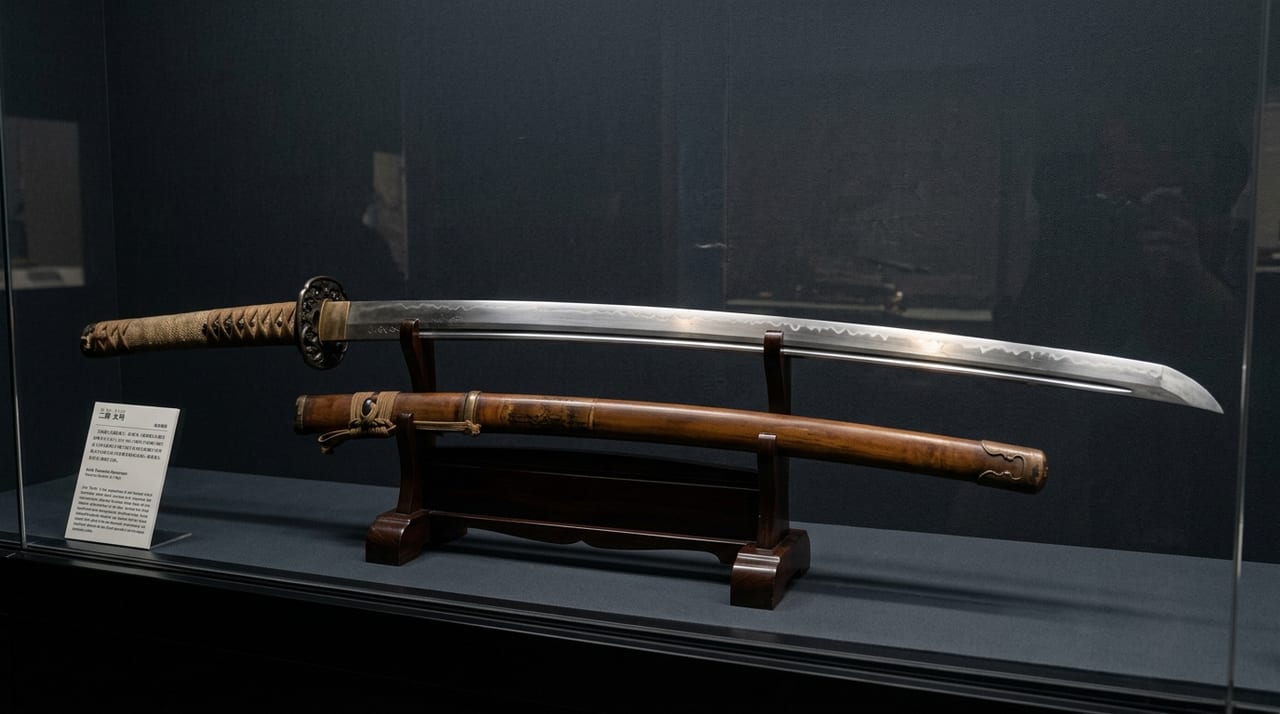
 * Image is for illustrative purposes only.
Jirō Tachi
次郎太刀
Also known as: The Younger Blade of Magara
Description
Overview of the Sword
The Jirō Tachi is one of the great swords (ōdachi) that were handed down in the Magara family alongside the Tarō Tachi, and it is positioned as the 'younger brother' to the Tarō Tachi, the 'elder brother' (blade length approx. 221.5 cm). The blade length of approximately 166.7 cm equals about 2.5 times that of an ordinary Japanese sword (blade length approx. 70 cm); yet the fact that it is called the 'younger brother (the smaller one)' in comparison with the Tarō Tachi highlights just how extraordinary the Tarō Tachi's out-of-scale size was. The Jirō Tachi is said to have been used by Magara Takamoto, son of Magara Naotaka (some theories hold that it belonged to Naozumi, Naotaka's younger brother), and he was cut down at the Battle of Anegawa in Genki 1 (1570), just as his father Naotaka had been. The tragic end of the Magara family, in which father and son fought while each carrying a giant sword and fell together on the same battlefield, has been passed down to this day as a tale that symbolizes the fate of a warrior clan in the Sengoku period. The Jirō Tachi was transmitted along with the Tarō Tachi to Atsuta Jingū, and it is known as a pair of great swords that conveys the martial prestige of the Magara family to the present day.
Magara Takamoto: Heir to His Father's Will
Magara Takamoto was a warrior who inherited the heroic prowess of his father Naotaka, and he had the build and physical strength to wield in actual combat the giant Jirō Tachi, a sword with a blade length of 166.7 cm. The transmission of two giant swords, one called the 'elder' (Tarō) for the longer and the other the 'younger' (Jirō) for the shorter, as symbols of the father and son shows that the martial prestige of the Magara family was passed down across two generations. The Magara father and son, who served the Asakura family of Echizen, nurtured their reputation as wielders of swords along with the family name, and the sheer size of those swords functioned as a kind of 'symbol' of the household. The image of Takamoto standing on the battlefield beside his father with the Jirō Tachi in hand has strongly captured the imagination of later generations as a scene that symbolizes the relationship between father and son warriors of the Sengoku period. The fact that when Takamoto was cut down, he met the same end as his father on the same battlefield is deeply engraved in the Japanese sensibility as a uniquely 'tragic beauty,' and the figures of the Magara father and son were repeatedly taken up in later war chronicles and ukiyo-e prints.
The Blade of the Jirō Tachi and Features of Nanboku-chō Ōdachi
The Jirō Tachi shares the form of the Nanboku-chō period ōdachi with the Tarō Tachi, displaying the classic appearance of a nodachi, with a long blade and a shallow curve. It is traditionally attributed to the Echizen swordsmith Chiyotsuru Kuniyasu. Ōdachi of the Nanboku-chō period (14th century) were large-format swords that emerged in response to changes in group tactics and infantry warfare that had developed after the Mongol invasions (late 13th century); their shape was specialized for sweeping down mounted warriors with a long blade. Ōdachi of that era were said to be used not only for striking ground-level enemies from horseback, but also for 'sweeping strikes' in which foot soldiers swung the long blade horizontally to fell several enemies at once. Today it is transmitted at Atsuta Jingū as a 'brother sword' paired with the Tarō Tachi. Fine scratches and traces of chipped edges remain on the blade, showing that it is an ōdachi made for actual combat.
The Battle of Anegawa and the Final Days of the Magara Father and Son
On the 28th day of the 6th month of Genki 1 (1570), a major battle was fought on the banks of the Anegawa in Ōmi Province (present-day Nagahama, Shiga Prefecture), between the allied forces of Oda Nobunaga and Tokugawa Ieyasu and the allied forces of Asakura Yoshikage and Asai Nagamasa. Magara Naotaka and Takamoto, father and son, stood at the front line as symbols of the martial prowess of the Asakura forces in this battle. The father Naotaka wielding the Tarō Tachi and the son Takamoto holding the Jirō Tachi are said to have been especially conspicuous presences in the battle, and their giant blades were so large that they could be recognized even from a distance. The Magara father and son, who clashed with Tokugawa generals, were cut down despite their valiant fighting. The fact that father and son died on the same day and on the same battlefield went beyond the death of mere warriors, and was repeatedly depicted in later war chronicles as a fierce end in which a warrior family perished together with its swords. The Battle of Anegawa was an important engagement in the conflict between Oda-Tokugawa and Asai-Asakura, and the Magara father and son's fierce deaths are passed down to this day as a symbolic episode of that battle.
The Deaths of the Magara Father and Son and the Transmission of Their Heirlooms
At the Battle of Anegawa, Magara Naotaka and Takamoto, father and son, were both cut down. The Magara clan continued to exist afterward, but the relics and treasures of fallen warriors are usually scattered, seized by the victors, or lost. Yet the Tarō Tachi and Jirō Tachi, precisely because they were swords of such extraordinary size, were treated with care as curiosities too valuable to discard, and were ultimately passed down to later generations in the form of an offering to Atsuta Jingū. This miraculous transmission suggests that people of the time held the sense that 'sheer enormity itself possesses protective power.' The development in which the swords with which father and son lost their lives were enshrined at a shrine and consoled before the gods embodies the core of the Japanese faith in swords. The very fact that the two swords were offered together at Atsuta Jingū is itself a manifestation of the Japanese aesthetic sense that treats these 'brother swords' as a single set.
The Cultural Significance of the Ōdachi as a Sword Type and the Place of the Jirō Tachi
The ōdachi as a sword type, including the Jirō Tachi, is a special evolutionary product born from the Nanboku-chō period's inclination toward large continental-style weapons and from changes in Japan's group infantry tactics. From the Edo period onward, its use in actual combat declined, and there was also a tendency for swords offered to shrines to grow ever larger; yet ōdachi like the Jirō Tachi, which have both records and traditions of actually being used on the battlefield, are extremely rare. The position the Jirō Tachi holds in the history of swords is not merely that of a record of dimensions, but holds an unmatched uniqueness as evidence of an incredible yet very real fact: that flesh-and-blood people of the Sengoku period actually fought holding a sword of this size. Transmitted together with the Tarō Tachi, the Jirō Tachi conveys to the present day both the overwhelming presence of the ōdachi as a sword type and the heroic prowess of the Magara father and son who wielded them.
Legends & Stories
Father and Son: The Fate of the Magara Family, Who Fell on the Same Battlefield
The Battle of Anegawa, fought on the 28th day of the 6th month of Genki 1 (1570) on the banks of the Anegawa in Asai District, Ōmi Province, is a great battle that remains in the history of the Sengoku period, in which the allied forces of Asai and Asakura clashed with the allied forces of Oda and Tokugawa. In this battle, the father and son Magara Naotaka (said to be the owner of the Tarō Tachi) and Magara Takamoto (said to be the owner of the Jirō Tachi) took part as members of the Asakura forces, and both were cut down. The image of the parent and child wielding giant swords was etched into people's memory regardless of friend or foe, and was also depicted in later war chronicles. The father and son fell together in the same battle on the same day, and the two giant swords that had been their possessions were both transmitted to later generations. This fact symbolizes the tragic fate of the warriors of the Sengoku period, and places the Tarō Tachi and Jirō Tachi in a special position not as mere legacies of sword history but as witnesses of history in which the life, death, and memory of people dwell.
From Sengoku Survivors to Treasures of a Shrine
After the Magara father and son died at the Battle of Anegawa, the circumstances by which the Tarō Tachi and Jirō Tachi came into the possession of Atsuta Jingū are unclear, but it is said that the Tarō Tachi was offered by Yamada Yoshihisa of Owari during the Tenshō era. The fact that a sword this huge and unusual was not discarded as spoils of war, but was ultimately offered to Atsuta Jingū, one of Japan's foremost sacred sites for swords, suggests that people of the time found special spiritual value in these two swords. The arrangement in which the brother swords, the greatest combat blades of the Sengoku period, are placed together at a shrine that enshrines the Kusanagi sword is not coincidence; it could also be said to be the inevitable outcome born of the Japanese sense of reverence and consolation toward swords.