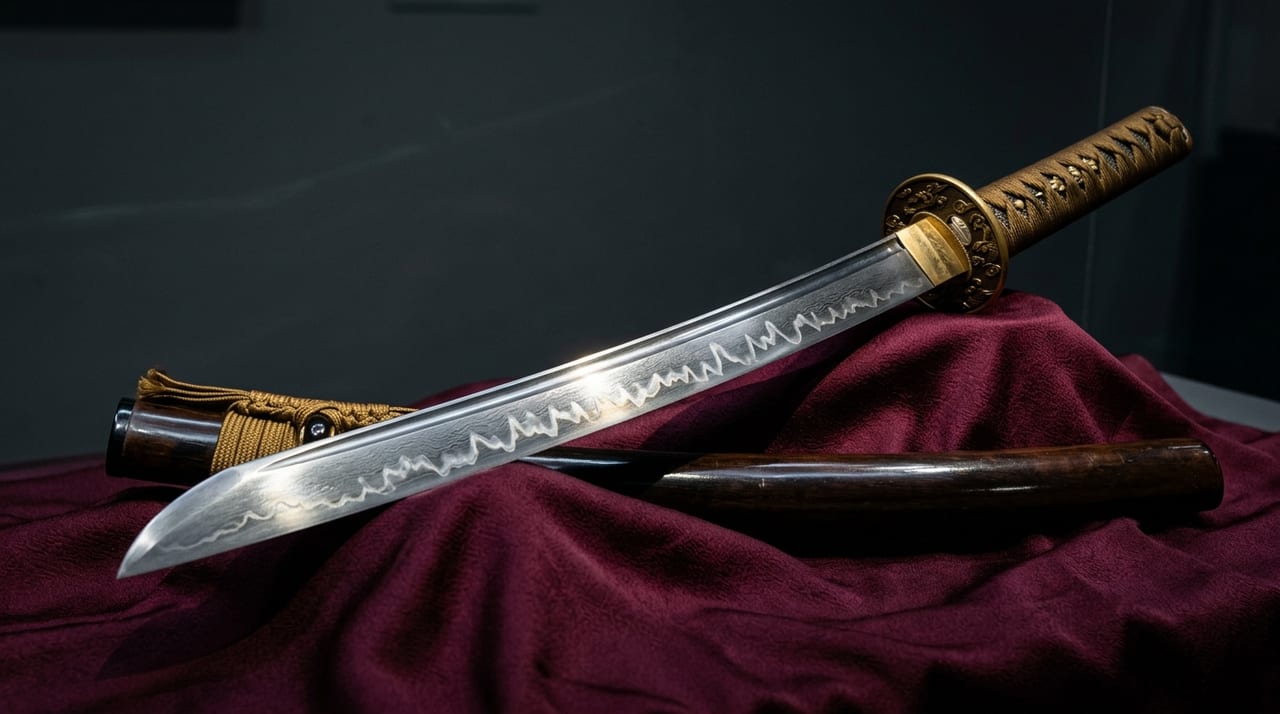
 * Image is for illustrative purposes only.
Jiganemaru
治金丸
Also known as: Jiganemaru; Black-lacquered wakizashi mounting, unsigned blade named Jiganemaru
Description
A Wakizashi Handed Down in the Ryukyu Royal House
Jiganemaru is one of the treasured swords passed down in the Sho royal house of the Ryukyu Kingdom. Though the blade itself is unsigned, it is attributed to Ōei Nobukuni, a Kyoto swordsmith of the Muromachi period. It is a hira-zukuri wakizashi with a blade length of about 53.8 cm, preserved together with a mounting in a black-lacquered scabbard. Forged on the Japanese mainland, it crossed the sea to become a treasured heirloom of the Ryukyu royal house.
Presented to King Sho Shin
According to the Kyuyo, the official history of Ryukyu, the blade was presented in 1522 to King Sho Shin, then ruler of the Ryukyu Kingdom, by Nakasone Toyumya, a powerful chieftain of Miyako Island. Nakasone Toyumya was known as the figure who unified Miyako, and this gift to the royal house was thereafter carefully preserved as a treasure of the Sho family.
The Legend of the Polisher
A legend attached to Jiganemaru tells of a sword polisher who, recognizing the blade's worth, attempted to make off with the genuine article after substituting a fake. The substitution is said to have been discovered because the queen had traced the shape of the original blade, and after diplomatic negotiation the genuine sword was recovered. The tale illustrates how the blade was treated not merely as a weapon but as a symbol of royal authority.
Designation and Present Status
Jiganemaru is designated a National Treasure together with its sister blades Chiyoganemaru and Chatan Nakiri as part of the "Materials Related to the Ryukyu Royal Sho Family," and is today held by the Naha City Museum of History in Naha, Okinawa Prefecture. It stands as an important relic of Okinawan sword culture, testifying to how the forms of the Japanese sword were incorporated into the royal rites of the Ryukyu Kingdom.
A Mounting that Tells of Japan-Ryukyu Exchange
Although the blade of Jiganemaru itself is a wakizashi forged by the Nobukuni school in Kyoto, its exterior is a black-lacquered scabbard fitted with a mounting of distinctly Ryukyuan design. This combination — a blade imported from the Japanese mainland fitted with a mounting made to Ryukyu's own taste — symbolizes the lively trade and exchange between Japan and the Ryukyu Kingdom of the period. Together with its sister blades Chiyoganemaru and Chatan Nakiri, it is valued in the study of Japan-Ryukyu exchange history as a rare surviving example in which a Japanese sword blade was united with distinctly Ryukyuan mounting culture.
Legends & Stories
A legend tells that a polisher who recognized the true worth of Jiganemaru secretly substituted a fake and tried to make off with the genuine blade. The ruse is said to have been discovered because the queen had traced the original blade's shape beforehand, and after diplomatic negotiation the real sword was recovered.