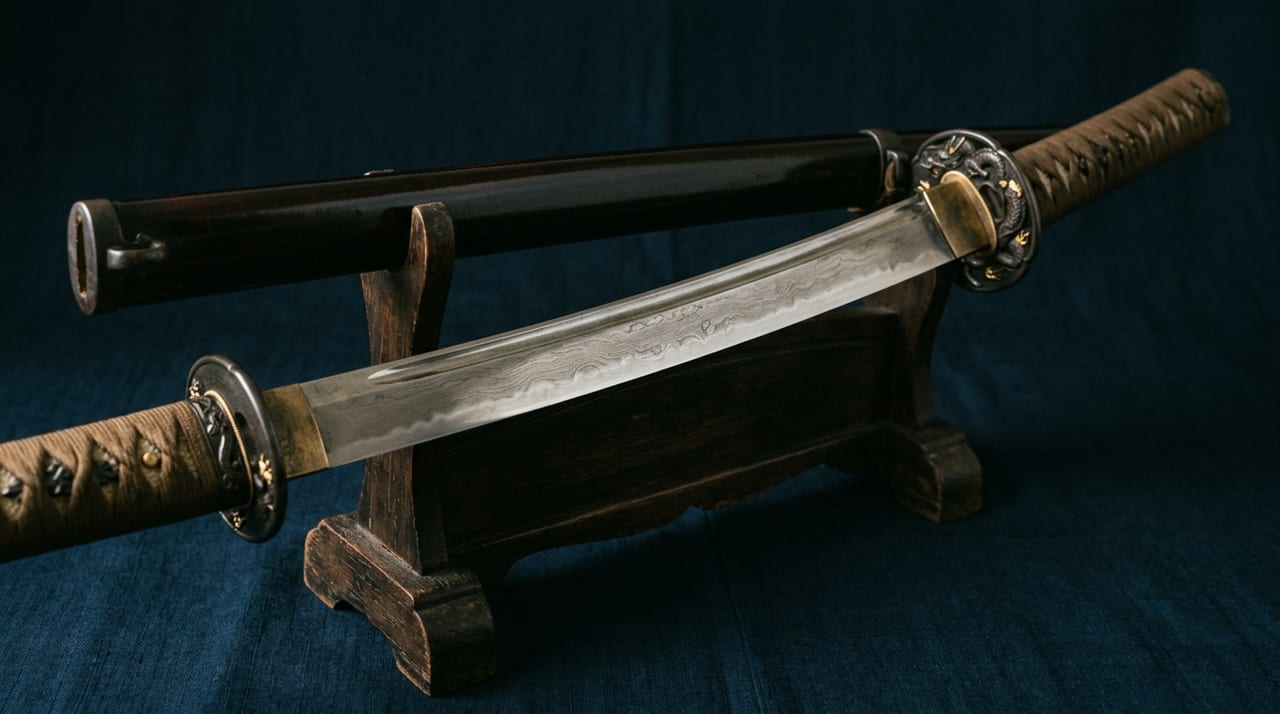
 * Image is for illustrative purposes only.
Iwakiri
岩切
Also known as: Tachi of the Rock-Cutter
Description
Iwakiri is said to be an ancient tachi of the late Heian period, bearing a legend that its sharpness could cleave even rock. The name "Iwakiri"—meaning "Rock-Cutter"—derives from the legend that this blade's sharpness was such that it could cleave even rock, and it has been venerated since ancient times as a divine sword possessing overwhelming spiritual power. Itsukushima Shrine is one of Japan's most representative shrines, registered as a UNESCO World Heritage Site, and its sacred precincts—famous for the great torii gate rising from the sea—preserve numerous cultural treasures dating from the Heian period onward.
Itsukushima Shrine, deeply revered by Taira no Kiyomori and which received abundant dedications from the Taira clan, preserves several excellent tachi from the late Heian through early Kamakura periods. A tachi in the Ko-Bizen style bearing the name "Iwakiri" is said to exist, but there is little concrete evidence that Iwakiri was transmitted to Itsukushima Shrine.
The blade displays the typical graceful tachi form of the late Heian period. With deep koshi-zori and slender mihaba, the blade represents a beautiful union of Ko-Bizen's characteristically clear jigane and refined ko-chōji-midare hamon. The elegant nioi-deki hamon shines softly, with fine, even nie along the edge complementing the deep jigane to create a beauty of rare distinction. The nakago retains the ancient form of the Heian period and is regarded as an important scholarly resource for the study of Masatsune-style signatures.
Concrete records regarding its current designation and preservation are sparse.
Legends & Stories
The most celebrated legend surrounding the name "Iwakiri" reaches back to the era of the Genpei War (1180–1185). According to tradition, when this tachi — enshrined as a sacred treasure of Itsukushima Shrine — passed into a warrior's hands, that warrior attempted to use it to sever iron chains driven into an enemy's rocky fortification. The heavy iron chains that no ordinary sword could so much as scratch were cut cleanly through in a single stroke of Iwakiri, and the blade's sharpness was loudly proclaimed as capable of "cutting even rock" — giving rise to the name. It is further said, however, that afterward the warrior was seized with awe at having used a blade belonging to the gods, and immediately returned it to Itsukushima Shrine. There is also a tradition connected to Taira no Kiyomori: when Kiyomori was making a pilgrimage to Itsukushima Shrine, he saw this tachi glowing with light before the sacred altar and declared, "This is a sword of the gods — it surpasses the grasp of mortal hands," and offered lavish tribute in worship. Kiyomori's fervent devotion to Itsukushima and the tragedy of the Taira clan's fall are widely known to later ages, and Iwakiri has been told of in connection with the great historical drama of the Taira's rise and ruin. Itsukushima's deity — Ichikishima-hime no Mikoto — is venerated as the goddess of water and beauty, and Iwakiri has long been believed to be a sacred sword (shinken) inhabited by this goddess's spirit, surpassing the status of a mere weapon. It is held since ancient times that this tachi, enshrined in the divine precinct rising from the sea, is the vessel of both the power of the sea-ruling deity and the spiritual might of a blade that cuts even rock.