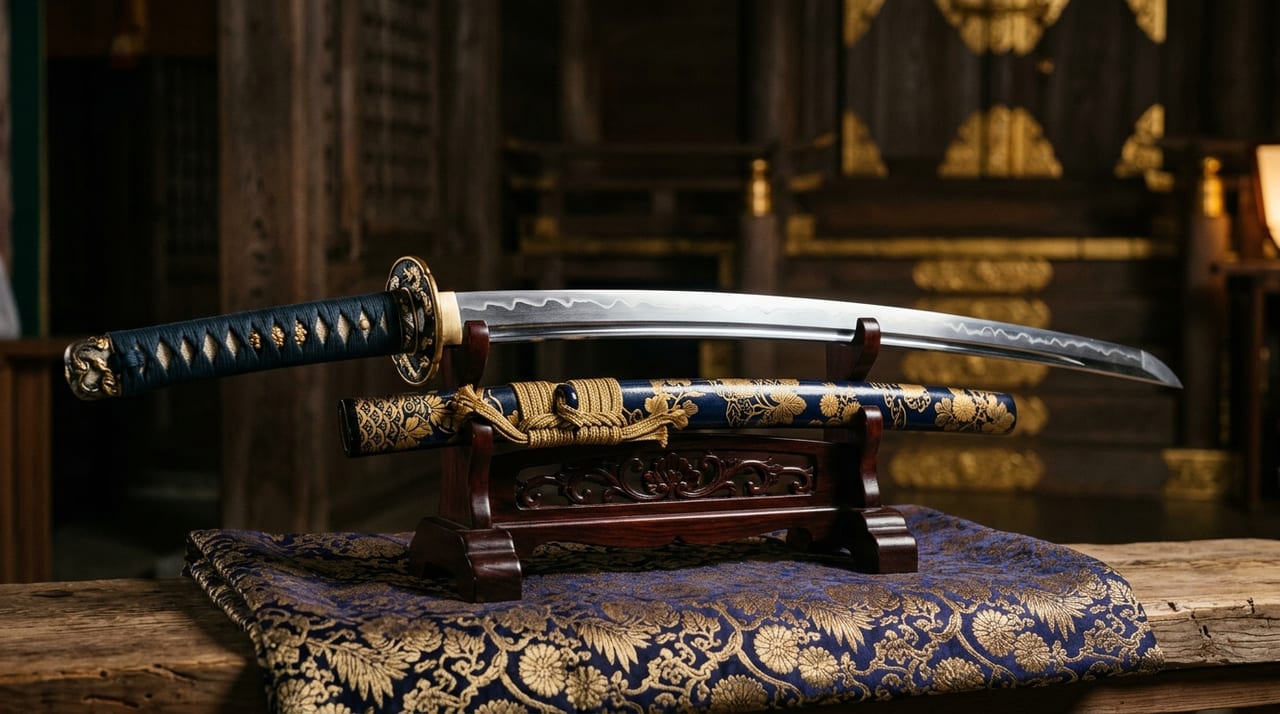
 * Image is for illustrative purposes only.
Iku-tachi
生太刀
Description
Overview of Iku-tachi — The Living Sword that Forged the Divine Realm
Iku-tachi (生太刀, "Living Tachi") is one of the most ancient divine swords recorded in the Kojiki, Japan's oldest chronicle of mythology. It was one of three sacred treasures bestowed upon Ōkuninushi-no-Kami by his father-in-law Susanoo-no-Mikoto: the Iku-yumiya (living bow and arrows), Iku-tachi (living sword), and Ama-no-Norigoto (heavenly zither). Among these, Iku-tachi symbolized martial power and sovereign authority. The prefix "iku" (生) means "living" or "life-bearing," signifying that this was not merely a weapon but a sacred implement imbued with divine vitality and the power to subjugate enemies.
According to the Kojiki, Ōkuninushi endured repeated assassination attempts by his eighty half-brothers (Yasogami) before passing Susanoo's trials and obtaining the Iku-tachi and Iku-yumiya. Armed with these divine treasures, he defeated all eighty rivals and unified Ashihara-no-Nakatsukuni (the Central Land of Reed Plains, representing the Japanese archipelago). The Iku-tachi functioned not only as a physical blade but as a testament to divine legitimacy and authority. As a "living sword," it was believed to respond to the wielder's will, vanquishing foes and pacifying the land.
No physical artifact of Iku-tachi survives today. However, it remains symbolically enshrined within the faith surrounding Ōkuninushi at Izumo Taisha (Izumo Grand Shrine, Shimane Prefecture). Izumo Taisha is the sacred site where Ōkuninushi was enshrined after the mythological "Transfer of the Land" (kuni-yuzuri), and Iku-tachi occupies a central place in this narrative as the divine weapon that embodied martial force and rightful rule during the age of nation-building. Though it exists only in myth, the name Iku-tachi symbolizes the trinity of martial power, life-force, and sovereign legitimacy in Japanese mythology, serving as a prototype for later sword veneration.
Among the three treasures, Iku-yumiya represented ranged power, Ama-no-Norigoto represented kotodama (spirit of language) and political authority, and Iku-tachi represented close combat and martial dominance. By unifying these three, Ōkuninushi achieved complete sovereignty. Swords in Izumo mythology—such as Iku-tachi—form the archetype of later imperial and shrine-based divine blades like Kusanagi-no-Tsurugi and Futsu-no-Mitama-no-Tsurugi. As one of the earliest examples, Iku-tachi holds a critical position in both mythological studies and the history of Japanese swords.
Legends & Stories
The Power of the "Living Blade" — The Subjugation of Yasogami and Prelude to Kuni-yuzuri
The most famous legend surrounding Iku-tachi is the tale of Ōkuninushi's defeat of the eighty gods (Yasogami) as recorded in the Kojiki. Ōkuninushi (then called Ōnamuji) came into conflict with his eighty half-brothers over the beautiful princess Yagami-hime of Inaba. The rival gods repeatedly attempted to kill him—crushing him with a heated boulder disguised as a red boar, and squeezing him to death between the cleft of a tree. Yet each time, Ōkuninushi was resurrected through the power of his mother goddess and Kamimusubi-no-Kami. Eventually, he fled to Ne-no-Kuni (the Underworld) where Susanoo-no-Mikoto dwelled.
Susanoo subjected Ōkuninushi to a series of ordeals: forcing him to sleep in chambers filled with serpents, wasps, and centipedes, and setting fire to a field to burn him alive. With the help of Susanoo's daughter Suseribime and his own ingenuity, Ōkuninushi overcame each trial. Recognizing his worth, Susanoo allowed Ōkuninushi to escape while he slept, taking with him the Iku-tachi, Iku-yumiya, and Ama-no-Norigoto. When Susanoo awoke and gave chase, he stopped at the border of Yomotsu-hirasaka (the slope to the underworld) and shouted: "With that living sword and living bow, drive your half-brothers to the base of the hills and sweep them to the river rapids. Proclaim yourself Ōkuninushi-no-Kami, take Suseribime as your chief wife, and raise great pillars at the foot of Mount Uka!" This was the mythological moment of Iku-tachi's bestowal.
Armed with this divine sword and bow, Ōkuninushi defeated the Yasogami one by one and became ruler of Ashihara-no-Nakatsukuni. Iku-tachi, as a "living blade," was said to respond to the wielder's will and divine authority, automatically vanquishing all who opposed him. This sword was not merely a symbol of martial power but also proof that Susanoo had recognized him as the legitimate successor.
Later, during the mythological "Transfer of the Land" (kuni-yuzuri), Ōkuninushi ceded Ashihara-no-Nakatsukuni to the emissary of Amaterasu and was enshrined at Izumo Taisha. Iku-tachi, having fulfilled its mythological role, was symbolically enshrined alongside Ōkuninushi in Izumo. Yet its name endures as the archetype of "life-bearing martial power" in the age of the gods, occupying a foundational place in the veneration of Japanese swords.