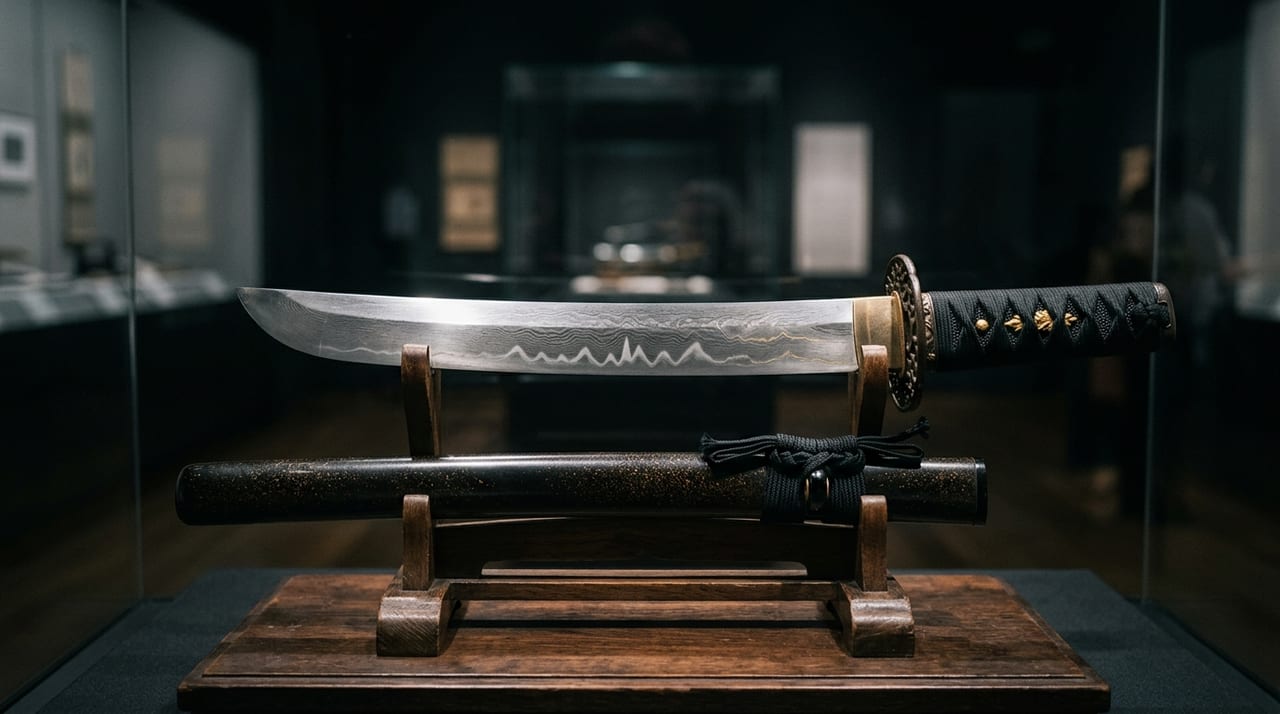
 * Image is for illustrative purposes only.
Hōchō Masamune
包丁正宗
Also known as: The cleaver-shaped Masamune; Masamune on the cutting board
Description
Hōchō Masamune is a tantō attributed to Sōshū Masamune (Okazaki Gorō Nyūdō Masamune), and its distinctive name derives from "hōchō" — the Japanese cooking knife. Several explanations for this unusual name are transmitted, but the most widely known is that this tantō's form — with a notably wider mihaba than the typical warrior tantō and a prominently flat-ridged (hira-zukuri) construction — was said to resemble a cooking knife at first glance, and was thus named for its distinctive proportions.
Masamune's tantō are broadly characterized by the "naginata-naoshi" or hira-zukuri style, with abundant activity within the ha and intense nie as their greatest distinguishing features. Hōchō Masamune is particularly prized as an example with an especially wide mihaba and thin kasane, and is interpreted as one of the works in which Masamune conducted formal experiments with the tantō. The form, which appears almost too idiosyncratic to be "practical," is conversely taken as proof of Masamune's genius for design.
The hamon exhibits the characteristically fierce Masamune ō-midare, with notare, gunome, and pointed-ha elements unfolding in complex composition; the nie is intense, and kinsuji and sunagashi fill the ha. The jigane flows in itame-hada with abundant ji-nie and active jikei. The nakago is close to ubu-nakago and bears Masamune's signature, and has been certified as genuine through long-standing appraisal. Three Hōchō Masamune are known in the Kyōhō-meibotsu-chō (the register of famous swords compiled during the Kyōhō era), and the two examples held by the Tokugawa Art Museum and the Eisei Bunko are each designated as National Treasures.
Legends & Stories
A famous legendary episode is associated with the origin of Hōchō Masamune's name. A wealthy merchant once came to Masamune with the request: "Please make the sharpest kitchen knife in the world." Masamune laughed and attempted to decline, saying: "I am a swordsmith, not a kitchen knife maker." But the merchant pressed on: "Just forge the finest edge you are capable of putting into a sword — in the shape of a kitchen knife, that is all I ask." After a night of consideration, Masamune agreed and began forging the next morning. What he completed was indeed "a Masamune in the shape of a kitchen knife" — said to be the prototype of the present Hōchō Masamune — and the merchant displayed it in his kitchen and cherished it throughout his life as "the most beautiful kitchen knife in the world." Another tradition holds that the head chef of the shogunal household harbored an irresistible desire to "cut ingredients with a blade by Masamune." Obtaining the shogun's special permission, he commissioned a tantō from Masamune. When he received the finished blade and nervously applied it to a vegetable, it passed through with not the slightest effort, and he collapsed in astonishment. The sword thereafter came to be called by the nickname "hōchō" (cooking blade), and this, it is said, became the origin of the present name.