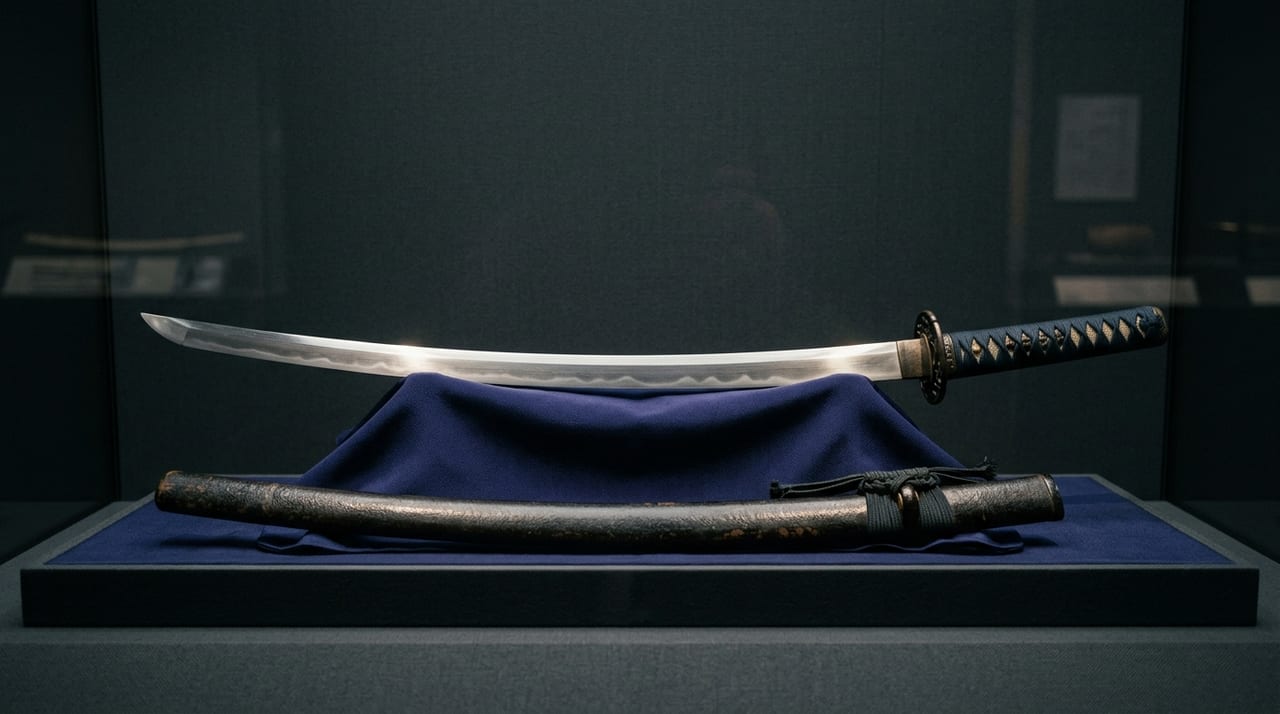
 * Image is for illustrative purposes only.
Hizen Ōmi Tadakuni
肥前近江忠国
Also known as: Ōmi no Tadakuni / Hizen Tadakuni (Ōmi no Kami) Uchigatana
Description
Hizen Ōmi Tadakuni is an uchigatana forged by the Hizen swordsmith Tadakuni, who was based in Hizen Province (present-day Saga and Nagasaki prefectures) during the early-to-mid Edo period. While the origin of the name "Ōmi" is debated among scholars, it is believed to derive from the court titles (Ōmi no Kami and Ōmi Daijō) held by Hizen smiths; hence the designation "Hizen Ōmi Tadakuni." Hizen blades were produced by the official swordsmith collective of the Hizen-Nabeshima clan, founded by Hizen Tadayoshi, and they achieved nationwide acclaim throughout the Edo period.
The characteristic features of Hizen blades include steel (jigane) with finely-packed small itame grain patterns and ji-nie, creating a beautiful fine-grained surface quality, and elegant hamon based on suguha (straight pattern) with subtle ko-notare and ko-gunome undulations. Tadakuni faithfully inherited this Hizen blade tradition while earning high personal acclaim as a swordsmith; he supplied numerous uchigatana trusted by samurai both within and outside the clan.
The blade of this uchigatana displays standard width (mihaba), normal thickness (kasane), and moderate curvature (sori), creating well-proportioned and balanced proportions. The hamon is dominated by suguha with subtle ko-notare undulations, exemplifying the characteristic Hizen blade pattern. The nie is fine and uniformly applied, with deep, clear nioi creating the refined and dignified aesthetic typical of Hizen blades. The jigane displays tightly-packed small itame patterns with ji-nie, and the distinctive fine-grained "chiri-chiri" surface characteristic of Hizen blades is prominently evident. The mei (signature) "Tadakuni" is clearly inscribed on the nakago (tang), which remains in excellent original condition.
The "Ōmi no Kami" court title held by Hizen smiths attests to the high nationwide regard for Hizen blades. This uchigatana, designated an Important Cultural Property and remaining in private ownership, is valued as precious evidence transmitting the advanced technical standards of Hizen blade culture to the present day.
Legends & Stories
"Ōmi" does not refer to a place name indicating Ōmi Province, but rather derives from the court rank title (an honorific designation from the imperial court) received by the smiths of the Hizen Tadayoshi lineage. The Hizen Tadayoshi school worked consistently as retainer-smiths for the Nabeshima clan, forging blades in Hizen Province (Saga), and Tadakuni was one of them. Therefore, the signature "Hizen Ōmi Tadakuni" indicates that the blade was forged in the land of Hizen while bearing the title "Ōmi"—not that the blade was transmitted from Hizen to Ōmi Province.
Furthermore, in the world of Hizen blades, there is an ancient tradition that blades "protect their masters." This blade, carefully preserved as a daimyo's sword, was displayed in the tokonoma (place of honor) even during the peaceful Edo period and is said to have been revered as a symbol of the samurai class.
The "fine-grained chiri-chiri" jigane of Hizen blades has long been expressed as "like stars that have fallen from the heavens and dwell in the blade." This Hizen Ōmi Tadakuni's jigane is similarly praised, and the clarity and beauty of its jigane—likened to a starlit night sky—has been transmitted poetically through the ages. Possessing the refined small-grain texture distinctive to Hizen swords, it holds a special place among sword enthusiasts.