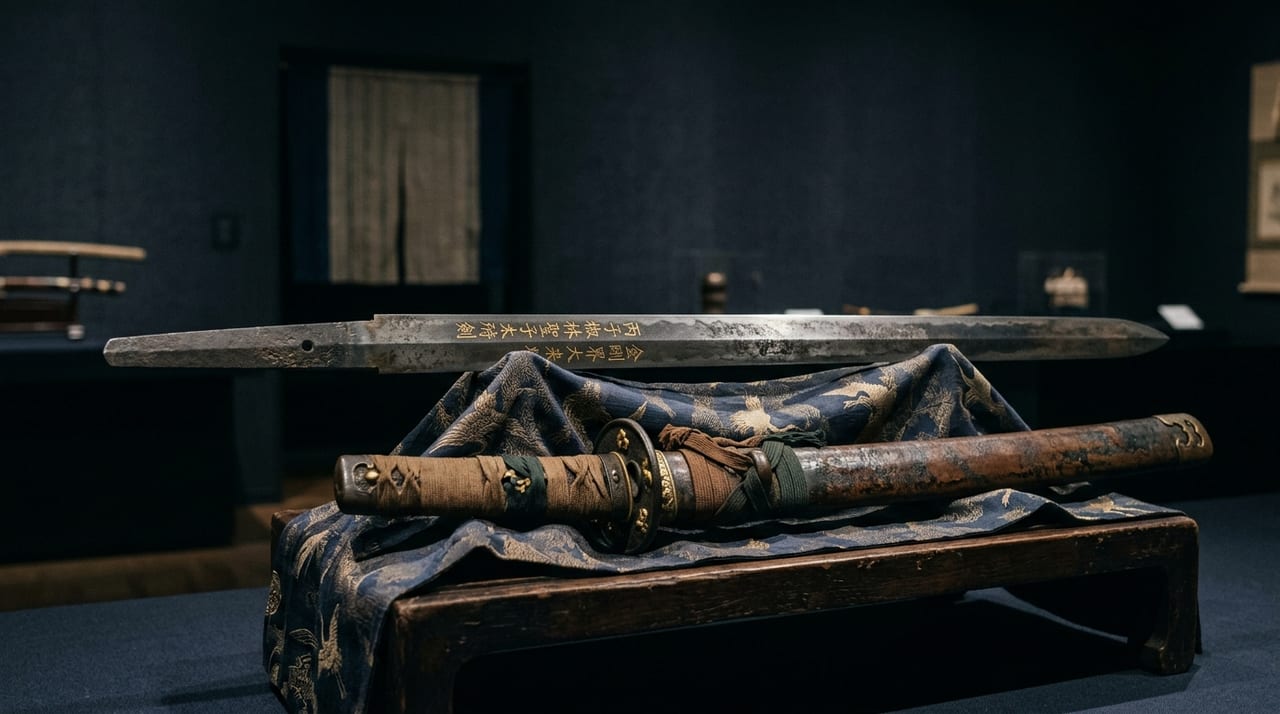
 * Image is for illustrative purposes only.
Heishi Shōrinken
丙子椒林剣
Also known as: Treasured Sword of Prince Shōtoku / Sacred Sword of Shitennō-ji Temple
Description
Overview of the Heishi Shōrinken — Prince Shōtoku's Treasure Sword
The Heishi Shōrinken is a straight sword of the Asuka period transmitted to Shitennō-ji in the Tennō-ji ward of Osaka, and is designated as a National Treasure as a treasure sword reportedly worn by Prince Shōtoku (Shōtoku Taishi, 574–622). The sword's name "Heishi Shōrin" is taken from the inscription in gold inlay carved on the blade; "Heishi" (the cyclical calendar sign) and "Shōrin" are interpreted as the maker's name. This inscription closely resembles the manufacturing style of continental China or the Korean Peninsula, suggesting it is likely a foreign import — that is, a piece imported to Japan from the continent. This sword, transmitted to Shitennō-ji's treasure hall, is traditionally paired with the Shichiseiken as the "Twin Swords of Prince Shōtoku."
Characteristics as a Straight Sword of the Asuka Period (Ancient Sword)
The Heishi Shōrinken is classified as a "jōkotō" (ancient straight sword) — a straight blade of the Asuka and Nara periods and before. Japanese swords are typically defined as curved single-edged blades with a curve developed after the late Heian period, but before that era, swords were predominantly "chokutō" (straight blades) influenced by continental China and the Korean Peninsula. The Heishi Shōrinken is a straight blade with a total length of 65.8 cm, and the blade bears the characters "Heishi Shōrin" carved in gold inlay. The straight-blade form directly inherited the sword styles of China and Korea, and as the finest sword work of an era before Japan's distinctive "curved blade" was perfected, it possesses irreplaceable documentary value in exploring the prehistory of the Japanese sword. Surviving examples of Asuka-period blades are extremely rare, and designated National Treasures among them are even more limited; the Heishi Shōrinken holds exceptional importance among these.
Prince Shōtoku and Shitennō-ji
The figure inseparable from the Heishi Shōrinken is Prince Shōtoku (Prince Umayado). As regent under Empress Suiko, Prince Shōtoku played a decisive role in the formation of ancient Japan through active promotion of Buddhism (promulgation of the Seventeen-Article Constitution, founding of Hōryū-ji and Shitennō-ji) and adoption of continental culture. Shitennō-ji is traditionally said to have been founded by Prince Shōtoku in 593, the first year of Empress Suiko's reign, and is one of Japan's oldest state temples, reportedly founded when the Prince prayed to the Four Heavenly Kings for victory in battle. The Heishi Shōrinken, as the treasure sword of the Prince transmitted to this temple most closely associated with him, stands at the forefront of the history of Japan's adoption of Buddhism and formation of the ancient state.
Interpretation of the Gold Inlay Inscription and Cultural Exchange
One of the greatest scholarly values of the Heishi Shōrinken lies in its gold-inlaid inscription. The four characters "Heishi Shōrin" are not mere decoration but possibly convey the sword's date of manufacture (the year of Heishi) or its name, and this inscription style is similar to that seen on blades of China's Six Dynasties period (3rd–6th centuries) or the Sui and early Tang periods. If the Heishi Shōrinken is indeed a continental imported piece, it would constitute one of the most important pieces of material evidence for active exchange of goods between Asuka-period Japan and the East Asian continent. The historical context in which high-quality continental swords were presented to the imperial family and nobility as part of Prince Shōtoku's policy of adopting continental culture is entirely understandable, and the Heishi Shōrinken is positioned as a rare piece of material historical evidence embodying such a process of "diplomatic and cultural exchange."
Preservation at Shitennō-ji and Transmission to the Present
Though located in central Osaka, Shitennō-ji has been repeatedly subjected to warfare and disaster throughout its long history. Passing through the destruction related to the Ishiyama War involving Oda Nobunaga in 1576, damage from the Summer Campaign of Osaka in 1615, and the severe devastation from the Osaka air raids in March 1945 during World War II — that the Heishi Shōrinken has survived these historical catastrophes to reach the present day is little short of miraculous. Efforts to evacuate and protect cultural property amid warfare preserved the treasure sword, and it is now carefully preserved in the Shitennō-ji treasure hall. As of 2023, special public displays are held periodically, and the Heishi Shōrinken, as the sword worn by Prince Shōtoku, continues to convey its presence across 1,400 years to viewers, moving those who visit with profound religious and historical emotion beyond mere cultural property.
Modern Significance of the Heishi Shōrinken
The cultural and historical significance of the Heishi Shōrinken is multifaceted. First, as an extremely rare surviving blade of the Asuka period, it holds technological and historical value in illustrating the prehistory of the Japanese sword. Second, as a relic of Prince Shōtoku, one of the most important figures in Japanese history, it holds historical value. Third, as material evidence of cultural exchange between Asuka-period Japan and the East Asian continent, it holds comparative-historical value. And fourth, as historical testimony to 1,400 years of institutional preservation of cultural property at a temple, it holds institutional-historical value — these four dimensions position the Heishi Shōrinken in a special place among Japan's cultural properties. The history of the Japanese sword is usually explained as beginning with the curved blade of the late Heian period, but the Heishi Shōrinken embodies the most important chapter of that "prehistory of the Japanese sword," and as material evidence indispensable to understanding the complete picture of Japanese sword culture, it continues to receive the highest evaluation from both sword-research scholars and historians.
Legends & Stories
The Legend of Prince Shōtoku's Twin Swords—The Heishi Shōrinken and the Shichiseiken
Two treasured swords transmitted to Shitennō-ji Temple—the Heishi Shōrinken and the Shichiseiken—have been traditionally spoken of as a pair, known as "the Twin Swords of Prince Shōtoku." The image of Prince Shōtoku carrying two swords in prayer for the protection of Buddhism embodies what appears to be a paradoxical fusion of religion and weaponry, but this expresses the concept of "dharma protection" (gohō)—the belief that force is necessary to defend the Buddhist Law—a guardian-deity concept brought to Japan with Buddhism itself, wherein the Four Heavenly Kings serve as protectors of the dharma in Indian and Chinese Buddhist tradition. Prince Shōtoku is traditionally said to have achieved victory in his struggle with the Soga clan through his prayers to the Four Heavenly Kings, and the transmission of two guardian swords to Shitennō-ji Temple—dedicated to those same Four Heavenly Kings—embodies in its purest form the Asuka-period religious worldview wherein the sword stands as a symbol of dharma protection.
The Decisive Battle with Mononobe no Moriya—The Prince's Prayer and Victory
The most significant historical context in which the Heishi Shōrinken is traditionally said to have been worn is the confrontation between Prince Shōtoku and Mononobe no Moriya. In the second year of Emperor Yōmei's reign (587), a military conflict erupted between Mononobe no Moriya, who opposed the acceptance of Buddhism, and the forces of Soga no Umako and Prince Shōtoku, who championed Buddhism. In this conflict, Prince Shōtoku made a vow to the Four Heavenly Kings (protective deities of Buddhism), pledging that if he achieved victory, he would construct a temple in their honor. According to tradition, this pledge led to the founding of Shitennō-ji Temple following the prince's triumph. The tradition that Prince Shōtoku carried the Heishi Shōrinken into this decisive battle demonstrates that the sword functioned as more than a mere weapon—it served as a "symbol of religious protection." The defeat of Mononobe no Moriya and the victory of the Soga and Prince Shōtoku marked the pivotal historical moment that determined the establishment of Buddhism in Japan. The tradition that the Heishi Shōrinken was present at this transformative moment places this sword in a uniquely luminous position as the blade that "stood witness at the genesis of Japanese Buddhist history."
Prince Shōtoku Veneration and the Sacred Consecration of the Treasured Swords
After his death, Prince Shōtoku came to be widely revered as a "saint of the common people" in Japan and became the focal point of a popular religious movement known as "Prince Shōtoku veneration" (taishi no shinkō). Veneration of Prince Shōtoku as the "embodiment of the Future Buddha" and the "Śākyamuni Buddha of Japan" spread throughout the nation during the medieval period, and Shitennō-ji Temple became the supreme pilgrimage destination for this cult, drawing countless devotees. Within this context, the Heishi Shōrinken and Shichiseiken became far more than historical relics; they were venerated as "sacred relics" (seiibatsu) in which the spiritual power of the prince was believed to reside. It is recorded that at certain periods, a popular belief arose that merely touching the Prince's swords could cure illness. This positioning of swords as "religious sacred relics" constitutes one of the most ancient layers of cultural meaning attributed to blades in Japan, and here we can discern the prototype of the later belief in Japanese sword culture that "spiritual power resides in renowned swords."
The Osaka Campaign and the Crisis of Cultural Treasures
Shitennō-ji Temple sustained severe damage during the Osaka Campaign of 1615. This conflict, known as the final confrontation between Tokugawa Ieyasu and Toyotomi Hideyori, inflicted devastating damage on the temples and shrines surrounding Osaka Castle, causing Shitennō-ji Temple to lose most of its primary structures (garan). While detailed records of how the treasured swords—the Heishi Shōrinken and Shichiseiken—were protected during this crisis have not survived, the fact that the swords were confirmed following the temple's reconstruction attests to a miraculous succession of protective efforts ensuring that "even amid warfare, the most precious treasures were safeguarded." Additionally, during the Great Osaka Air Raid of March 1945 in World War II, Shitennō-ji Temple sustained severe damage and many cultural treasures were lost; however, the Heishi Shōrinken is said to have escaped destruction through evacuation. This fact of survival through two successive catastrophic destructions stands as testimony to the steadfast dedication and sense of mission of those who labored to preserve the Heishi Shōrinken, and it speaks quietly to the truth that the act of "protecting cultural treasures" sometimes demands sacrifice of the highest order. The fact that most of the structures standing in Shitennō-ji Temple's grounds today are postwar reconstructions underscores why the Heishi Shōrinken shines with unique radiance in Osaka's historical memory.