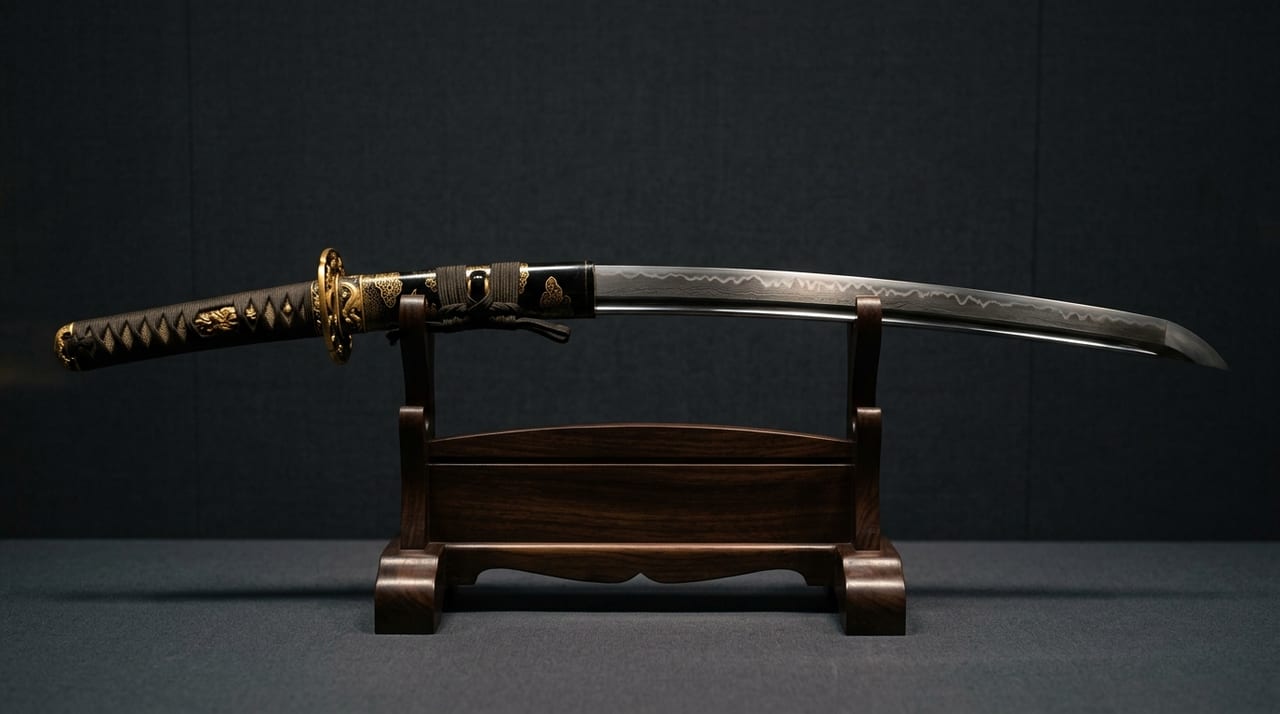
 * Image is for illustrative purposes only.
Hatsukari
初雁
Also known as: Tachi of the First Wild Goose
Description
Hatsukari is a tachi of the late Heian period, transmitted in Ko-Bizen style. The name "Hatsukari"—meaning "the first wild geese," the earliest migrating flock that announces the coming of autumn—was given because the blade's graceful yet spirited form was said to evoke the sight of a flock of geese sailing swiftly through an autumn sky. It is a tachi that has long been carefully enshrined as one of the sacred treasures of Atsuta Shrine.
Atsuta Shrine is known as one of the three great shrines of Japan, enshrining the Kusanagi no Tsurugi as its divine body, and its precinct and treasure hall preserve numerous renowned swords from the Heian and Kamakura periods. Hatsukari is positioned as a particularly distinguished example among these; according to shrine tradition, it is said to have been dedicated by ancient imperial or court noble families, but the details remain officially undisclosed.
The blade characteristically exemplifies Ko-Bizen style of the late Heian period. It displays a deeply curved, slender tachi silhouette of graceful bearing, with antique dignity pervading throughout. The mihaba is narrow, the kasane somewhat thick, and the kissaki is the refined ko-kissaki. The hamon centers on ko-midare or ko-chōji, with a bright and clear nioi-deki edge. The jigane displays densely packed ko-itame-hada that is pellucid and pure, with profound ji-nie rising evenly throughout. The nakago remains in a state close to its original ubu-nakago, directly conveying the excellent Ko-Bizen forging to the present day.
It is transmitted to embody Ko-Bizen tachi aesthetics, though official records regarding its current designation and custody are scarce.
Legends & Stories
The most widely told legend associated with Hatsukari concerns the circumstances of its dedication to Atsuta Shrine. According to ancient tradition, a certain Heian courtier received a divine oracle in a dream — a messenger of the Great Deity of Atsuta appeared at his bedside and commanded: "Offer forth the tachi in your possession." The following morning, the courtier dedicated to Atsuta Shrine the finest sword in his family's possession — the blade later called Hatsukari — and because it proved worthy of the deity's will, his family was said to have prospered for generations thereafter. There is also a tradition preserved within Atsuta Shrine about the origin of the name "Hatsukari." Long ago, a shrine priest who had reverently viewed this sword in the treasure hall witnessed, one early autumn morning, a flock of wild geese passing over the shrine grounds. The graceful arc and vigorous flight of the geese overlapped in his mind with the form of the blade he had seen the night before — its deep koshi-zori and slender, dignified body — and he murmured involuntarily, "Truly, this is the tachi of the first wild geese." This is said to be how the name came to be. Atsuta Shrine is home to many mysterious sword legends, beginning with the Kusanagi no Tsurugi, and Hatsukari too has long been venerated within that sacred atmosphere as a divine sword (kamitachi) possessed of spiritual power. An oral tradition also holds that on certain festival occasions, a mysterious light emanated from the direction of the treasure hall — and the blade's spiritual presence as a divine sword has been deeply believed by those within the shrine precinct.