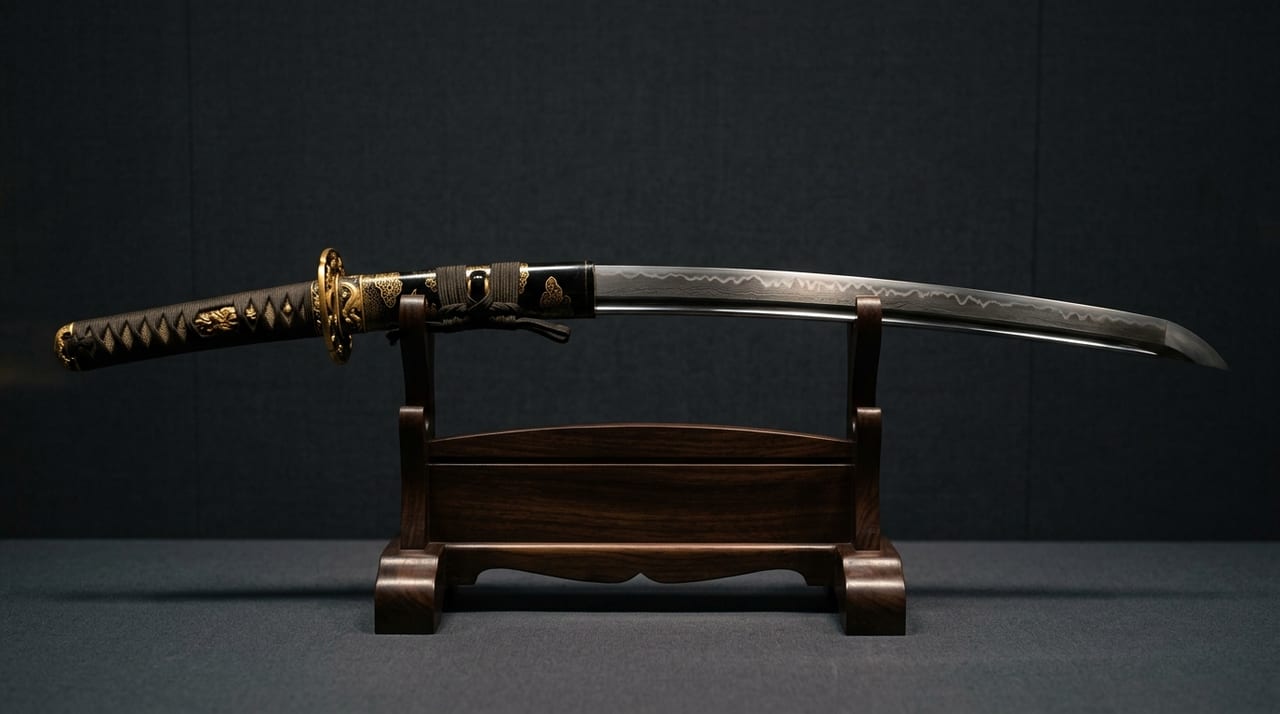
 * Image is for illustrative purposes only.
Hanjin
泛塵
Also known as: Hanjin; Chiriharai; "Worn by Sanada Saemon"
Description
A Wakizashi Said to Have Been Worn by Sanada Nobushige
Hanjin is a wakizashi traditionally attributed to Uda Kunitsugu, a swordsmith of the Etchū Uda school active in the Muromachi period. It is said to have been the personal sidearm of Sanada Nobushige — better known by his popular name Sanada Yukimura — the Sengoku commander who died at the Siege of Osaka. Among Japanese swords it is remarkable as much for its narrative as for its workmanship, yet its whereabouts have been untraceable since the late Edo period, leaving only records and tradition behind.
Workmanship and the Gold-Inlaid Inscription
The blade measures one shaku six to seven sun (roughly 48.5 to 51.5 cm), with a moderate curvature in standard proportions and a shōbu-zukuri construction. The hamon is a broad suguha, showing the restrained temper characteristic of the Etchū Uda school. Originally unsigned, the tang was later fitted with gold-inlaid inscriptions: the obverse reads "Hanjin — worn by Sanada Saemon," while the reverse reads "made by Uda Kunitsugu, refined by Kunihiro." The obverse records the owner as Sanada Saemon-no-suke Nobushige; the reverse is understood to credit the shortening or polishing of the blade to Horikawa Kunihiro.
The Meaning of the Name "Hanjin"
The characters admit two readings. Read as "Chiriharai" — literally "dust sweeper" — the name is said to praise an edge so keen that motes floating on running water were severed when the blade was held against the current. Read as "Hanjin," scholars interpret it as a Zen-inflected phrase evoking the frailty of human life, as fleeting as dust adrift on water; a further reading takes the term simply as a word for a keen-edged sword. Under any interpretation, the name has long been read against Nobushige's death in the Toyotomi cause.
From Kōyasan to Kishū: Provenance Until Its Disappearance
After Nobushige fell at the summer campaign of Osaka in 1615, the blade is said to have passed out of Kōyasan and onto the open market. It came into the hands of Itō Rangū, a Confucian scholar of the Kishū domain, who reportedly refused his lord's request to present it, on the grounds that it had belonged to a commander of the opposing side. Following Rangū's death, his son pawned the sword, and it was purchased by Noro Kaiseki, a Kishū retainer celebrated as a literati painter, who kept it as a treasured possession. After Kaiseki's death in 1828, the record of ownership breaks off entirely, and it is not known whether the blade still survives.
The Etchū Uda School and Uda Kunitsugu
The Uda school traces its origins to Ko-Nyūdō Kunimitsu, a Yamato smith who relocated to Etchū Province; the signature "Uda" is understood to denote the school's ancestral place name. Because several smiths worked under the name Kunitsugu, the specific maker of this blade has never been identified. From the Ōei era onward, Uda work shows suguha mixed with gunome, often with muneyaki and irregularities in the temper, which led Edo-period connoisseurs to rank the school modestly. Yet that same practical, hard-wearing character explains why such blades were carried by fighting men of the Sengoku era — and why one hung at Nobushige's hip.
Legends & Stories
After Sanada Nobushige fell at the summer siege of Osaka in 1615, the blade is said to have been sold out of Kōyasan. Itō Rangū, a Confucian scholar of the Kishū domain, reportedly refused to surrender it to his lord, declaring it the sword of an enemy commander. After Rangū's death it was pawned and acquired by the literati painter Noro Kaiseki, who treasured it in secret; following Kaiseki's death in 1828 the blade vanished from the record. The name, read "Chiriharai," is said to derive from an edge keen enough to sever motes of dust on running water; read "Hanjin," it is taken to evoke the frailty of human life, adrift like floating dust.