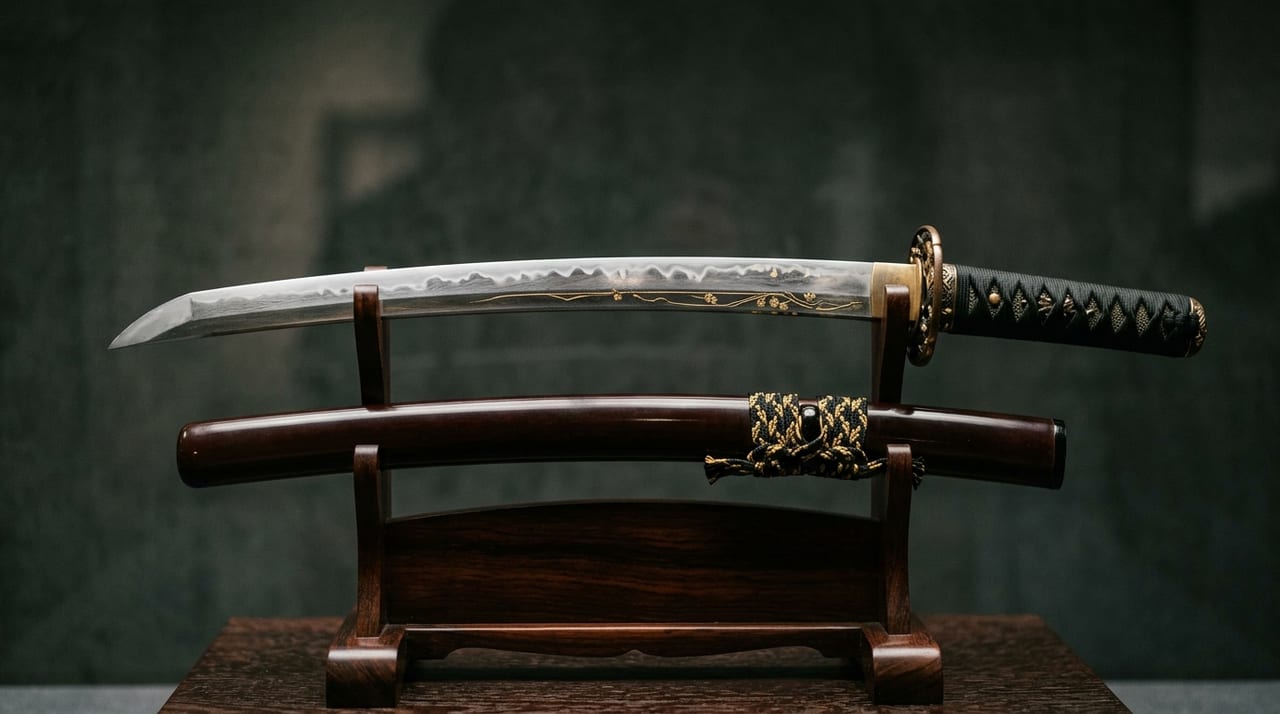
 * Image is for illustrative purposes only.
Gotoba-in Gozaku
後鳥羽院御作
Also known as: Emperor's Own Forging
Description
Gotoba-in Gozaku refers to swords personally forged by the retired Emperor Go-Toba (1180–1239), one of the most remarkable figures in Japanese history — a poet, musician, and warrior-aesthete who became passionately devoted to sword-making. Go-Toba instituted the 'goban-kaji' (rotating blade-smith) system, summoning the finest sword-masters from across Japan to reside at the palace in monthly rotation and teach him their craft. He personally trained under masters of the Yamato, Ko-Bizen, Awataguchi, and Ichimonji traditions, then forged swords himself. Several of these imperially forged blades survive today, all designated Important Cultural Properties, held at shrines including Minase Shrine (dedicated to Go-Toba himself) and Ōyamazumi Shrine. Their quality is remarkably high — not the work of a mere dilettante, but of a determined practitioner who absorbed Japan's finest sword-making traditions directly from their masters.
Legends & Stories
## The Jōkyū Rebellion and the Emperor's Obsession The life of Emperor Go-Toba was one of the most dramatic tragedies in Japanese history. In 1221 (Jōkyū 3), Emperor Go-Toba issued an imperial edict ordering the destruction of Hōjō Yoshitoki and raised an army to overthrow the Kamakura shogunate—this event is known as the "Jōkyū Rebellion." However, the shogunate's vast forces crushed the emperor's army in merely three weeks, and Emperor Go-Toba was exiled to Oki Province (present-day Shimane Prefecture). For the next nineteen years, Emperor Go-Toba lived on that remote island of Oki, never returning to the mainland during his lifetime, and passed away on Oki in 1239. Even after his exile, Emperor Go-Toba continued to compose poetry and authored treatises on poetic arts such as the *Gotoba-in Goroku*. And he continued to forge swords. It is said that even in Oki, he maintained the equipment of a sword-smith and continued forging blades, and the unwavering passion for swords that the exiled emperor never abandoned only heightened the spiritual power of those swords. ## The Go-Ban Kajin System and Encounters with Master Smiths The "Go-Ban Kajin" system established by Emperor Go-Toba was a revolutionary event in Japanese sword history. Master smiths from throughout the realm—from Bizen, Yamato, Yamashiro, Sagami, and other provinces—were summoned to the imperial palace and forged swords in the emperor's presence while transmitting their techniques. Emperor Go-Toba was not merely observing; he himself operated the bellows, grasped the hammer, and forged swords. This experience is reflected in the swords of Gotoba-in Gozaku, and a unique style emerged in which the essence of each regional tradition was fused in the hands of a single craftsman—the emperor. The master-disciple relationship, where the masters were Japan's greatest sword-smiths and the disciple was the emperor, was an unprecedented episode in the history of the Japanese sword. ## The Land of Tsuki no Wa—Emperor Go-Toba's Aesthetic Vision Emperor Go-Toba possessed outstanding talent in the composition of waka poetry and directly participated in the selection of poems for the *Shinkokinwakashū*. His poetry was celebrated as both delicate and powerful, fusing deep emotion with linguistic beauty at the highest level. This literary aesthetic eye was also projected onto his swords, and the blades of Gotoba-in Gozaku possessed a character that transcended mere weapons or art objects—they were "swords as poetry." The swords that Emperor Go-Toba forged during his lonely days in Oki carry within them both the melancholy of a deposed emperor and an undiminished passion for beauty. Such swords, imbued with personal emotion, occupy a special spiritual dimension among sword blades as cultural properties. ## Minase Shrine and the Emperor's Spirit Consolation Minase Shrine is a shrine dedicated to three ex-emperors—Emperor Go-Toba, Emperor Tsuchimikado, and Emperor Juntoku—and is situated at Minase (present-day Shimamoto Town, Osaka Prefecture), a place connected to Emperor Go-Toba. Founded to console the spirits of the three ex-emperors exiled through the Jōkyū Rebellion, the fact that swords of Gotoba-in Gozaku are enshrined there demonstrates that the blade and the emperor's spirit have been transmitted together to later ages as one unified entity. The swords that the emperor himself forged are enshrined in the shrine that honors the emperor, protecting his spirit—this circular structure represents a unique position in Japanese cultural history as an example where the life of this rare individual, Emperor Go-Toba, and the spiritual nature of swords as cultural properties beautifully converge. ## The Go-Ban Kajin System—The Emperor's Institutional Design for Swords The "Go-Ban Kajin" system established by Emperor Go-Toba was a noteworthy epoch-making institution in Japanese sword history. The Go-Ban Kajin was a system in which the emperor summoned master smiths from various provinces and had them forge swords on a rotating basis in a forging workshop established near the imperial palace in Kyoto, for a fixed period each month. Emperor Go-Toba's conception of organizing an environment where master smiths from throughout the realm would regularly gather and compete in their highest techniques was a brilliant policy from the standpoint of promoting sword culture. The smiths of the Go-Ban Kajin, in exchange for being given the opportunity to forge, materials, and compensation by the emperor, dedicated their finest work. The emperor himself is said to have learned sword-smithing techniques through this system. Through this system, the sword-smithing techniques of various regions were exchanged and fused in Kyoto, the center of cultural activity, contributing to the rapid development of Japanese sword culture in the early Kamakura period. Although the Go-Ban Kajin system ended with the emperor's downfall following the Jōkyū Rebellion, its legacy was inherited by sword-smiths of later ages. ## The Chrysanthemum Mon and the Mark of the Emperor on Gotoba-in Gozaku The "chrysanthemum imperial crest" engraved on the tang of swords of Gotoba-in Gozaku is the sole and unique characteristic that distinguishes this group of swords from all other famous blades. The chrysanthemum crest, as the symbol of the imperial house, continues to the present day, and its engraving on the tang of a blade signifies that the authority of the imperial family is literally inscribed into the sword itself. Emperor Go-Toba's act of engraving the chrysanthemum mon on the swords he himself forged was an act of crystallizing imperial legitimacy and authority in the highest form of craftsmanship, and can be interpreted as the deposed emperor's "final assertion of authority" after his defeat by the shogunate in the Jōkyū Rebellion. When swords of Gotoba-in Gozaku are displayed in the modern era, the tang bearing the engraved chrysanthemum crest invariably becomes the focus of attention. The chrysanthemum crest, still clearly engraved after more than seven hundred years, continues to transmit across the ages the strong will of Emperor Go-Toba, who even in exile never abandoned his identity as emperor. ## Modern Evaluation of Gotoba-in Gozaku In the modern era, the swords of Gotoba-in Gozaku hold the most special position in the history of the Japanese sword and receive the highest respect. The unique provenance of swords forged by the emperor himself, unparalleled anywhere in the world; the tang bearing the engraved chrysanthemum crest; the tumultuous life of the deposed emperor who was defeated in the Jōkyū Rebellion—all these factors imbue Gotoba-in Gozaku with overwhelming historical and cultural significance. Multiple existing examples of Gotoba-in Gozaku swords have been confirmed, each protected rigorously as either a National Treasure or Important Cultural Property. The surviving chrysanthemum-mon works (Gotoba-in Gozaku) are housed in institutions such as the Kyoto National Museum and remain designated as National Treasures or Important Cultural Properties, still carrying the memory of the emperor. For sword researchers, Gotoba-in Gozaku represents one of the highest research subjects, with investigations continuing from various angles including technical analysis of the forging techniques, authentication of signatures on the tang, and provenance research. Eight hundred years after the Jōkyū Rebellion, Emperor Go-Toba's passion for swords continues to be transmitted to people throughout Japan and around the world as one of the symbols of Japanese sword culture.