 * Image is for illustrative purposes only.
Goroemon-saku Masamune
五郎右衛門作正宗
Also known as: Goroemon Masamune — attributed to Sōshū Masamune, formerly in the Goroemon family collection
Description
Goroemon-saku Masamune is a tachi attributed to Okazaki Masamune, the supreme master of the Sōshū tradition active from the late Kamakura through the Nanbokuchō period, taking its name from a merchant or samurai family named "Goroemon" in whose possession it was held during the Edo period. The suffix "-saku" (literally "made by") reflects a Japanese sword naming convention in which a sword is prefixed with the name of a notable former owner, a practice recorded in the Kyōhō Meibutsuchō (Catalogue of Famous Objects) and other Tokugawa shogunal sword registers.
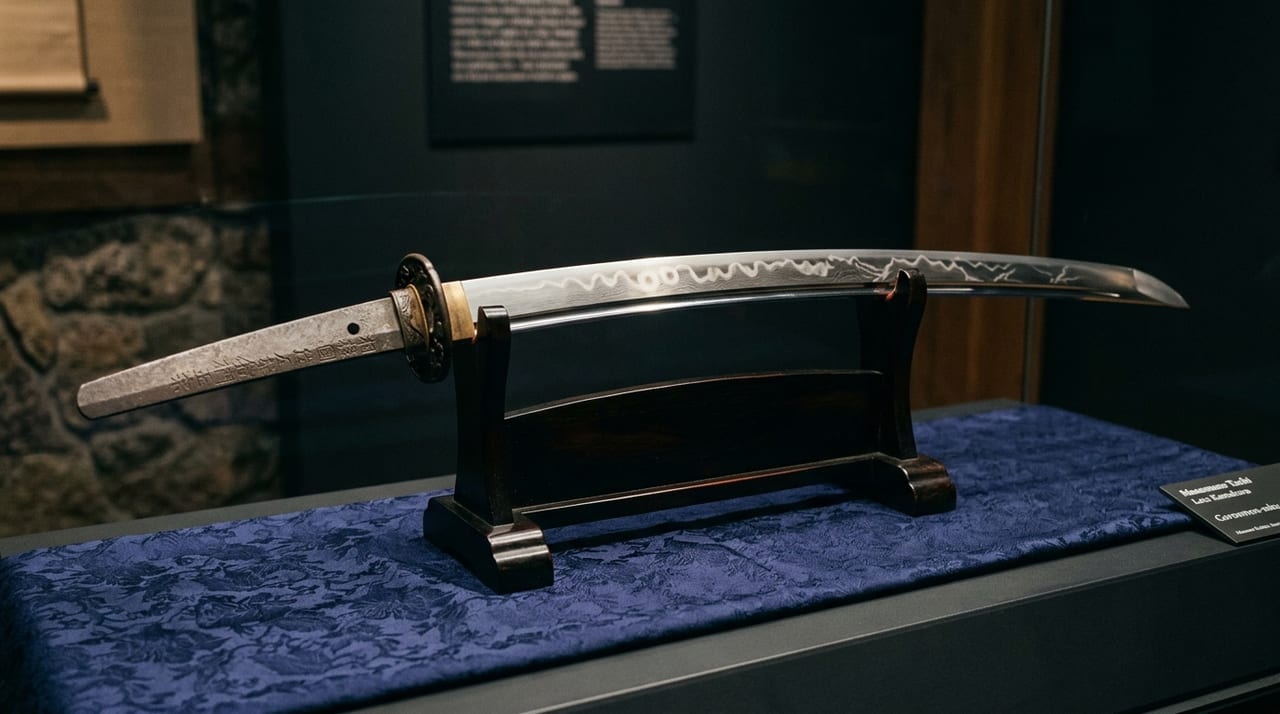
Surviving tachi by Masamune are extremely rare, and all works accepted as authentic have been designated National Treasures or Important Cultural Properties. Certain documentation regarding the designation and holding of Goroemon-saku Masamune is scant. The blade presents a typical late Kamakura tachi configuration—shinogi-zukuri, iori-mune, and naka-zori—with a modest degree of suriage (shortening) resulting in its present form.
The jigane shows Masamune's characteristic mokume-mixed itame-hada with abundant ji-nie and chikei in vigorous activity. The hamon embodies the defining qualities of Masamune's art as the teacher of the Masamune Jittetsu: based on notare, with complex layering of ō-gunome, ashi, and yō, with dramatic nie-kuzure, kinsuji, and inazuma dancing through the interior—a powerful and animated landscape. The nakago retains a portion of the ubu (unaltered) tang, and the sword's authenticity is supported by Masamune's signature and accompanying appraisal documents. Certain documentation regarding its current whereabouts is scant.
Legends & Stories
The most widely known legend surrounding Goroemon-saku Masamune concerns the story of the merchant "Goroemon" who acquired this tachi in the mid-Edo period. According to tradition, Goroemon came upon the sword during a clearing-out of a samurai estate's storehouse and purchased it at a modest price, but was puzzled night after night by a faint light leaking from his sleeping quarters. Investigating, he found that the tachi in its sword box was emanating a pale blue light. Alarmed, Goroemon brought it to a swordsmith for appraisal, who declared without hesitation, "This is without doubt a masterwork blade by Masamune" — and from that point the sword's fame spread under the name "Goroemon's Masamune." Another tradition holds that while the sword was in the keeping of a samurai household, a period of discord and illness afflicted the family; when they placed the Masamune tachi in the tokonoma (decorative alcove) and began paying respects to it each morning, the family's fortunes recovered. The belief that "a Masamune sword wards off evil and protects the household" was widely held in the Edo period, and Goroemon-saku Masamune has been passed down as a sword embodying that tradition.