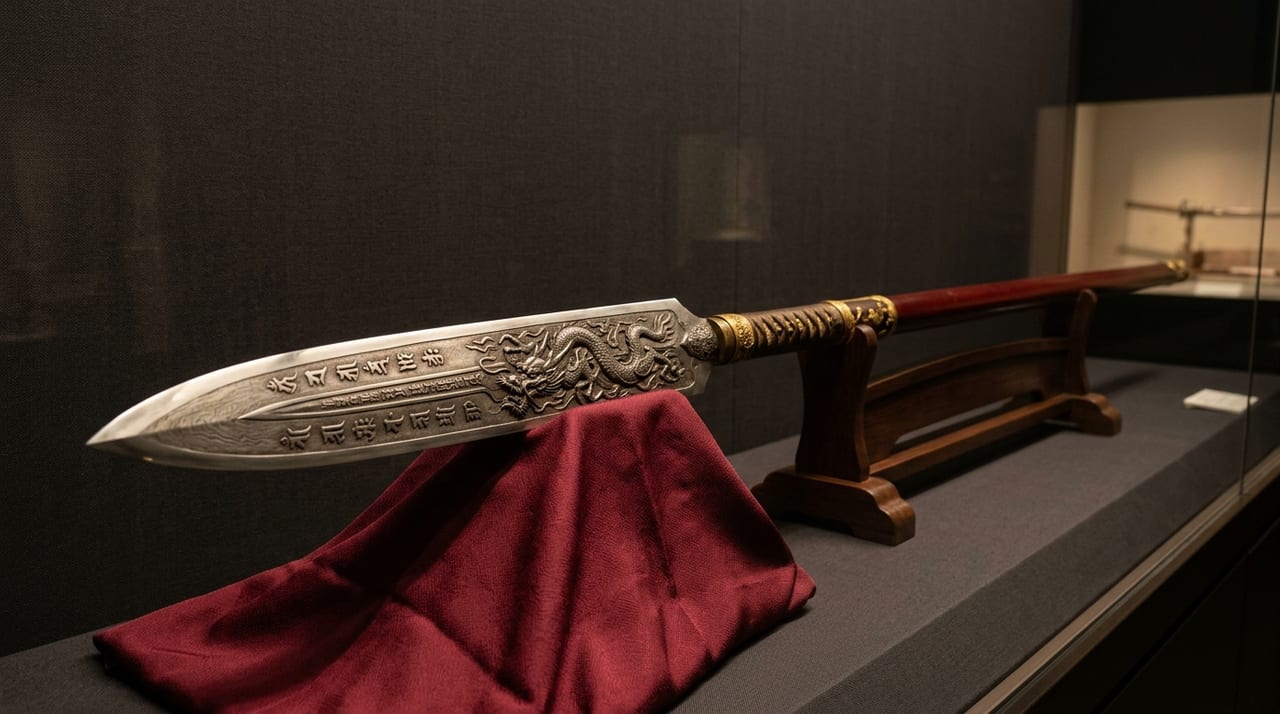
 * Image is for illustrative purposes only.
Goke Kanemitsu
後家兼光
Also known as: Sword: Attributed to Osafune Kanemitsu (Large Modification, No Signature, Known as Goke Kanemitsu)
Description
Goke Kanemitsu is an uchigatana traditionally attributed to the swordsmith Osafune Kanemitsu, who was active in Osafune, Bizen Province (present-day Okayama Prefecture), during the Nanboku-chō period. The tang has been greatly shortened by ō-suriage, leaving the blade mumei (unsigned), but it has been appraised as the work of Osafune Kanemitsu. The museum's catalogue title is 'Katana, ō-suriage, unsigned (known as Goke Kanemitsu)', attributed to Osafune Kanemitsu.
Osafune Kanemitsu is regarded as the fourth-generation sōryō (head) of the Osafune school and is a master craftsman who, inheriting the chōji-midare hamon from his father Kagemitsu and actively incorporating Sōshū tradition techniques represented by Masamune——bold nie, kinsuji, sunagashi, and so on——established a style called Sōden-Bizen. This uchigatana, with a blade length of 80.0 cm, a curvature (sori) of 2.1 cm, and an estimated length of around 90 cm before ō-suriage, displays bold overall proportions, and the strong nie typical of Sōden-Bizen together with the intense hamon, a bold mixture of gunome-midare, ō-gunome, and notare, overwhelms the viewer. The jigane shows ō-itame-hada with thick ji-nie, giving it a spirited ground surface, and the bōshi is greatly disordered and burned in deeply.
The provenance traces back to the belongings of Toyotomi Hideyoshi. After Hideyoshi's death, in accordance with his last wishes, Naoe Kanetsugu, a senior retainer of Uesugi Kagekatsu, received this uchigatana as a keepsake. When Kanetsugu died on 23 January 1620 (Genna 5/12/19), his wife, Lady Osen (Osen-no-kata), presented it to her master, Uesugi Kagekatsu (thus the Uesugi family of Yonezawa), as a keepsake, and so it came to bear the go (sobriquet) goke (widow), that is, the meaning 'a sword presented by a widow'. Afterward, as thanks to the Tosa domain for its assistance during the Boshin War, which spared the Yonezawa domain from severe punishment, it is said to have been presented from the Uesugi family of Yonezawa to the Yamauchi family, lords of the Tosa domain. From the Meiji period onward, it passed into the hands of Iwasaki Yanosuke, second head of the Mitsubishi zaibatsu, and has been housed in the Seikadō Bunko, which he founded, to the present day.
Legends & Stories
Goke Kanemitsu is said to be the 'Kanemitsu tachi', bestowed on Naoe Kanetsugu by the last wish of Toyotomi Hideyoshi. The name originates from the fact that Lady Osen (Osen-no-kata), who became a goke (widow; a wife who has lost her husband) after Kanetsugu's death, presented it to her master's house, the Uesugi family of Yonezawa.