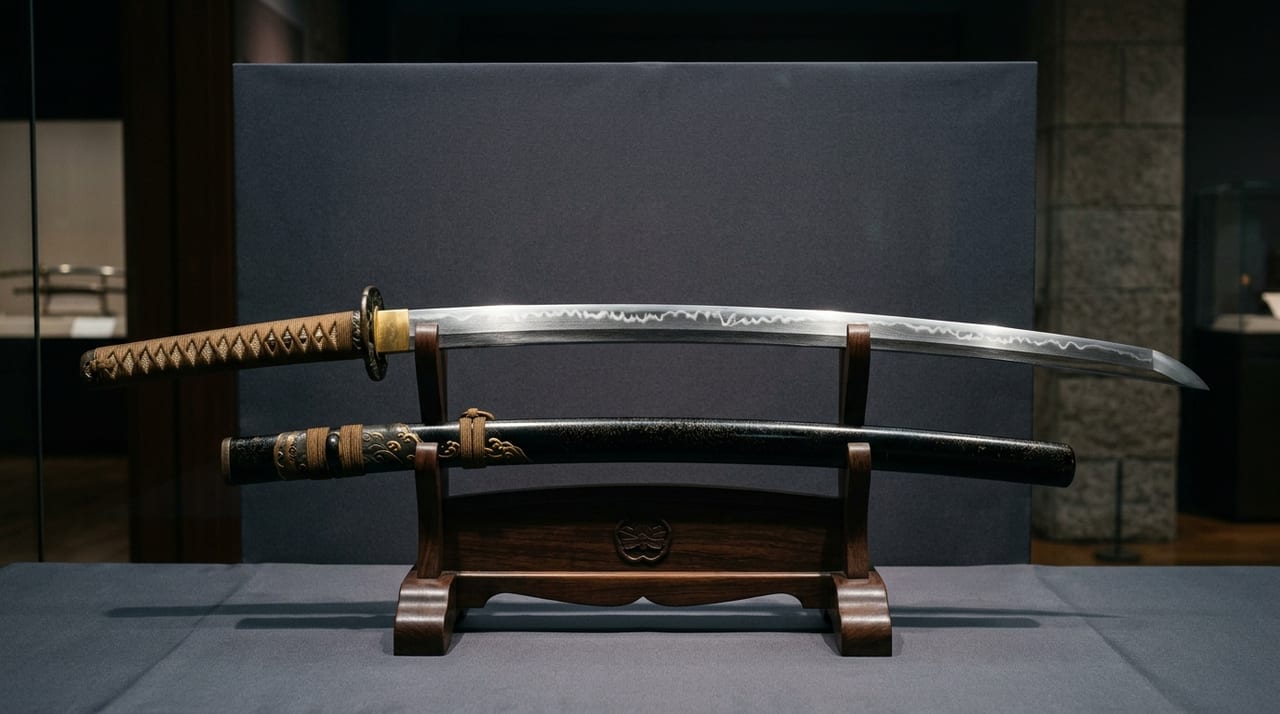
 * Image is for illustrative purposes only.
Fukuoka Ichimonji Yoshifusa Tachi
福岡一文字吉房の太刀
Also known as: Fukuoka Ichimonji — National Treasure Tachi by Yoshifusa, Ichimonji School, Mid-Kamakura Period
Description
Fukuoka Ichimonji Yoshifusa Tachi is a National Treasure tachi forged in the mid-Kamakura period by the swordsmith Yoshifusa (birth and death years unknown) of the Ichimonji school, based in Fukuoka in Bizen Province (present-day Osafune-chō Fukuoka, Setouchi, Okayama Prefecture). The Ichimonji school was a group of swordsmiths active in the Kamakura period, based in Fukuoka in Bizen Province and elsewhere. They were called the Ichimonji school because of the custom of inscribing the character for 'one' (一) in their signatures. The tachi made by Yoshifusa, the representative swordsmith of Fukuoka Ichimonji, display the ideal tachi form, combining the grandeur and grace sought by Kamakura warriors. Several outstanding examples designated as National Treasures or Important Cultural Properties survive.
This tachi is the National Treasure 'Tachi, signed Yoshifusa' (blade length 70.6 cm, curvature 2.7 cm) held by the Tokyo National Museum. It is said to have been possessed by Toyotomi Hideyoshi, then given to Takenokoshi Masanobu, a warrior of Tokugawa Ieyasu, and passed down through that family for generations. Its overall form is a bold build with a strong curve throughout. The base steel consists mainly of fine itame-hada, with mokume mixed into the flowing grain. Utsuri appear clearly, displaying the essence of the Bizen tradition.
The hamon features a splendid chōji-midare, and nie and nioi harmonize exquisitely to create a richly expressive scene within the blade. Fine ashi flow into each part of the chōji-midare, and the boundaries of the hamon change lively. This feature is shared by the greatest masterpieces of the Ichimonji school, and this work is a typical example of it. Yoshifusa is regarded as the most splendid stylist among the Ichimonji school, and there are five tachi designated as National Treasures.
Related Famous Swords
姫鶴一文字
Important Cultural PropertyHimetsuru Ichimonji
Ichimonji School (Bizen)
同田貫正国
Kumamoto Prefecture Important Cultural Property (a Masakuni blade held by Honmyō-ji), among othersDōtanuki Masakuni
Dōtanuki Masakuni (Higo Dōtanuki school)
毛抜形太刀
National Treasure / Important Cultural Property (multiple designated examples)Kenuki-gata Tachi
Unknown (Heian period)
一期一振
Gomotsu (Imperial Collection)Ichigo Hitofuri
Awataguchi Yoshimitsu