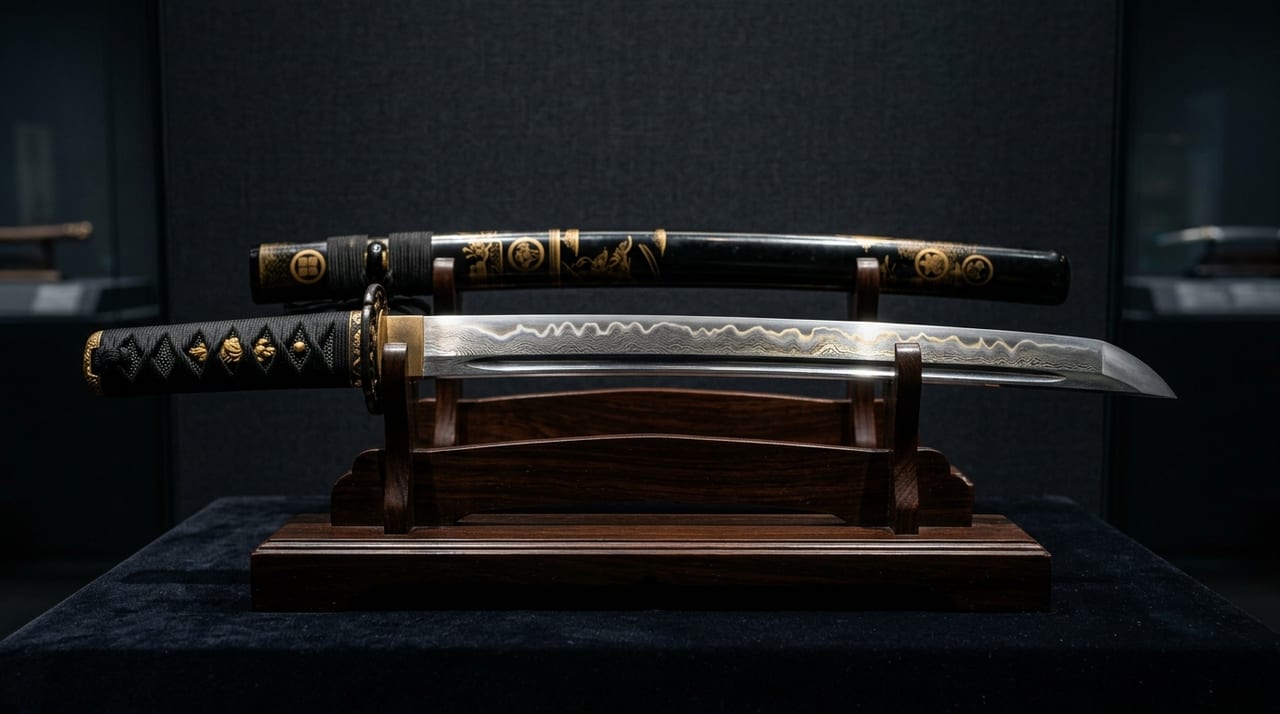
 * Image is for illustrative purposes only.
Daikoku Masamune
大黒正宗
Also known as: Daikoku — Masterwork Tantō by Masamune, Tokugawa Art Museum
Description
Daikoku Masamune is a masterwork tantō forged by Masamune, the progenitor of Sōshū-den, designated an Important Cultural Property and held at the Tokugawa Art Museum. The name "Daikoku" is said to derive either from Daikokuten — the god of fortune who brings prosperity — bestowed during the sword's transmission through the Owari Tokugawa family, or from a figure who wore a distinctive daikoku hood. The sword, now enshrined at the Tokugawa family's museum in Nagoya, is regarded as one of the supreme treasures of Japanese sword history born of the bond between the Tokugawa house and Masamune. Masamune's tantō represent a form in which many of his finest Sōshū-den works survive alongside his longer blades. The typical blade is approximately 24–26 cm in length with an internal curve (uchizori) or flat construction (hira-zukuri), and the compressed presentation of complex steel texture and turbulent hamon within a narrow body creates a distinctive tension and beauty. Daikoku Masamune is no exception: its rich jigane shows intricate itame and ō-itame intermingled, while abundant ji-nie and chikei give the entire blade a quality of glowing from within. The hamon, based on ō-gunome-midare with intense nie, shows kinsuji and sunagashi running in all directions inside and outside the blade, with a vivid yakiotoshi. The Tokugawa Art Museum was established in 1935 by the nineteenth head of the Owari Tokugawa family, Tokugawa Yoshichika (1886–1976), and houses approximately ten thousand masterworks centering on the great daimyo's collection. Daikoku Masamune is counted among the museum's supreme treasures alongside the illustrated Tale of Genji scrolls and wedding trousseau fittings. Regular public exhibitions at the museum make it one of the rare opportunities to observe an authentic Masamune tantō in person.
Legends & Stories
Daikoku Masamune is said to be associated with a mysterious tale of its transmission to the Mogami family. On the New Year's Eve of a certain year, a retainer assigned to maintain Daikoku Masamune in the Mogami family's sword room noticed a low, groaning sound emanating from the sword box. Out of fear, the next morning the retainer called a sword craftsman and opened the box, and the blade — which had shown cloudiness until the previous day — was found to be polished to a mirror finish, with the nie of the blade pattern gleaming brightly. The household believed this to be due to the protection of Daikokuten, and thereafter Daikoku Masamune is said to have come to be treated as an indispensable sacred sword in the Mogami family's year-end and new-year rites. Additionally, as a legend illustrating Masamune's mastery, it is said that the sword fitter who made the koshirae for Daikoku Masamune said, 'Each time I dress this blade, it teaches me the form that is right for itself' — demonstrating a belief in the spiritual autonomy that resides in a great sword.