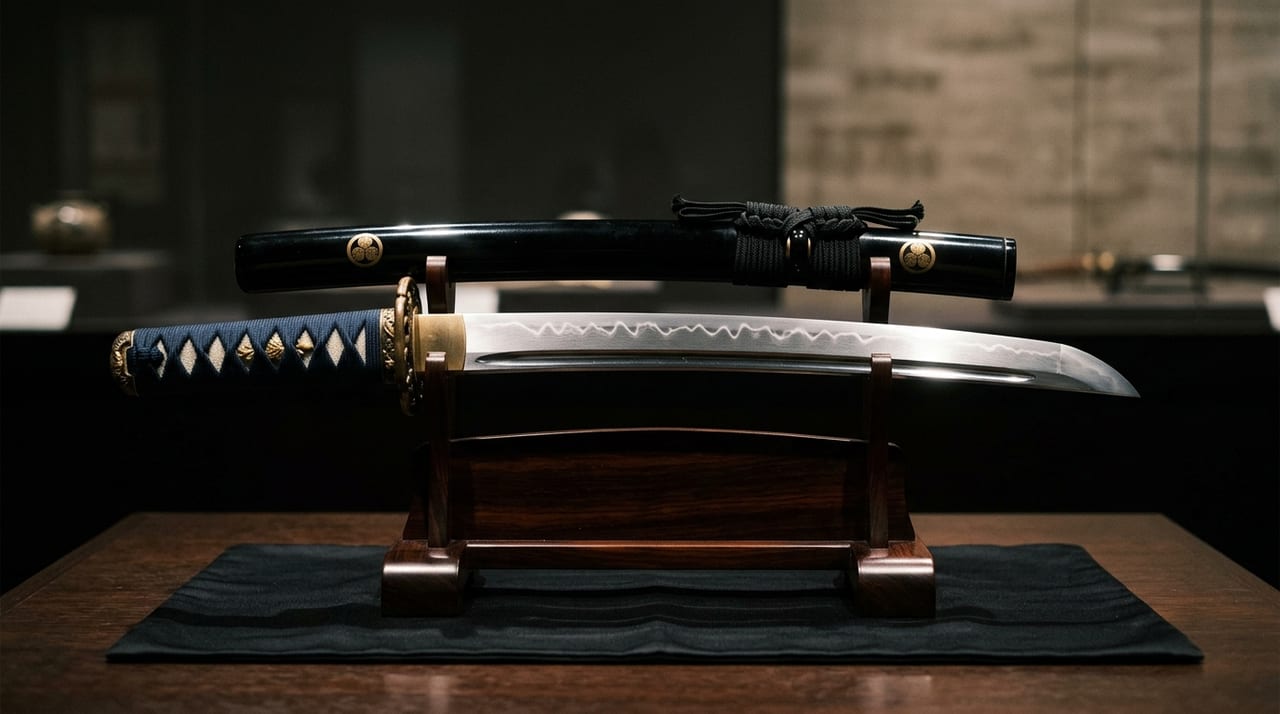
 * Image is for illustrative purposes only.
Chatan Nakiri
北谷菜切
Also known as: Chatan Nakiri — Bewitched Blade of the Ryukyuan Shō Royal House
Description
Chatan Nakiri is a tantō (dagger) handed down in the Shō family, the royal house of the Ryūkyū Kingdom. It is unsigned and of unknown authorship, about 23 cm long, and traditionally dated to around the 15th century. Housed in a lavish lacquered koshigatana mounting inlaid with crushed shell, it is counted, together with Chiyoganemaru and Jiganemaru, among the representative treasure swords of Ryūkyū.
The name and the "vegetable-cutter" tradition
As the name "Nakiri" (vegetable cutter) suggests, the blade is said to have originally been a kitchen knife. It was later reforged into a tantō, and because a lord of the Chatan district owned it, it came to be called "Chatan Nakiri"—an origin reflecting a sword culture unlike that of the Japanese warrior class.
The legend of the bewitched blade
Chatan Nakiri carries an eerie legend, by which it is also called the "bewitched blade Nāchirā." A farmwoman of Chatan is said to have taken up the knife and, without the edge even touching, severed the neck of her own infant. Protesting that she had only made a cutting motion, an official tested it by feinting a cut toward a goat, whereupon the goat's head truly fell. From such tales of "cutting without contact," the blade was handed down as a bewitched sword.
Mounting and form
The blade is preserved in an opulent mounting decorated with raden (mother-of-pearl) inlay of finely scattered shell fragments. The accompanying kozuka (small accessory knife) is sheathed in gold and bears Chinese-style ornament, reflecting Ryūkyū's trade and cultural exchange with the Asian mainland.
Provenance and present location
Chatan Nakiri, with Chiyoganemaru and Jiganemaru, descended through the Shō royal house of Ryūkyū. It was not designated a National Treasure on its own, but in 2006 as part of the "Materials Related to the Shō Family, Kings of Ryūkyū" (1,251 items in total). It is today held at the Naha City Museum of History in Okinawa, at times exhibited together with Chiyoganemaru and Jiganemaru.
Legends & Stories
Chatan Nakiri carries a legend befitting its reputation as a bewitched blade. Long ago in Chatan magiri (the area around present-day Chatan Town, Okinawa), a farm woman was working in the fields with her infant in her arms when, swinging the knife she happened to be holding, she accidentally severed her own child's neck and killed it.
Seized by the authorities, the woman protested her innocence, saying she had "only made a motion of cutting with the knife and had no murderous intent whatsoever." The disbelieving official, to test her claim, swung the same knife at a goat in a mere gesture of cutting — and though the blade never touched it, the goat's head truly fell. By this the woman's innocence was acknowledged, and the knife of dreadful sharpness was reforged into a tantō to ward off further calamity. This, it is said, is the origin of the name Chatan Nakiri.
The blade was handed down through the generations in the Shō royal house of the Ryukyu Kingdom and was counted, together with the Chiyoganemaru and Jiganemaru, among the three treasured swords of the Shō family. These were treasures that may be called symbols of royal authority, precious relics transmitting the history and culture of the Ryukyus to the present day.
These three treasured swords handed down in the Shō house, along with their related materials, were collectively designated a National Treasure as the "Materials Relating to the Shō Royal House of the Ryukyu Kingdom." Chatan Nakiri, with its beautiful shell-inlaid koshigatana mounting, is now housed in the Naha City Museum of History and carefully preserved as a cultural treasure in which Okinawa takes pride.