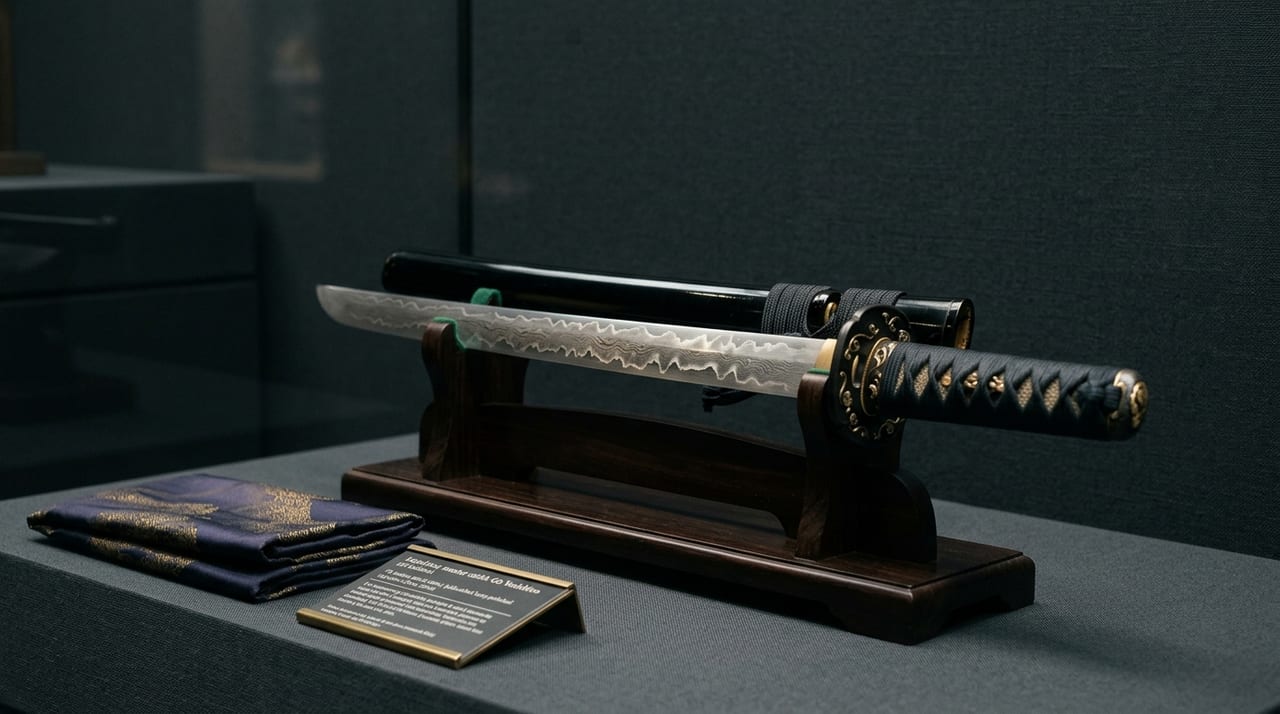
 * Image is for illustrative purposes only.
Buzen-Gō
豊前江
Also known as: Buzen-Gō; the Hosokawa Clan's Gō blade
Description
Buzen-Gō — A Named Blade Attributed to Gō Yoshihiro
Buzen-Gō is a tachi (unsigned) attributed to Gō Yoshihiro and is renowned in sword history as one of the named swords of the "Gō" group, standing alongside such blades as the "Tomita-Gō" of the Maeda clan, lords of Kaga Domain. The name "Buzen" is said to derive from the fact that this blade was once transmitted through the Ogasawara clan, lords of Kokura Domain in Buzen Province. Buzen-Gō was designated as an Important Art Treasure in 1937 (Showa 12), but its location subsequently became unknown; it is currently listed in the Agency for Cultural Affairs' registry of "Missing Nationally Designated Cultural Properties."
Gō Yoshihiro's Work — A Named Blade of Highest Appraisal
Although Gō Yoshihiro's works are known to have left almost no reliably signed pieces, their evaluation has been extraordinarily high since ancient times, and works certified with the Honami family's "Gō authentication" have received the highest appraisal in sword circles. Buzen-Gō, too, has been highly regarded as one such named blade authenticated as a Gō work. Gō Yoshihiro's style is characterized by precise jigane with "small-grain itame tightly packed, fine and uniformly glowing ji-nie, and vibrantly active ji-kei" and a dynamic hamon in which "notare-based irregular blade forms the foundation, with ashi and ha working actively." It embodies an aesthetic world that might be called "stillness within motion" — appearing serene at first glance while concealing intense inner energy.
Status as a Named Blade
"Meibotsu" (named treasures) is a cultural category designating swords, tea utensils, and other objects with illustrious provenance and superior artistic merit, recognized since the Edo period; acknowledgment as a "renowned treasure of the realm" represented one of the highest forms of appraisal for a sword. Buzen-Gō is documented in the meibotsucho (catalogs of named swords) compiled during the Edo period and was recognized as a named blade as a member of the "Gō" group. Within the history of Toyotomi Hideyoshi's patronage of Gō Yoshihiro's works as "renowned treasures of the realm" and his aesthetic judgment's influence on the formation of the "meibotsu" concept in Edo-period sword culture, Buzen-Gō stands as a representative example bearing special cultural authority. Even in its currently missing state, it remains an important cultural property whose rediscovery is anticipated.
Legends & Stories
Hosokawa Yūsai, Hosokawa Tadaoki, and Swords—The Aesthetic of Warriors Uniting Martial and Literary Excellence
Hosokawa Yūsai (Fujitaka) stands as one of the most celebrated embodiments of the "warrior of both brush and sword" (bun-bu ryōdō) during the Sengoku period, whose aesthetic principle was "to select the highest weapon and highest art with the same discerning eye." As the keeper of the secret oral transmission of the Kokinshū (Kokin-denjū), Yūsai held supreme authority in the world of classical Japanese poetry, and possessed such profound devotion to culture that he left behind the anecdote of "remaining in his castle to preserve the Kokin-denjū manuscript" during warfare—the siege of Tanabe Castle. When such a person chose a sword, one can infer that his gaze encompassed both "practical utility for actual use on the battlefield" and "perfection as a work of art." The manner in which a cultured warrior-poet's discerning eye selected the blade of Gō Yoshihiro confers upon this sword a profound significance: "not merely a weapon, nor merely an artwork, but the very quintessence of Japanese culture wherein martial and literary excellence are unified."
Lady Garasha and the Tragedy of the Hosokawa Clan—Where Sword and History Intersect
Hosokawa Tadaoki's wife, Hosokawa Garasha (baptismal name: Garasha; birth name: Tamako), was born the daughter of Akechi Mitsuhide, converted to Christianity, and—facing the approach of the Battle of Sekigahara—took her own life rather than become an enemy hostage, standing as one of the most celebrated women in Japanese history. Her husband Tadaoki, while known as a martial commander, possessed the cultural refinement of being a high disciple of Sen no Rikyū in the tea ceremony, and is transmitted to us as a complex figure who wavered between his deep love for his wife Garasha and the stern code of the samurai. The blade known as Buzen-e, which passed through the hands of those who endured that tumultuous Sengoku age, carries within it "the memories of life and death of those who lived through the upheaval of the Sengoku period," and as a cultural artifact transcends being a mere sword-masterpiece—it possesses the singular narrative weight of being a "witness to the human drama of history."