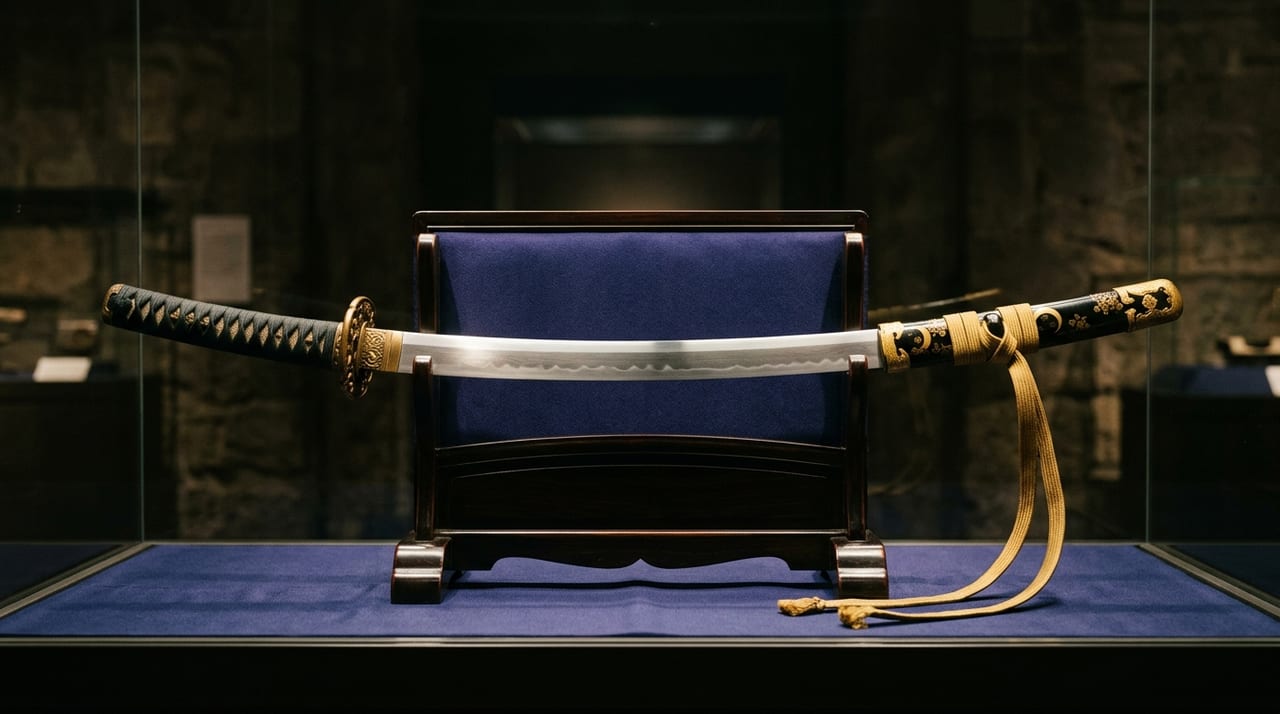
 * Image is for illustrative purposes only.
Tachi by Yukihira of Bungo Province
豊後国行平作太刀
Also known as: Yukihira; Bungo Yukihira
Description
Yukihira—The Oldest Named Swordsmith of Kyushu and Witness to "The Dawn of the Japanese Sword"
Yukihira (行平) is said to have been a swordsmith active during the late Heian period (11th–12th century) in Bungo Province (modern Ōita Prefecture), known by the name "Bungo Yukihira" (豊後行平) or simply "Yukihira," making him among the oldest named swordsmiths in Japanese history. The era in which Yukihira was active was a critical historical turning point when the basic form of the Japanese sword—a curved, single-edged blade (tachi)—was being established, and his works occupy a special place in sword history as the earliest complete examples of this form. Yukihira's tachi, belonging to the earliest categories in the periodization of "jōkotō" (上古刀, ancient swords) and "kotō" (古刀, old swords), are designated as National Treasures or Important Cultural Properties, standing alongside Ko-Bizen Masatsune and Ko-Bizen Tomonari as the most crucial surviving examples witnessing "the birth period of the Japanese sword." The fact that the earliest master swordsmith of the Japanese sword emerged from Bungo Province (Ōita)—a region not widely known today as a sword-making center—demonstrates that the origin of the Japanese sword was not confined to any single region, but rather a phenomenon that occurred simultaneously across various parts of Japan in response to the demands of the Heian period itself.
Stylistic Characteristics of Yukihira Tachi—The Archaic Beauty of the Heian
Yukihira's tachi retain strong characteristics of "Heian archaic style" (Heian koyō, 平安古様), the earliest formal style of the Japanese sword, displaying an aesthetic distinct from the fully developed Japanese swords of the Kamakura period onward. The blade length is relatively long, and the curve is characterized by koshi-zori (腰反り)—curvature concentrated near the base of the blade—a distinctive feature that sets it apart from the "naka-zori" (中反り, center curvature) and "saki-zori" (先反り, tip curvature) of the Kamakura period and later. The jigane (地鉄, steel surface) is based on itame (板目, wood-grain pattern), and the hamon (刃文, edge pattern) consists primarily of suguha (直刃, straight) or gentle komidare (小乱れ, small undulating) forms; though simpler than the complex hamon of later periods, this simplicity is praised as embodying "the pure aesthetic sensibility of the Japanese sword's formative period." The tang (茎, nakago) exhibits a form close to the distinctive "haagari kurijiri" (刃上り栗尻, blade-widening chestnut-butt) style unique to the Heian period, making Yukihira's corpus an indispensable reference point for understanding "the earliest formal phase of the art of the Japanese sword," and thus holding the highest importance in sword scholarship.
Bungo Province and the Origin of the Japanese Sword—The Lineage of Sword Forging in Kyushu
Bungo Province (豊後国, modern Ōita Prefecture) has long been known as a region possessing high-quality iron resources, and it is believed that "Bungo iron" received considerable acclaim during the Heian period when Yukihira was active. Regarding the origin of the Japanese sword, various theories exist—including "Yamato" (大和, Nara), "Yamashiro" (山城, Kyoto), and "Bizen" (備前, Okayama)—and the question of which represents "the first center of Japanese sword manufacture" remains a contentious theme in sword scholarship; yet the existence of Yukihira's surviving works clearly demonstrates that "high-level swordsmiths were already active in Kyushu and Bungo during the Heian period." The history of sword forging in Bungo after Yukihira is understood as "the tradition of Kyushu swordsmiths beginning with the foundational figure of Yukihira," and Yukihira occupies a special position as the starting point of Kyushu sword history, with outstanding swordsmiths continuing to flourish across Kyushu—in Bungo, Higo (肥後), and Chikuzen (筑前)—until the Edo period.
National Treasure Designations of Yukihira Tachi—The Beauty Revealed by Japan's Oldest Master Blades
Multiple surviving works by Yukihira bear the designation "National Treasure" (国宝, Kokuhō), demonstrating that Yukihira's works have received the highest evaluation in Japan's cultural property administration as the oldest complete form of the Japanese sword. Well-known examples of Yukihira's National Treasure tachi include the "Tachi with Signature 'Bungo Yukihira'" held in the Tokyo National Museum and the National Treasure "Tachi of the Kogo Denzū" (古今伝授の太刀) in the Eisei Bunko collection, each highly regarded as a masterwork of the earliest period of the Japanese sword. The "quietness of Heian archaic style" emanating from Yukihira's National Treasure tachi—with neither complex hamon nor imposing form, but rather a serene perfection of "simply being correct as a sword"—creates a unique aesthetic world distinct from the "tension between strength and beauty" characteristic of renowned blades from the Kamakura period onward. This "silence before dawn"-like quality makes these works the purest embodiment of "antiquity" as an aesthetic value in Japanese sword appreciation, earning them special reverence among lovers of old swords (kotō).
The Cultural Position of Yukihira—The Literary Resonance of the Name
The name "Yukihira" carries another important significance in the Japanese cultural context. Ariwara no Yukihira (在原行平, 818–893), a Heian-period poet and elder brother of Ariwara no Narihira, is remembered for poems such as "Wakainu reba / Koromo tatakiru / Natsu no yo wa / Mada yoi nagara / Akenu ru mono wo" (not knowing dawn / do sleeves cling wet? / summer's night— / still but evening— / already morning breaks), and the name "Yukihira" is deeply bound to the world of refined Heian literature. The fact that the swordsmith Yukihira and the poet Ariwara no Yukihira were active during the same era (the Heian period) is sometimes discussed as representing "two Yukihiras born of the Heian age—the Yukihira of poetry and the Yukihira of blades," and the name "Yukihira" carries special resonance in Japanese cultural history as embodying two seemingly contrasting aspects of Heian culture: the delicacy of waka poetry and the sharpness of the sword.
Legends & Stories
Yukihira's surviving blades carry a quality that no later masterwork, however brilliant, can replicate: they are witnesses to a beginning. When we look at a blade by Mikazuki Munechika or Dōjigiri Yasutsuna — the supreme masterpieces of late Heian and early Kamakura swordmaking — we are looking at the apex of a tradition that had already reached self-awareness of its own formal possibilities. When we look at a Yukihira tachi, we are looking at that tradition in the moment before self-consciousness arrived, when the form was still discovering itself, when the curve of the blade and the simplicity of the hamon had the freshness of something being done for the first time. This 'archaic style' (koyō) is not a failure to achieve what came later; it is the expression of a different relationship between maker and form — an intimacy with the pure logic of the blade before that logic had been elaborated into the dazzling complexity of the Bizen, Yamashiro, or Sōshū traditions. That such blades survived at all across nine centuries of warfare, fire, flood, and social upheaval is remarkable enough. That several of them survive in condition sufficient to be designated National Treasures — the highest category of cultural preservation in Japan — is a kind of historical miracle. Yukihira of Bungo stands at the threshold of Japanese sword history as the smith who, somewhere in the hills of ancient Ōita, helped give definitive form to an object that would become Japan's most distinctive contribution to the world's traditions of edged weapons.