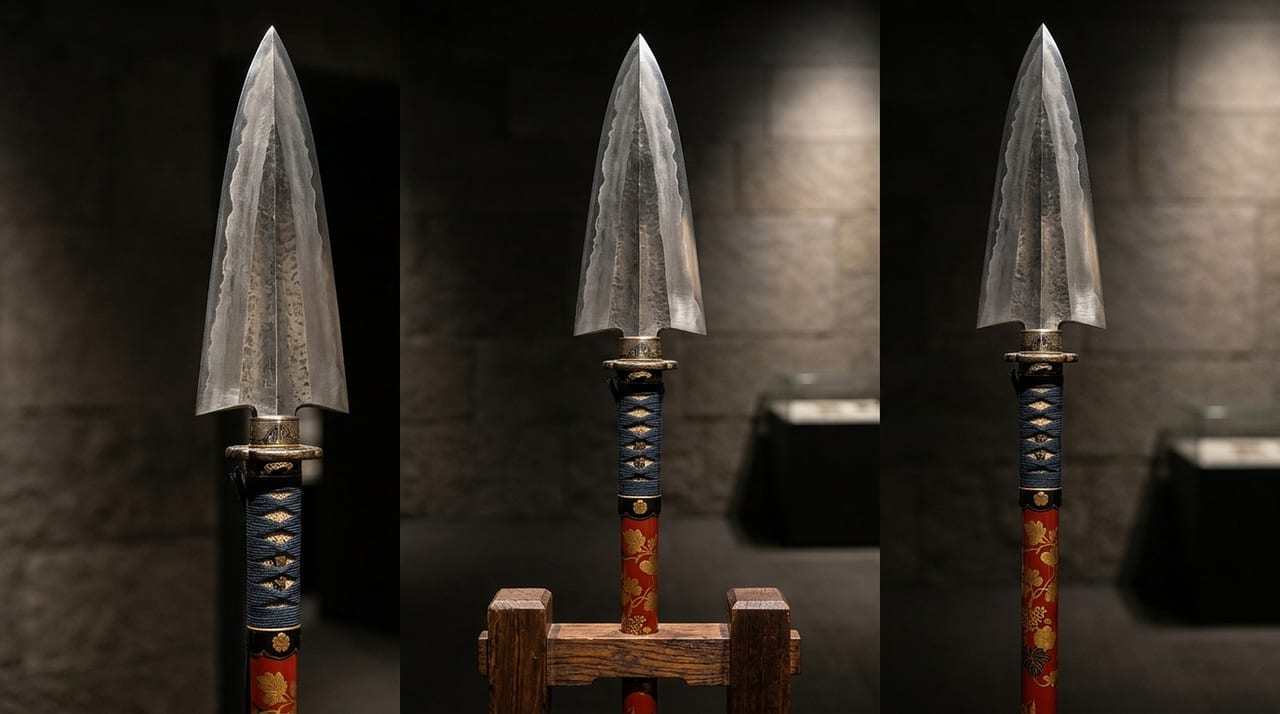
 * Image is for illustrative purposes only.
Azamaru
あざ丸
Also known as: Azamaru; Wakizashi, mumei (unsigned)
Description
Azamaru (Wakizashi, mumei) is an unsigned wakizashi believed to have been made from the late Heian period to the Kamakura period. It is designated an Aichi Prefecture Designated Tangible Cultural Property and is held and dedicated at Atsuta Jingū in Nagoya, Aichi Prefecture.
The blade is an ō-suriage unsigned blade, 54.7 cm long with a curvature of 1.5 cm, and is considered to be in the Bizen tradition. There are various theories regarding its maker, including Sukehira, Kanehira, Masatsune, Moritsune, and Monju, and it has not been confirmed to this day.
As for its provenance, it is said that Fujiwara no Kagekiyo (Taira no Kagekiyo), a Taira warrior, used it as his carried sword, after which it was dedicated to Atsuta Jingū, but it passed into the hands of Senshū Suemitsu, the ōgūji (chief priest) of Atsuta Jingū. When Suemitsu was killed in battle, Kageyama Kazukage, a general of the Saitō side, acquired it, and it then came into the possession of Niwa Nagahide, a retainer of Oda Nobunaga. Niwa Nagahide again dedicated this wakizashi to Atsuta Jingū, and since then it has been handed down from generation to generation as a treasure of the shrine.
The name Azamaru has two proposed origins. The first is the theory that Fujiwara no Kagekiyo used this wakizashi as a substitute for a mirror, looking at the mark on his face through it, and the mark disappeared. The second is the theory that near the habaki of the blade there is a black, mark-like part that did not disappear no matter how many times the blade was reground. Which is correct is not certain.
Atsuta Jingū is known as a sacred site connected with swords, enshrining the Kusanagi no Tsurugi, and since ancient times many famous swords have been dedicated there. Azamaru has been transmitted to Atsuta Jingū to the present day as one of those swords.
Legends & Stories
Azamaru is said to have brought misfortune to its owners in succession. According to the Shinchō Kōki, Senshū Suemitsu of the Atsuta Jingū head-priest family, who fought on the Oda side at the Battle of Kanōguchi, used this Azamaru as a wakizashi and was killed in battle. Soon after, Kageyama Kazukage of the Saitō side, who obtained it, had his left eye shot through by an arrow fired by the castle side while in camp near Ōgaki Castle, and then his right eye was shot through as well.
After that, Niwa Nagahide, who obtained Azamaru, also came to suffer from an eye disease, and when he dedicated it to Atsuta Jingū following the advice of the people around him, he is said to have stopped suffering from the eye disease.
Azamaru, along with Kagekiyo, appears often in stories. In the Noh play Daibutsu Kuyō and the kōwakamai Kagekiyo, Kagekiyo uses this sword in the scene where he attacks Minamoto no Yoritomo.