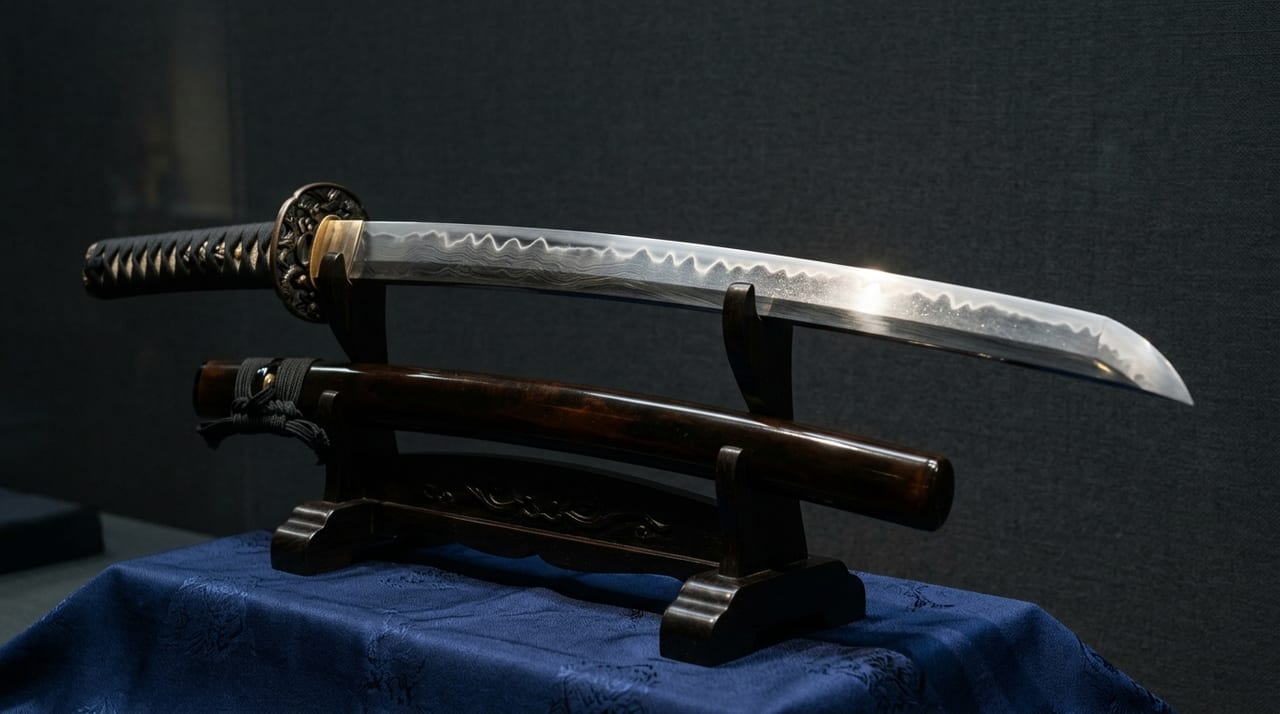
 * Image is for illustrative purposes only.
Ayanokoji Sadatoshi
綾小路定利
Also known as: Tachi signed Sadatoshi; Ayanokōji Sadatoshi
Description
Who Was Ayanokōji Sadatoshi
Sadatoshi was a swordsmith of Yamashiro Province in the Kamakura period, called Ayanokōji Sadatoshi because he lived on Ayanokōji street in Kyoto. He is traditionally held to have flourished around the Bun'ei era (1264-1275), yet his workmanship displays features of the earlier Kamakura period, and his dates have long been debated. The Ayanokōji school prospered in Yamashiro from the early to mid-Kamakura period and is distinguished by graceful tachi shapes and finely worked steel.
The National Treasure "Tachi Signed Sadatoshi"
The tachi signed Sadatoshi held by the Tokyo National Museum measures 78.7 cm in blade length with a curvature of 3.0 cm. It was designated a National Treasure on 9 June 1951. It is regarded as Sadatoshi's representative work and as a benchmark piece for understanding the Ayanokōji school.
Workmanship
The blade is of shinogi-zukuri construction with an iori ridge, showing the high waist curvature and strong taper characteristic of an early Kamakura tachi. The ground is a tightly packed ko-itame with fine ji-nie. The temper pattern is a ko-midare of ko-nie deki with a deep nioi mouth, mixed with choji, with ashi entering frequently. Alongside contemporary Yamashiro work by the Awataguchi and Rai schools, it possesses the refinement and dignity particular to Kyoto blades.
Position within the Yamashiro Tradition
Yamashiro was a great centre of swordmaking where the Awataguchi, Rai, Ayanokōji and Sanjo schools competed, and the Ayanokōji school is known for retaining archaic features. Because surviving works by Sadatoshi are few, this National Treasure is also a valuable document for the study of the Yamashiro tradition.
Legends & Stories
The name Ayanokōji derives from the forge Sadatoshi maintained on Ayanokōji street in Kyoto. Although tradition places him in the Bun'ei era, his workmanship shows the shape of a generation earlier, in the early Kamakura period. Connoisseurs have therefore long debated whether Sadatoshi was a single smith or several generations working under the same signature.
Related Famous Swords
姫鶴一文字
Important Cultural PropertyHimetsuru Ichimonji
Ichimonji School (Bizen)
同田貫正国
Kumamoto Prefecture Important Cultural Property (a Masakuni blade held by Honmyō-ji), among othersDōtanuki Masakuni
Dōtanuki Masakuni (Higo Dōtanuki school)
毛抜形太刀
National Treasure / Important Cultural Property (multiple designated examples)Kenuki-gata Tachi
Unknown (Heian period)
一期一振
Gomotsu (Imperial Collection)Ichigo Hitofuri
Awataguchi Yoshimitsu