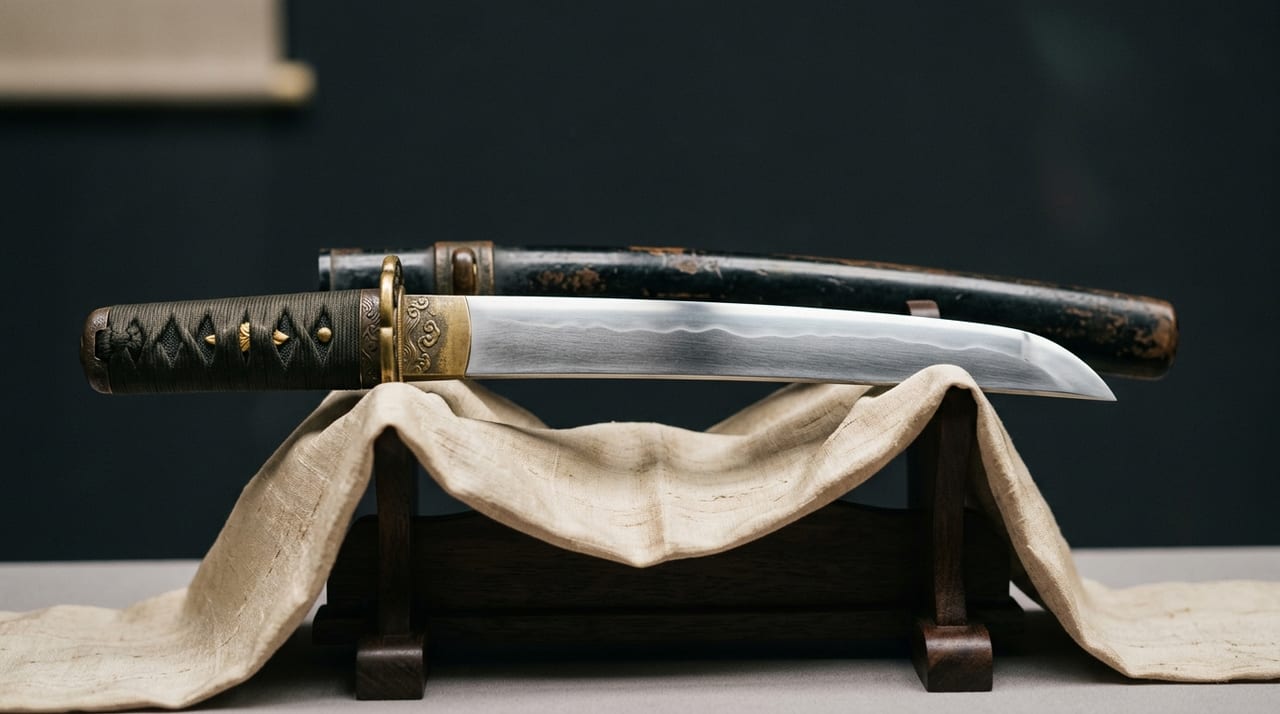
 * Image is for illustrative purposes only.
Awataguchi Yoshimitsu Tantō
粟田口吉光短刀
Also known as: Yoshimitsu; Japan's Greatest Tantō Master; Incomparable Kamakura Tantō
Description
Overview of the Blade
Awataguchi Yoshimitsu (粟田口吉光), known by his common name Tōshirō Yoshimitsu, was a swordsmith active in the Mid-to-Late Kamakura period (second half of the 13th century) in Awataguchi, Yamashiro Province (present-day Higashiyama Ward area, Kyoto). He is universally regarded as the greatest tantō maker in Japanese sword history and has maintained an unwavering reputation for a millennium. The Awataguchi school was one of the representative swordsmithing groups of Yamashiro Province. Six brothers—Kunitomo, Hisakuni, Kuniyasu, Arikuni, Kunikiyo, and Kunitsuna (sons of Awataguchi Kuniie)—rose together in the Early Kamakura period. In the Mid-Kamakura period, Yoshimitsu of the succeeding generation emerged and, as the apex of the Awataguchi school, rendered the school's renown eternal. Yoshimitsu's true name was "Tōshirō Yoshimitsu" (藤四郎吉光), and from his common name "Tōshirō," his tantō came to be known as "Tōshirō-mono" (藤四郎もの), treasured throughout history as the supreme short blades ever created. Extant works by Yoshimitsu are overwhelmingly dominated by tantō, multiple examples of which have been designated National Treasures and Important Cultural Properties.
Yoshimitsu's Artistic Style and Technical Characteristics
The defining features of Yoshimitsu's tantō are the luminous transparency of the jigane and the serene, refined suguha hamon. The jigane displays uniformly packed ko-itame with fine, homogeneous jigoke, gleaming with crystalline clarity like a polished steel mirror. This jigane quality is the hallmark of the Awataguchi school, yet in Yoshimitsu it reached its supreme pinnacle. The hamon is based on suguha, displaying a restrained and dignified appearance interspersed with subtle irregular patterns. The nioi-guchi is tightened with brightness and clarity, while the nie settles uniformly with refined fineness. The bōshi is small and round, returning with utmost elegance. The tang typically bears the unpolished surface, signed "Yoshimitsu" or "Tōshirō Yoshimitsu." Overall, Yoshimitsu's tantō embodies "pure beauty stripped of all excess," wherein infinite depth dwells within quietude.
The Establishment of the Tantō Form
The Mid-Kamakura period in which Yoshimitsu flourished was an era when the tantō became an indispensable part of samurai daily life. From the preceding age dominated by the tachi, demand grew for lightweight, portable short blades, and Yoshimitsu established a new aesthetic standard for tantō production. Yoshimitsu's tantō transcended mere practical function as weapons, becoming instead symbols of samurai cultivation and aesthetic discernment. The concept that "the greatest samurai possessed the greatest Yoshimitsu" was widely shared among Kamakura samurai society, and owning a Yoshimitsu tantō became the highest badge of samurai honor.
Yoshimitsu's Tachi
Yoshimitsu is said to have produced tachi in addition to tantō, though signed extant examples are extremely rare. One theory suggests that as demand in Yoshimitsu's later years shifted from tachi to tantō, he devoted himself exclusively to tantō production. Nevertheless, "Yoshimitsu tachi" are said to have existed, and their legendary rarity has added further mystique to his name.
Yoshimitsu Tantō as Tennō Meibutsu (Named Treasures of the Realm)
The Tokugawa shogun house's "Kyōhō Meibutsucho" (Register of Famous Objects) records numerous works by Yoshimitsu. Named pieces—"Ichigo Hitofuri," "Hirano Tōshirō," "Fudō Yukimitsu," and many others—form the most celebrated group of short blades in sword history. These named tantō passed through the hands of the Ashikaga shoguns, Toyotomi Hideyoshi, and the Tokugawa shoguns—the supreme power-holders of successive eras—and continue to be regarded as the pinnacle of Japanese swords in the present day.
Transmission to the Modern Era
Today, Yoshimitsu tantō are preserved in the Tokyo National Museum, various shrines and temples, and samurai-related museums throughout Japan, with regular public exhibitions. The popularity of characters in the game "Touken Ranbu" based on Yoshimitsu's named pieces such as "Ichigo Hitofuri" and "Hirano Tōshirō" demonstrates his continued high reputation and appeal in modern times. Even after seven centuries, Awataguchi Yoshimitsu, revered as the supreme tantō maker, stands at the eternal apex of Japanese sword culture.
Yoshimitsu's Aesthetics and Influence on Japanese Culture
The aesthetic of "completeness within quietude" that Yoshimitsu's tantō embodies resonates profoundly with the broader aesthetic ideals of Japanese culture. The spirit of wabi-sabi in the tea ceremony, the stillness-in-motion of Noh theatre, the beauty of negative space in haiku—Yoshimitsu's tantō represents the highest realization in metal of this "pure beauty lacking nothing and exceeding nothing" that underlies all these forms. The impact of Yoshimitsu's blades on later artists and craftspeople is beyond measure. The tantō aesthetic established by master craftsman Yoshimitsu in the Kamakura period continues to influence a broad spectrum of creative endeavors, from digital art to traditional craftsmanship, seven centuries hence. Awataguchi Yoshimitsu—the supreme artist produced by Japanese sword culture—will have his name perpetuated for eternity. The annular accumulations visible in the jigane of Yoshimitsu's tantō stand as testimony to a master's lifelong dedication, and the fact that such blades retain their radiance undiminished seven centuries later attests to the extraordinary sophistication of Japan's sword-forging technology. Those who stand before a Yoshimitsu blade experience direct contact with historical profundity, sensing through their being the continuity and spiritual abundance of Japanese culture. Yoshimitsu's achievement—condensing the universe within the small form of the tantō—transcends the realm of craftsmanship, standing as an artistic accomplishment and the pride of Japanese culture. His legacy will endure eternally.
Legends & Stories
The Tōshirō Legend—The Soul Dwelling in the Blade
The most famous legend surrounding Awataguchi Yoshimitsu is that his tantō, once they came into the hands of an owner, would forge a profound bond with that person. It is said that Toyotomi Hideyoshi, who reigned as ruler of all Japan, was devoted to Yoshimitsu's tantō throughout his life, and there is an anecdote claiming he declared: "All the treasures of heaven and earth are mine, yet only the tantō of Yoshimitsu were gifts from heaven—the greatest treasure bestowed upon me." The famous Yoshimitsu blades in Hideyoshi's possession—the tachi Ichigo Hitofuri and the tantō Hirano Tōshirō and Hakata Tōshirō, among others—all bear Hideyoshi's name in their provenance, testifying to how deeply the man who wielded Japan's greatest power treasured the works of Japan's greatest sword smith. After Hideyoshi's death, these tantō were inherited by Hideyori and Tokugawa Ieyasu, and some are said to have perished in the flames during the Osaka Campaign (1615), yet those that survive all possess miraculous histories.
Ichigo Hitofuri and the Fall of the Toyotomi
Among Yoshimitsu's renowned tantō, the "Ichigo Hitofuri" possesses the most dramatic history. This tachi was known as Toyotomi Hideyoshi's beloved blade and was scorched in the flames when Osaka Castle fell during the Summer Campaign of the Osaka Siege in Keichō 20 (1615). The Kyōhō Meibutsu-chō records that it was later re-edged by Echizen Yasusuke, the first official smith of the Tokugawa house, and shortened from 2 shaku 8 sun 3 bu to 2 shaku 2 sun 3 bu, with its mei repositioned on the tang. The Ichigo Hitofuri is today held in the Imperial Household Agency's collection as an imperial treasure and is carefully preserved as a treasure of the imperial house. The Ichigo Hitofuri, which passed through the flames of Osaka Castle and has come down to the modern age, is spoken of as a symbol of the supernatural vitality possessed by Yoshimitsu's tantō.
Yoshimitsu and the Sōshū-den—Influence and Lineage
Awataguchi Yoshimitsu's techniques exerted profound influence on sword smiths of later generations. In particular, Masamune, the master smith of the Sōshū-den who was active from the late Kamakura period through the Nanboku-chō period, is said to have received profound influence from the beauty of Yoshimitsu's jigane. The technical hallmarks of the "Sōshū-den" established by Masamune, Sadamune, and Yukimitsu—thick ji-nie with elaborate hamon displaying kinsuji and inazuma patterns—achieved the fullest expression of the Japanese blade's possibilities when contrasted with Yoshimitsu's "serene beauty of the straight edge." The dynamic Sōshū-den and the serene Awataguchi represent two poles that encompass all later Japanese sword aesthetics. The tantō aesthetics pioneered by Yoshimitsu were inherited by the tantō of Masamune, Sadamune, and Yukimitsu, forming one of the foundations of Japanese blade culture during the golden age of the Kamakura and Nanboku-chō periods.
The Kyōhō Meibutsu-chō and the Establishment of Yoshimitsu's Reputation
The Kyōhō Meibutsu-chō, compiled during the Kyōhō era (1716–1736) under the order of Tokugawa Yoshimune, is the official register of celebrated Japanese swords recognized by the Edo shogunate. Among the blades recorded in this meibutsu-chō, Awataguchi Yoshimitsu's tantō hold the distinction of appearing most frequently, demonstrating Yoshimitsu's overwhelming esteem in Edo-period sword appraisal. Honami Kōetsu and successive generations of sword appraisers alike ranked the Tōshirō tantō as "supreme in all the realm," and Yoshimitsu's name became established throughout the Edo period as the absolute standard for Japanese tantō.
The Modern Rediscovery of Yoshimitsu
When the digital game Touken Ranbu was released in 2015, the famous tantō associated with Yoshimitsu were brought to life as characters, introducing Yoshimitsu's legacy to a new generation of sword enthusiasts. Characters bearing the names Ichigo Hitofuri, Hirano Tōshirō, Hakata Tōshirō, and Gotō Tōshirō were portrayed with vivid personalities, successfully conveying the historical context of each blade through the medium of gaming. This phenomenon resulted in increased attendance at exhibitions, and whenever Yoshimitsu's tantō are displayed as National Treasures or Important Cultural Properties, crowds form long queues. The miracle of a master craftsman's technique from a thousand years ago finding new life through modern popular culture eloquently testifies to the enduring cultural vitality of Yoshimitsu's blades.
Yoshimitsu's Legacy and the Future of Tantō Culture
The tantō aesthetics established by Awataguchi Yoshimitsu in the Kamakura period continue to function in the modern age as the supreme standard for Japanese blade appreciation. Sword enthusiasts throughout Japan regard Yoshimitsu's tantō as the ideal, scholars analyze Yoshimitsu's technique scientifically, and contemporary smiths pursue Yoshimitsu's aesthetics—this chain of cultural endeavor keeps Yoshimitsu's legacy alive and vital. When one contemplates a Yoshimitsu tantō directly, one can only fall silent before a serene beauty and commanding presence that transcend verbal explanation. The luster of Yoshimitsu's work, unfaded after seven centuries, stands as an eternal testament to both the creative depth of Japanese culture and one genius smith's perfect fusion of technique and beauty. The fact that Yoshimitsu's tantō remain carefully preserved, studied, and appreciated as National Treasures is proof of how deeply Japan cherishes and accepts responsibility for its cultural heritage. The name Awataguchi Yoshimitsu will continue to be spoken as the paramount proper noun in the history of Japanese blade culture. Yoshimitsu's achievement in realizing supreme beauty in the tantō—a form smaller and less conspicuous than the tachi—perfectly embodies the core of Japanese aesthetics: that true beauty lies not in size or ostentation, but in inner depth.