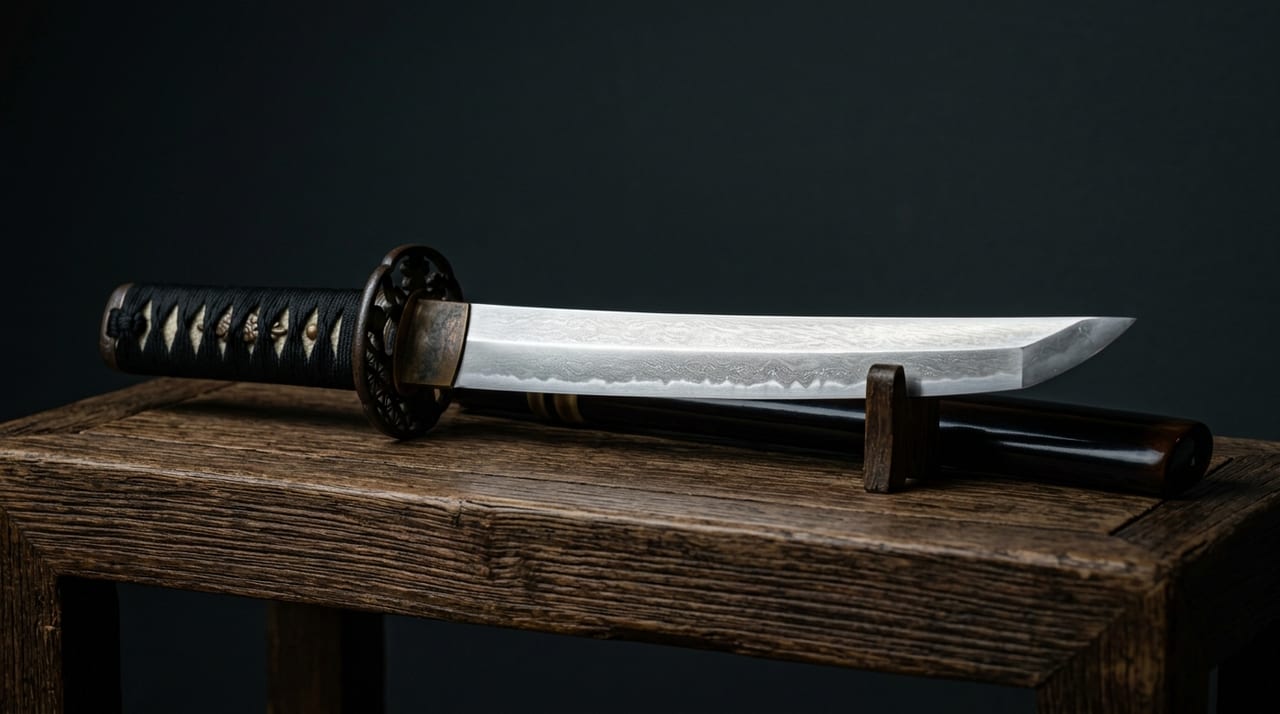
 * Image is for illustrative purposes only.
Awataguchi Kuniyoshi
粟田口国吉
Also known as: Awataguchi Kuniyoshi; Supreme Master Before Yoshimitsu; Prized Sword of the Imperial Household
Description
Overview of the Sword
Awataguchi Kuniyoshi (粟田口国吉) was a renowned swordsmith who flourished in Kyoto's Awataguchi district during the early to mid-Kamakura period, highly evaluated as a master of tantō who demonstrated the highest technical standards of the Awataguchi school. Kuniyoshi was a swordsmith of the generation following the Six Brothers of Awataguchi (Kunitomo, Hissakuni, Kuniyasu, Arikuni, Kunikiyo, and Kunitsuna, sons of Awataguchi Kunietsu), was said to be the son of Norikuni, and belonged to a different generation from the later Yoshimitsu (Tōshirō Yoshimitsu). Among his representative works is the uchigatana "Naki-Kitsune" (Crying Fox), designated as an Important Cultural Property and held by the Tokyo National Museum, known for its rare Kamakura-period form.
The Awataguchi School and Kyoto's Sword Culture
The Awataguchi school was a group of swordsmiths who lived in Awataguchi in eastern Kyoto (now Higashiyama Ward, Kyoto) from the late Heian period through the Kamakura period, representing one of the most important schools of the Yamashiro tradition. Awataguchi was a strategic transportation hub where the Tōkaidō and Tōsandō roads passed, and served as the eastern gateway to Heian-kyō, frequented by many travelers. Swordsmiths gathered in this location due to the ease of obtaining materials such as iron, charcoal, and water, as well as proximity to the finest patrons—the court nobility and samurai of the capital. Awataguchi swords, as exemplars of the Yamashiro tradition, were characterized by finely packed grain, refined yet restrained blade patterns, and refined proportions, embodying Kyoto's sophisticated aesthetic sensibility.
Kuniyoshi's Style and Technique
Awataguchi Kuniyoshi's works were characterized by the fine, densely packed ko-itame grain distinctive to the Awataguchi school, and refined hamon mixing straight blade with subtle undulations. With fine jinie covering the surface, the "Awataguchi skin" radiates a white, bright luminosity, conveying to the viewer an impression of limpid clarity and high dignity. When compared to the later Yoshimitsu's tantō, Kuniyoshi's works present a simpler and more refined impression, and are evaluated as embodying "Kyoto's simplicity and elegance" particularly within the aesthetic of the Awataguchi school. The steel grain, hamon, and overall form are highly valued in sword appreciation as works embodying the Awataguchi ideal.
The Essence of the Yamashiro Tradition and Awataguchi's Aesthetic Sensibility
The Yamashiro tradition is known as the most urban and refined school among the five sword traditions of Japanese blades. Born in Kyoto, the political and cultural center, the Yamashiro tradition possessed a unique aesthetic sensibility—neither the splendor of the Bizen tradition nor the grandeur of the Soshu tradition, but rather what might be called "depth within stillness." The Awataguchi school, as the purest embodiment of this Yamashiro tradition, refined to the utmost three elements: the fine luminosity of the steel grain, the refined stillness of the hamon, and the symmetry of the overall form. In particular, the "Awataguchi skin," where white, fine jinie subtly illuminates the whole surface, possesses a mysterious charm that calms the viewer's heart and seems to evoke Zen-like meditation.
Tantō Culture of the Kamakura Period and Kuniyoshi
The early Kamakura period was an important era in the development of Japanese swords, marking the transition from an age when the tachi was the primary form to a period when the tantō, a small personal sword, began to increase in importance as a warrior's portable weapon. Awataguchi Kuniyoshi occupied an excellent position in tantō production during this era, and is evaluated as a swordsmith who laid the technical and artistic foundation for the later perfection of the tantō by Yoshimitsu. Although Kuniyoshi's tantō are works from the early Kamakura period, they already demonstrate the high technical skill of the Awataguchi school, giving glimpses of their remarkable level of completion.
Legends & Stories
The Six Awataguchi Brothers – Early Kamakura Masters
The Six Awataguchi Brothers—Kunitomo, Kyūkuni, Kuniyasu, Yūkuni, Kunikiyo, and Kunitsuna—are known as a rare phenomenon in Japanese sword history: the emergence of six accomplished masters from the same family during the early Kamakura period. While each brother possessed his own distinctive character and high technical mastery, they shared a common aesthetic: the beauty of the jigane steel known as "Awataguchi-hada" and the elegance of refined hamon blade patterns. The youngest, Kunitsuna, is said to have left works approaching "the oldest known signed Japanese swords," and the collective excellence of all six is regarded as a miraculous achievement during the dawn of Japanese sword-making in the Kamakura era. This phenomenon—an entire family reaching the pinnacle of technique—reveals that Awataguchi functioned beyond mere geography as a "sacred site" of Japanese sword culture. Among these six brothers, Kuniyoshi excelled particularly in the tantō (short sword) and holds special historical significance as a bridge to the great master Yoshimitsu who followed.
Imperial Context – The Emperor and the Sword
In Japan, the imperial household has maintained a special relationship with swords since ancient times. Just as the mystical sword Kusanagi figures among the Three Imperial Regalia as a foundation of imperial authority, the sword is inextricably bound to the legitimacy of imperial rule. The imperial household's possession of the finest tantō by Awataguchi Kuniyoshi is not merely the collection of a work of art, but an act of maintaining and embodying the relationship between the imperial family and the sword—a core element of Japanese culture itself. Though the precise circumstances by which Kuniyoshi's tantō entered the imperial court remain unclear, the fact that the Awataguchi school, as a body of smiths in Heian-era Kyoto, maintained deep ties with the imperial house provides substantial basis for its transmission to the palace.
The Opening of Sannomaru Shōzōkan and the Public Display of Kuniyoshi's Tantō
In 2023, the Sannomaru Shōzōkan was completely renovated and newly opened adjacent to the Higashigyoen (East Garden) of the Imperial Palace in Tokyo. This museum, managed by the Imperial Household Agency and housing the imperial family's artworks and cultural properties, stands as one of the nation's most important repositories of cultural heritage. Kuniyoshi's tantō receives special treatment among its holdings as a work of particular distinction. While the Imperial Household Agency's collections were once limited in public access, the opening of Sannomaru Shōzōkan has enabled the nation's citizens to encounter these National Treasures and Important Cultural Properties more broadly. Those who have viewed Kuniyoshi's tantō experience a moment when they catch their breath before its brilliantly white, crystalline jigane and its austere hamon—an experience that transcends mere artistic appreciation. It is a moment when the weight of a thousand years of culture concentrates and radiates from a single short blade.
The Inheritance from Yoshimitsu – Continuity in Awataguchi Aesthetics
About a generation after Awataguchi Kuniyoshi, the great master Awataguchi Yoshimitsu (Tōshirō Yoshimitsu) appeared, inheriting and then elevating to new heights the techniques and aesthetic sensibilities of the Awataguchi school established by Kuniyoshi and his predecessors. The white radiance and austere beauty of the "Awataguchi-hada" seen in Kuniyoshi's tantō would be further refined and deepened in Yoshimitsu's celebrated masterworks such as the Atsushi Tōshirō and Ichigo Hitofuri. By viewing the works of these two masters side by side, one can directly experience how the Awataguchi aesthetic achieved both continuity and evolution across generations. The relationship between Kuniyoshi and Yoshimitsu most clearly demonstrates that the beauty of the Japanese sword is not the flash of isolated genius but rather an accumulation of technique and aesthetic sensibility inherited across generations.
The Weight of National Treasure Status – Experience Beyond Legal Designation
The designation as a National Treasure is at once a legal classification and a social and spiritual affirmation that the work is essential to Japan's culture and history. That Awataguchi Kuniyoshi's tantō bears National Treasure status means this single blade has formed part of Japan's cultural identity, transcending mere technical excellence. The opportunity to view this tantō at Sannomaru Shōzōkan represents, for Japanese citizens, an encounter with the very foundations of their nation's culture, and for international visitors, a witness to the apex of beauty that Japanese culture has attained. Standing before Awataguchi Kuniyoshi's tantō, one feels the weight of more than seven centuries of sword-making history, and within its white, crystalline beauty discovers one of the essential cores of Japan's spiritual identity.
### Awataguchi's "Quiet Beauty" – The Depths of Japanese Culture
Japanese aesthetic sensibility contains a unique quality: "depth within stillness"—the silence of Noh theater, the ma (interval) of the tea ceremony, the blank space of haiku, the stones and sand of the karesansui garden. Awataguchi Kuniyoshi's tantō stands as one of the supreme embodiments of this distinctly Japanese "quiet beauty" in the medium of the sword. His tantō, stripped of excess ornament and drawing the viewer through nothing but the texture of the jigane and the refined hamon, stands as the pinnacle of Japan's distinctive aesthetic philosophy of "subtraction." Protected as a National Treasure in the imperial collection, this tantō, now publicly displayed at Sannomaru Shōzōkan, creates an opportunity for its quiet, profound beauty to be widely shared. To appreciate a sword can transcend mere hobby and become an approach to the essential nature of Japanese culture—and Awataguchi Kuniyoshi quietly but surely continues to demonstrate this truth. The experience of standing before this blade opens a door to the profound spiritual world contained within the art form of the Japanese sword.