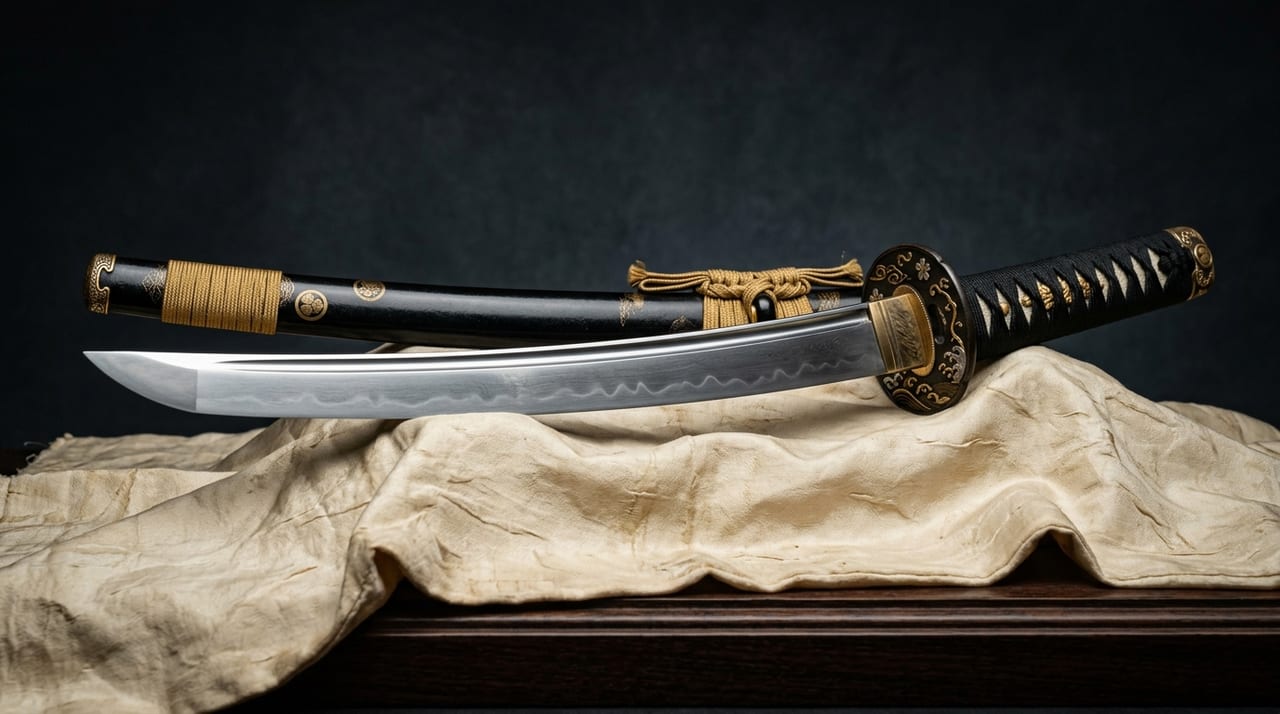
 * Image is for illustrative purposes only.
Awataguchi Hisakuni
粟田口久国
Also known as: One of the Awataguchi Six Brothers · Master smith of the Yamashiro tradition's formative period
Description
Awataguchi Hisakuni: Overview — One of the Six Brothers of Awataguchi
Awataguchi Hisakuni was a swordsmith of Yamashiro Province (modern Kyoto Prefecture) who flourished in the early to mid-Kamakura period (late twelfth to early thirteenth century), and is positioned as one of the "Six Brothers" of the Awataguchi school—one of the supreme schools in Japanese sword history. The Awataguchi school was the largest school of the Yamashiro tradition, centered at Awataguchi in Kyoto (present-day Higashiyama Ward, Kyoto City), and is said to have been founded through the joint efforts of six brothers—Kunitori, Hisakuni, Kuniyasu, Arikuni, Kunikiyo, and Kunitsuna—who shaped its golden age. This "Six Brothers" legend is one of the most famous legends of workshop collectives in Japanese sword history, and Hisakuni is highly regarded as a master craftsman who left excellent works in both tachi and tantō.
The Technical Characteristics of Awataguchi Hisakuni
The technical characteristics of Hisakuni's blades lie in "the refined steel surface and dignified hamon distinctive to the Awataguchi school." The general characteristics of the Awataguchi school are marked by an exceptionally fine and densely forged ko-itame surface with finely and uniformly applied ji-nie, creating a "clear, sharp" (saeta) steel quality. This refinement of steel surface was inherited in the later Rai Kunishun's distinctive "Rai skin," establishing the source of "the aesthetic of precise steel refinement" in the Yamashiro tradition. Hisakuni's hamon is based on suguha (straight blade) with gentle variations where fine ko-midare and ko-gunome subtly intermingle, characterized overall by "dignity, purity, and clarity." The point shape either curves and returns with a small roundness or exhibits a refined form close to tightly tempered, maintaining consistent "dignified coherence" from the tip throughout the hamon. This consistent dignity is the supreme aesthetic of "Awataguchi blades," and Hisakuni is inscribed in sword art history as one of its finest embodiments.
The Legend of the "Six Brothers" and Its Historical Significance
The legend of the Awataguchi "Six Brothers" is valued as important cultural-historical evidence that speaks to the organized character of sword production in Kamakura Kyoto. The fact—or legend—that multiple master craftsmen worked as "brothers" in the same region and era suggests that Awataguchi was not merely a gathering of individual geniuses but possessed a workshop organization as a "collective of craftsmen sharing technique." The existence of this workshop organization functioned as social infrastructure to maintain stable production of high-quality swords and formed the institutional foundation for preserving and transmitting specific technical standards. Hisakuni can be understood as a swordsmith who honed his individuality within this collective technical environment while simultaneously embodying the aesthetic standards of the Awataguchi school community.
Hisakuni as Innovator of the Tantō
Beyond his achievements in tachi, Awataguchi Hisakuni is also valued as an "innovator of the tantō." The Kamakura period was when the tantō form was fully developed in Japanese sword history, and Awataguchi smiths played an important role in establishing aesthetic standards for the tantō. Hisakuni's tantō are valued as excellent works combining the refined form of either hira-zukuri or shinogi-zukuri with the precise clarity of the steel surface and dignified suguha, and were later referenced as models for the "dignified form" of tantō. While Awataguchi Yoshimitsu of the grandson generation received the highest acclaim as the perfector of the tantō, Hisakuni's achievements formed an important foundation stone in the Awataguchi school's development of the tantō up to Yoshimitsu.
The Transition from Late Heian to Kamakura and Awataguchi
The era in which the Awataguchi school flourished coincided with the historical turning point when political power in Japan shifted from the Kyoto court to the samurai government at Kamakura. The shift from the Heian period's "court sword" to the Kamakura period's "warrior's sword" exerted a major influence on the aesthetic ideals of sword-making—sword makers faced the challenge of maintaining dignity between two demands: court elegance and samurai practicality. Awataguchi Hisakuni directly confronted this challenge of "fusing Kyoto dignity with warrior practicality" and demonstrated as his answer the "dignified practical blade combining refined steel surface and pure suguha." This answer became the aesthetic standard of the later Yamashiro tradition and continues to live as the standard for "the beauty of Yamashiro" in modern sword appreciation, passing through the Rai and Yoshimitsu schools.
Modern Evaluation and Positioning
In modern sword research, Awataguchi Hisakuni is positioned as one of the supreme masters of the Yamashiro tradition alongside Awataguchi Yoshimitsu and Rai Kunishun, and multiple works designated as National Treasures and Important Cultural Properties survive. Exhibitions of Hisakuni's works at the Tokyo National Museum and Kyoto National Museum are highly regarded as valuable opportunities to experience "the foundational period of the Yamashiro tradition" and are regularly introduced as essential viewing for sword enthusiasts and researchers. The "refined clarity of the steel surface" and "pure dignity of the suguha" displayed in Hisakuni's tachi have not faded in the slightest over more than seven centuries, and indeed, with the passage of time, the depth of their dignity is felt to increase ever more—such is the essence of "beauty that deepens with age" possessed by true masterworks. Awataguchi Hisakuni stands as the quintessence of the Yamashiro tradition, a master whose achievement formed the foundation for all the great craftsmen who followed, and whose legacy has reached the present day with supreme brilliance from the earliest epoch of Japanese sword history.
Legends & Stories
The Sacred Nature of Awataguchi
Awataguchi, located in present-day Higashiyama Ward, Kyoto City, has held special meaning since the Heian period as "the gateway to Higashiyama." As the starting point of the highway connecting Kyoto to the eastern provinces, this place took on religious and cultural significance as a "gateway to departure," and the Awata Shrine (Awataguchi Jinja) has been revered as the guardian deity of safe travels and the protector of swordsmiths. The fact that master smiths of the Awataguchi school forged swords in this "sacred place where the guardian deity of swordsmiths resides" imbued their work with a consciousness of "sacred mission" transcending mere craft labor. The legend that Hisakuni and his six brothers forged their swords at Awataguchi should be understood within the cultural context of the relationship between swordsmiths and shrines, and the religious significance of "swords born in a place blessed by divine protection" became one factor forming the special authority of Awataguchi swords. Even in modern times, Awata Shrine is revered as "the sacred site of swordsmiths," and devotees from across the nation visit its annual festivals.
The Transition from Heian to Kamakura—Swordsmiths Between Court and Samurai
The era in which Awataguchi Hisakuni worked (late 12th–early 13th century) was one of the greatest turning points in Japanese history, the period around the establishment of the Kamakura shogunate by Minamoto Yoritomo (1192). Swordsmiths in Kyoto during this era faced the challenge of serving not only their traditional patrons—nobility and the imperial court—but also a new clientele: the emerging warrior class. The Awataguchi smiths, including Hisakuni, succeeded in maintaining "Kyoto refinement" while meeting "samurai practicality," navigating this transition so skillfully that they not only survived but earned the highest appraisal of "finest swords" from both constituencies. Hisakuni's swords, acclaimed by both court aristocrats and samurai, embodied "the universality of beauty beyond social boundaries" in Japanese history, holding important symbolic significance in the cultural history of sword craftsmanship.
The Awataguchi Workshop—A Pioneering Model of Collective Creation
The legend of the Awataguchi Six Brothers, which depicts "multiple talents creating shared beauty through cooperation and competition," demonstrates a cultural pattern common to medieval European artist workshops (such as those of Renaissance Florence). Rather than individual genius producing masterworks in solitude, the model of creation in which figures connected as master-apprentice, siblings, and colleagues elevate one another while achieving shared aesthetic standards represents one of the deepest characteristics of Japanese craftsman culture. The technical environment, aesthetic standards, and relations of competition and cooperation that Hisakuni shared with other Awataguchi smiths as one of the Six Brothers should be evaluated not merely as individual works but as part of "the cultural practice that was Awataguchi." Without understanding this cultural practice, one cannot fully grasp the depth of Hisakuni's individual works.
Awataguchi and Yoshimitsu—Transmission Across Generations
Awataguchi Yoshimitsu, born in the grandson's generation two generations after Awataguchi Hisakuni, is a swordsmith who received overwhelming acclaim as "Japan's finest tanto maker," and such achievement would have been impossible without the accomplishments of Hisakuni and the Six Brothers. The aesthetic standards of "refined jihada and pure suguha hamon" that Hisakuni established became the foundation upon which Yoshimitsu elevated the tanto form to "humanity's highest forging art expressed in the tanto shape." The pattern of a master generation sowing seeds that a grandson's generation brings to blossom appears repeatedly in Japanese craftsman culture, and the transmission from Hisakuni to Yoshimitsu stands as one of the most brilliant examples of this pattern. To view Hisakuni's works is to directly witness the soil from which Yoshimitsu's genius grew, and to experience in its purest form the essential nature of Japanese sword culture: "collective creation across generations."
Modern Sword Evaluation and Awataguchi's Textbook Authority
In modern sword evaluation, the works of Awataguchi Hisakuni function as "textbook masterworks of the Yamashiro tradition" and stand as one of the highest-authority reference standards in evaluation. The maxim "One cannot speak of the Yamashiro tradition without understanding Awataguchi" demonstrates Hisakuni's absolute position in the world of sword evaluation. To accurately evaluate Yamashiro tradition works in sword evaluation examinations, it is prerequisite to have experientially understood Hisakuni's crisp jihada and dignified suguha hamon, and upon this understanding is built the eye needed to evaluate the distinctive raihada of Rai Kunitoshi and the uniqueness of Yoshimitsu's tanto. More than seven centuries later, Hisakuni's works continue to function as "foundational standards" for entrance-level study, and beyond being mere historical masterworks, they live as "universal standards for Japanese sword appreciation." This is the true core of Hisakuni's enduring value. The great tradition of the Awataguchi school, in which each of the Six Brothers expressed distinctive individuality while sharing a common spiritual foundation, is a magnificent artistic structure built upon Hisakuni's cornerstone, and that foundation's solidity continues to support the entire edifice even after seven centuries. The name Awataguchi Hisakuni, as one master smith who kindled the highest light in Japanese sword culture's dawn, will continue to be honored eternally. The tachi born of Hisakuni at Awataguchi, where urban refinement and the forge's flames intersected, continues to gleam as the highest expression of civilization that Japan achieved in the transition from the Heian to the early Kamakura period.