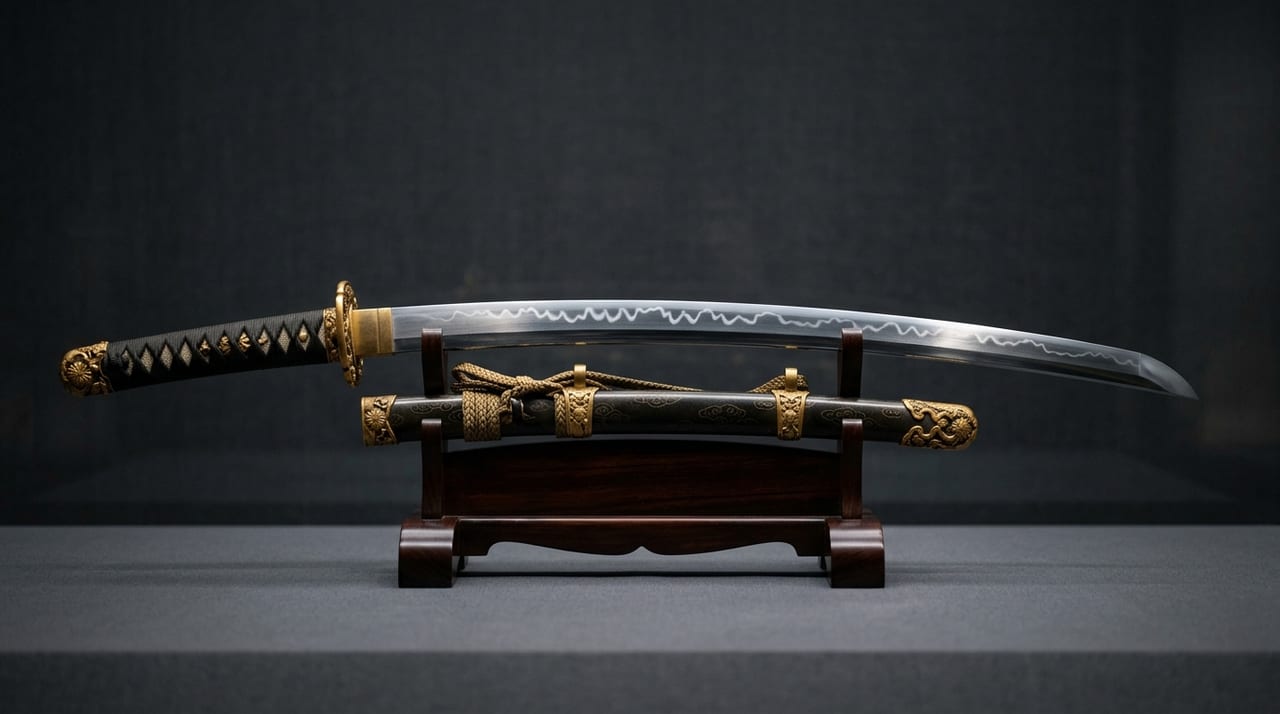
 * Image is for illustrative purposes only.
Sword Signed Yoshimitsu
剣 銘 吉光
Also known as: Sword by Awataguchi Yoshimitsu · Sacred Treasure of Atsuta Shrine
Description
Overview of "Sword Signed Yoshimitsu" at Atsuta
"Sword Signed Yoshimitsu" preserved at Atsuta Jingū Shrine in Nagoya is a sword forged by Awataguchi Yoshimitsu (also known as Tōshirō Yoshimitsu), a master craftsman of the Awataguchi school in Yamashiro during the mid-Kamakura period. Yoshimitsu is renowned for his expertise in short swords (tantos), and because he created very few swords or tachis, this work represents a precious rare example among his limited sword creations. The tang is inscribed with the two-character signature "Yoshimitsu" and is designated an Important Cultural Property. It is a double-edged (moroha-zukuri) sword of perfect bilateral symmetry, displaying Yoshimitsu's characteristic refined craftsmanship and elegant blade qualities. It is currently on public display at Atsuta Jingū's treasure exhibition facility, Kusanagi Hall.
Awataguchi Yoshimitsu and His Sword Works
Awataguchi Yoshimitsu belonged to the Awataguchi school of Yamashiro Province (Kyoto) and is transmitted to have been a student of either Kunikichi or Noriyoshi. He achieved outstanding excellence in short swords, producing many renowned pieces such as Atsushi Tōshirō, Hirano Tōshirō, Gotō Tōshirō, Honebami Tōshirō, Akita Tōshirō, and Yagen Tōshirō. By contrast, his production of swords (double-edged construction) is extremely limited; besides this work, only the National Treasure "Sword Signed Yoshimitsu (Hakusan Yoshimitsu)" preserved at Hakusan Hime Shrine in Ishikawa Prefecture is known. Swords employ a special double-edged construction with a ridge (shinogi) standing symmetrically on both sides, requiring forging techniques distinct from single-edged short swords. Yoshimitsu's swords are thus remarkable as examples demonstrating the breadth of his working range.
Style and Points of Interest
This sword features a double-edged blade forged with well-tightened mokume-hada (wood-grain pattern) ground steel, displaying jigane with fine material that imparts a lustrous finish. The blade pattern is characterized by a fundamentally straight (suguha) form with small feet marks, exhibiting uniform fine grain that gleams with clarity. The clean ground texture and refined blade qualities characteristic of the Awataguchi school are fully expressed even in this sword form, transmitting to the present day Yoshimitsu's outstanding technical mastery.
Atsuta Jingū Shrine and Swords
Atsuta Jingū is an ancient shrine that enshrines the Kusanagi no Tsurugi, one of the Three Imperial Treasures, and has maintained deep connections to swords since antiquity. Within the tradition of sword offerings by the samurai, numerous swords have been transmitted to the shrine, and Kusanagi Hall, its treasure exhibition facility, displays many renowned blades. Yoshimitsu's sword is one of the outstanding masterworks representative of Atsuta Jingū's collection, and is carefully preserved as a precious relic revealing another facet of Yoshimitsu—the master of short swords.
Legends & Stories
The Divine Kusanagi Sword and Sword Veneration at Atsuta
Atsuta Shrine, enshrining the Kusanagi Divine Sword (also called the Ame-no-Murakumo Sword), one of the Three Sacred Treasures in Japanese mythology, is regarded as one of the most sacred places related to swords. The Kusanagi Sword is enshrined deep within the sanctuary and remains unseen by mortal eyes; the presence of masterwork swords crafted by swordsmiths in this holy place signifies that the divine sword of legend and blades born of human skill coexist in sacred space. In Shinto cosmology, swords are regarded as vessels of spiritual power, and the dedication of blades to high-ranking shrines represented the highest form of samurai devotion. The transmission of Yoshimitsu's sword to Atsuta Shrine exemplifies this profound bond between sword craft and spiritual belief.
Encountering Yoshimitsu's Sword at Kusanagi-kan
Yoshimitsu's sword is currently on public display at the Kusanagi-kan treasure museum of Atsuta Shrine. Encountering a masterpiece blade within a shrine context offers an experience distinct from museum viewing, profoundly conveying how deeply sword culture is intertwined with spiritual faith. The opportunity to view one of Yoshimitsu's rare sword masterpieces at this sacred place offers visitors a truly exceptional encounter with the renowned short-sword master.