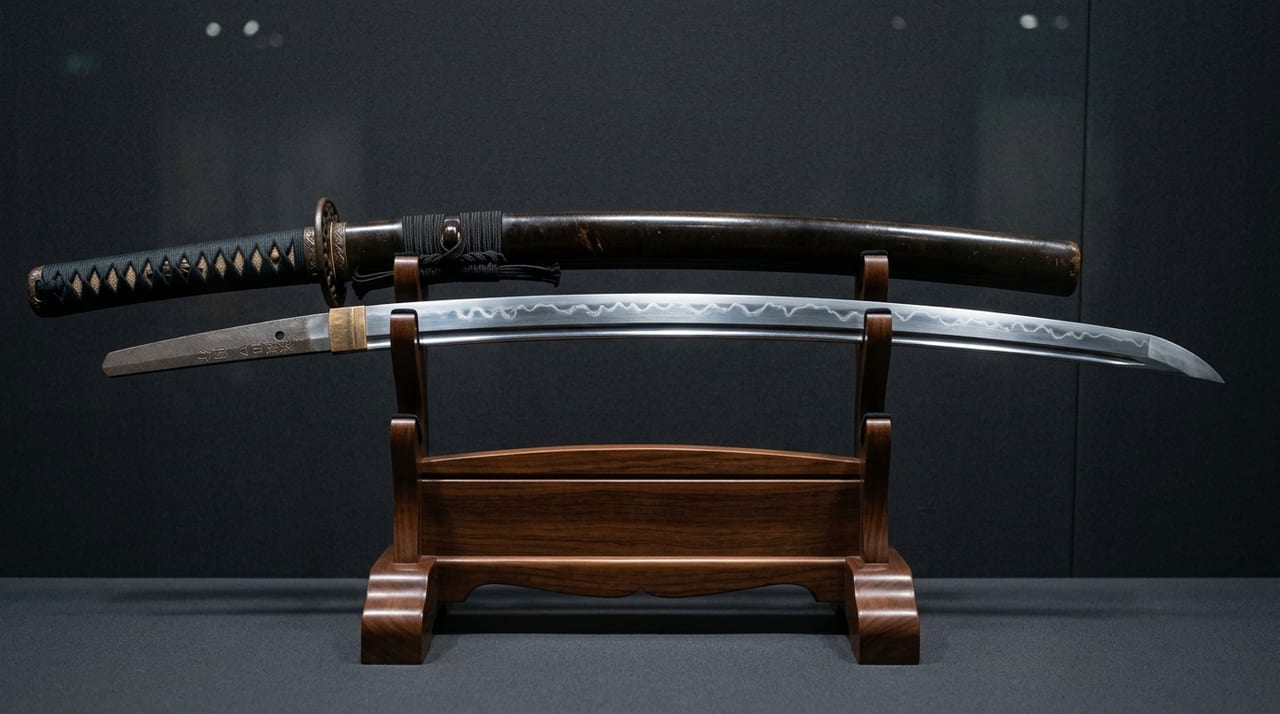
 * Image is for illustrative purposes only.
Akashi Kuniyuki
明石国行
Also known as: The Ultimate Treasure Born of the Akashi and Awataguchi Lineages
Description
Overview of the Sword
Akashi Kuniyuki is a tachi forged in the late Kamakura period by Kuniyuki, the leading master craftsman of the Rai school in Yamashiro Province. Among sword researchers, it is renowned as the supreme expression of the Rai school's serene and luminous aesthetic. The name "Akashi" is said to derive from its transmission to the Akashi Matsudaira family, rulers of Akashi in Harima Province, and this elegant designation perfectly accords with the blade's dignity. The blade exhibits a sword form characteristic of the Kamakura period with a length around 2 shaku 4 sun, and its beautiful curve, marked by a distinct koshi-zori, imparts to the viewer both dignity and a palpable sense of tension. This well-proportioned form testifies to the proper continuation of Rai school tradition and vividly demonstrates Kuniyuki's exceptional technical mastery. As a blade richly infused with the lingering essence of court culture from the late Heian through early Kamakura periods, it stands distinctly at a higher spiritual plane than swords from other production centers.
The History of the Rai School and Kuniyuki's Position
The Rai school was a community of swordsmiths based in Kyoto from the mid-Kamakura period through the Nanboku-chō period, producing celebrated masters including Kuniyuki, Kunishun, Niji-Kuniyuki, Rai Kunimitsu, and Rai Kunji. The founder of the Rai school is said to have been Kuniyoshi, and Rai Kuniyuki is known as the central master craftsman who established its lineage. Rai Kuniyuki is regarded as either the founding or revitalizing master of the Rai school and is known as an eminent craftsman active in the mid to late Kamakura period. The distinctive characteristics of the Rai school lie in its luminous hamon of fine straight grain and small irregular patterns as its foundation, and its precise jigane with itame-hada interspersed with fine itame. This is highly esteemed as a dignified Yamashiro aesthetic distinctly different from those of Yamato and Bizen. The refined sensibility cultivated in Kyoto, the highest center of Japanese culture, elevated the Rai school swordsmiths' technical prowess beyond mere weapons manufacturing to the creation of works of art. Akashi Kuniyuki faithfully embodies this tendency and is perfected as a blade permeating a cleanliness and refinement found in no sword from other production centers.
Detailed Examination of the Blade and Points of Appreciation
The jigane of Akashi Kuniyuki is tightly packed with fine itame-hada bearing fine ji-nie, with a bright iron color tinged with blue that accurately manifests the characteristics of the Rai school. The jigane, with little wave-like flow and an exceptionally uniform and settled appearance, quietly testifies to the high level of forging technique. The hamon, based on ko-midare with gonomé, ko-ashi, and leaves intricately interwoven, creates a scenery wherein one senses the craftsman's spirit that spurns monotony. The nioi-kuchi is bright and sharp with fine nie well-formed, and the radiance of the edge imparts vitality to the entire blade. The boushi has a small round form with a shallow return, and the scenery from the cutting edge through the boushi represents the apex of refinement. The tang is in its original unfinished state, bearing the two-character signature "Kuniyuki" incised with a chisel, and the dignity of its calligraphy likewise testifies to the maker's high cultivation and spiritual fullness. The curve's configuration and the degree of its tension embody the paradigmatic sword form of the early Kamakura period, representing the crystallization of the highest level of forging technique and aesthetic sensibility of that time united as one.
Transmission to the Akashi Matsudaira Family and Current Ownership
Akashi Kuniyuki is called "Akashi Kuniyuki" because of its transmission to the Akashi Matsudaira family, rulers of Akashi in Harima Province, and has been regarded as a celebrated sword of the realm since ancient times. It occupies the most prestigious position among Rai school tachi and is accorded the highest evaluation by sword researchers both domestically and internationally as a celebrated blade representative of the Yamashiro tradition. It is currently preserved as a National Treasure in the Sword Museum of the Japan Art Sword Preservation Association in Sumida Ward, Tokyo.
Yamashiro Tradition as the Pinnacle of Japanese Swordmaking—The Unique Character of Yamashiro among the Five Great Traditions
The principal production centers of Japanese swords are organized into Five Great Traditions: Yamashiro, Yamato, Bizen, Soshu, and Mino. Among these, the Yamashiro tradition possesses the oldest history and occupies a special place as a production center that nurtured a unique aesthetic cultivated through intimate connection with the refined culture of Heian nobility. Yamashiro blades are characterized less by raw strength and vigor than by the dignity and luminosity fostered by court culture, with their supreme appeal lying in the high-dimensional fusion of functional beauty as weapons with aesthetic refinement as works of art. The forging culture of Yamashiro, wherein celebrated workshops such as Awataguchi, Sanjo, and Rai competed to perfect the highest technique, formed one of the pinnacles of the art of Japanese swordmaking. Akashi Kuniyuki stands as one of the supreme flowers of this Yamashiro tradition, an exceptionally rare example transmitting intact to posterity the technique and aesthetic sensibility of the Rai school, a celebrated workshop. Even as the age of the samurai arrived with the Kamakura period, the swordsmiths of Kyoto continued to imbue in the blade the aesthetic of the court—Akashi Kuniyuki, as proof of this, radiates unchanged dignity even now, nearly a thousand years later.
The Significance of Akashi Kuniyuki in the Modern Era
Since the Meiji era, while many celebrated swords have flowed overseas or been lost during wartime, Akashi Kuniyuki has been continuously preserved in its complete state in the Sword Museum in Sumida Ward, Tokyo. In regularly held exhibitions, it is consistently granted a special position as the representative work of the Rai school, achieving a status among sword devotees as what is said to be "the essential blade for understanding Yamashiro tradition"—virtually a canonical masterwork. Those learning the beauty of Japanese swords for the first time are moved by it, and even those who have devoted themselves to the deepest study of swords are profoundly affected—the universal beauty of Akashi Kuniyuki demonstrates that the technique and spirit cultivated by the Rai school's swordsmiths in the Kamakura age lives on in our time today, the most eloquent testimony of all.
Legends & Stories
The Awataguchi Legend — The Consummate Art of Kyoto's Swordsmiths
Awataguchi was located at the eastern gate of Heian capital, the very threshold through which travelers first entered the city. The swordsmiths who gathered at this place, directly influenced by the court culture and shrine-temple culture of Kyoto, pursued the blade not as a crude weapon but as a work of art. Their swords possessed the same spirituality as waka poetry and Buddhist art, offering the beholder not fear at its sharpness but wonder at its beauty. Kuniyuki was an eminent master who legitimately inherited the spirit of Awataguchi, and Akashi Kuniyuki represents its supreme achievement. The crystalline beauty born from swordsmiths refined in Kyoto's culture stands like a cool breeze in an age of tumultuous warfare, purifying the hearts of sword enthusiasts even today.
Tokugawa Yoshimune and the Meibetsucho
The eighth shogun, Tokugawa Yoshimune, was known for his "Kyōhō Reforms" as a pragmatic administrator, but he was also a devoted sword collector with profound knowledge of the Japanese blade. Under Yoshimune's orders, the Honami family took the lead in compiling the Kyōhō Meibutsuchō, one of the most important documents in sword history, which surveyed and recorded celebrated swords throughout the realm. Inclusion in the Meibetsucho was not merely a cataloguing exercise but an authoritative attestation of a sword's value and provenance, becoming the standard for evaluating celebrated swords in early-modern samurai society. Though Akashi Kuniyuki does not appear among the meibetsu listed in the Meibetsucho, it has been highly valued as a great sword of Yamashiro tradition and Raiha school transmitted through generations in the Akashi Matsudaira family, and having been designated an Old National Treasure in Showa 12 and a National Treasure in Showa 28, it continues to maintain its exalted status to this day.