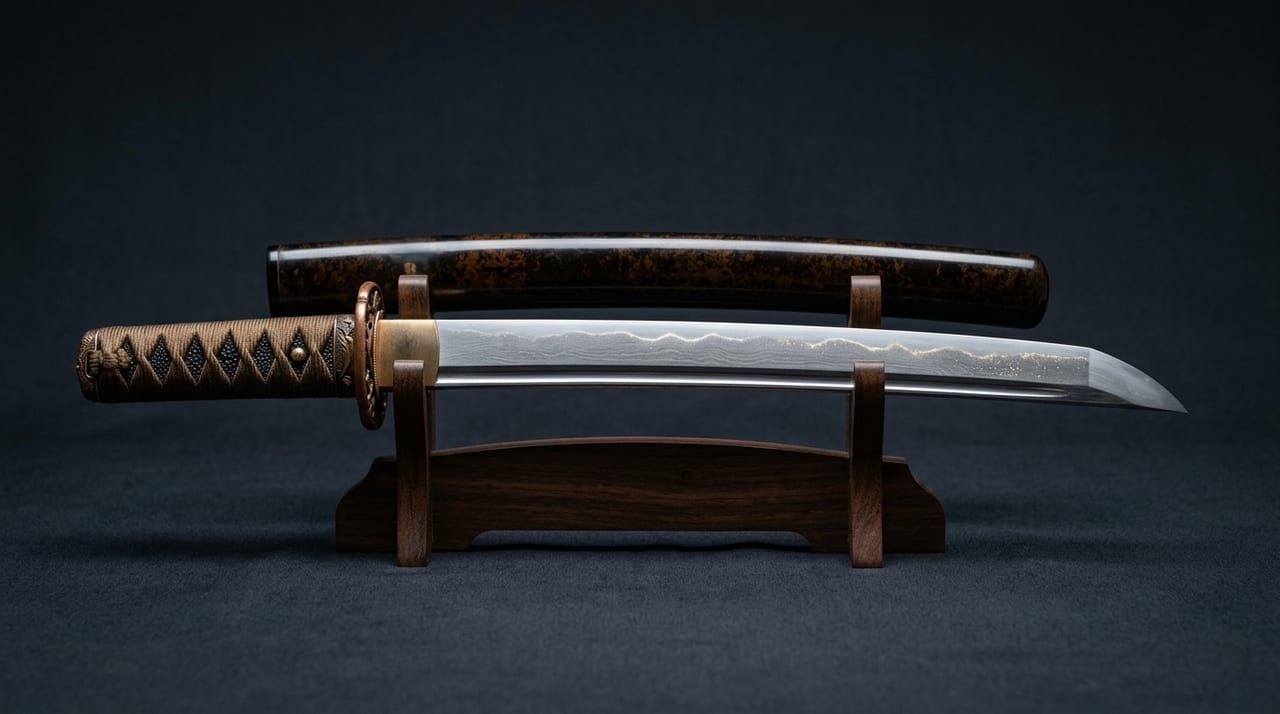
 * Image is for illustrative purposes only.
Aizen Kunitoshi
愛染国俊
Also known as: Aizen Kunitoshi; Rai Kunimitsu's Masterpiece
Description
Overview of Aizen Kunitoshi
Aizen Kunitoshi is a short sword forged by Niji Kunitoshi, a master craftsman of the Yamashiro Rai school during the late Kamakura period. It is called by this name because the tang is carved with Aizen Myōō. The Rai school is a family of swordsmiths from Yamashiro Province (Kyoto) that traces its lineage to Rai Kuniyuki as its de facto founder. Niji Kunitoshi belonged to this lineage and is called "Niji Kunitoshi" because he signed his blades with only the two characters "Kunitoshi" (国俊). This work is known as the only short sword made by Niji Kunitoshi and is a rare blade featuring a carving of Aizen Myōō with Shugendō associations. It was designated under the former National Treasure Preservation Law and is classified as an Important Cultural Property under the current Cultural Properties Protection Law.
The Rai School and Niji Kunitoshi
The Rai school is a lineage characterized by the distinctive features of the Yamashiro tradition: densely-packed small mokume grain in the base steel, combined with uniform straight-grain or subtly wavy hamon with fine nie. It produced many master craftsmen including Kuniyuki, Kunitoshi, Kunimitsu, and Kunitsugu. Among them, Niji Kunitoshi was particularly renowned as a master maker of large swords (tachi), and very few extant examples of his short swords survive. The base steel of this work exhibits the characteristic clear, fine mokume of the Rai school with ji-nie, and the hamon shows an elegant execution with subtle activity in a fundamentally straight pattern.
Origin of the Name and Provenance
The name "Aizen" derives from the carving of Aizen Myōō on the tang. Aizen Myōō is a wisdom king symbolizing the equation of earthly desires with enlightenment and was revered by the samurai class. According to tradition, this blade passed through the hands of Toyotomi Hideyoshi, and after the Summer Campaign of Osaka, came into the possession of Tokugawa Ieyasu, then was transmitted to the Maeda clan through Mori Tadasada (the younger brother of Mori Ranmaru). Currently it is housed at Burestoshību Corporation in Ibaraki, Osaka Prefecture, and the Japan Sword Museum Technical Research Foundation oversees its preservation. Note that this is distinct from the famous named examples of Rai Kunimitsu (such as the Uraku Rai Kunimitsu and the Gotō Rai Kunimitsu), being from different makers and lineages.
Legends & Stories
The name 'Aizen' connects this blade to Aizen Myōō — the Buddhist deity of passion and desire, who in the tantric tradition does not suppress human longing but transforms it, turning attachment into the engine of enlightenment. It is an unusual figure to find at the heart of a sword's identity: not a war deity, not a tutelary spirit, but a being whose domain is desire itself. The association suggests a blade that passed through the hands of priests before it reached warriors. Toyotomi Hideyoshi, who reportedly owned it, was himself a man of enormous appetite — desire was the primary force of his life, the engine that carried a farmer's son from sandal-bearer to ruler of all Japan. Whether he saw something of Aizen Myōō in himself, or whether that was simply the name the blade had always carried, is beyond recovery. What remains is the conjunction: Rai Kunimitsu's most refined tantō, its jitetsu glowing with the particular warmth the Rai school achieves at its best, named for the red-faced deity of transformed desire. The Maeda clan of Kaga — the great lords who built a culture rivaling Kyōto's in sophistication — kept it for centuries afterward. In the care of the Maeda Ikutokukai today, it remains what it has always been: a National Treasure of quiet, interior brilliance.