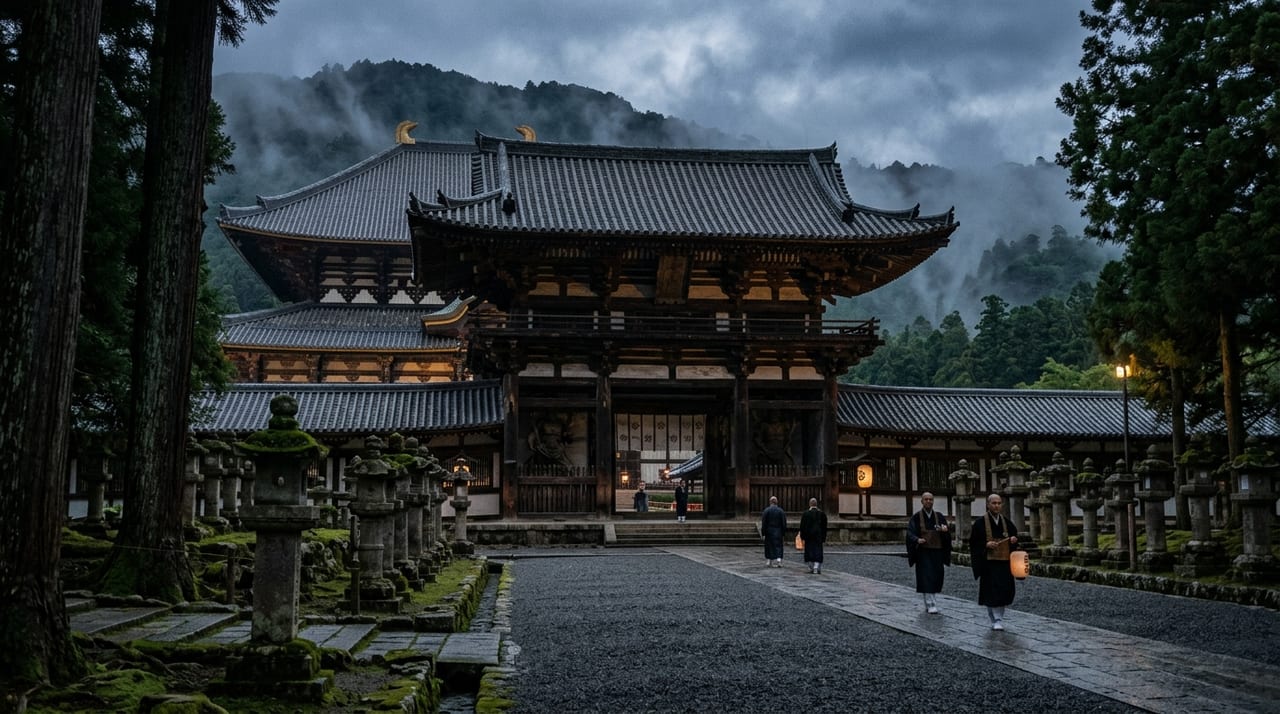
 * Image is for illustrative purposes only.
Tegai School
手掻派
A leading school of the Yamato tradition, based near the Tegai Gate of Tōdaiji in Nara. Known for masame-hada and suguha, it produced practical swords serving temple warriors and the warrior class.
Description
Origins and Geographic Background of the Tegai School
The Tegai school is a sword school whose origins lie in a community of smiths around the Tengai-mon gate of Tōdai-ji in Yamato Province (present-day Nara Prefecture). The name "Tegai" is said to derive from "Tegai-mon," an alternative name for the Tengai-mon, and this connection to the great temples of the Nanto region fundamentally defined the character of the school. Nara has been a center of Buddhist culture since ancient times and was a city where many monks and warrior monks gathered. From the late Heian period into the Kamakura period, as temples and shrines became militarized, great temples and shrines such as Tōdai-ji, Kōfuku-ji, and Kasuga Taisha maintained warrior monks (sōhei) for self-defense, and this demand for arms nurtured the swordsmiths of the Nara region. Tegai smiths, under the patronage of the temples, pursued purely practical swords and cultivated a distinctive aesthetic that prioritized sturdiness and reliability over decorative beauty.
Characteristics of Style: The Philosophy of Masame Hada and Sugu-ha
The style of the Tegai school is most succinctly expressed by the combination of "masame-hada" (straight-grain skin) and "sugu-ha" (straight hamon). Masame-hada is a forged-steel skin in which the wood-grain pattern runs vertically through the metal, and it has an orderly beauty that contrasts with the itame of the Bizen tradition and the ō-itame of the Sōshū tradition. This masame is born from a technique that keeps the direction of forging constant, and it is both a result of the manufacturing method peculiar to Yamato-den and an expression of a Zen-inspired aesthetic that eschews superfluous decoration. Sugu-ha, as the name says, is a hamon that runs straight, without dramatic variations such as chōji-midare or gunome-midare. Yet on close inspection the sugu-ha carries fine ko-nie, and the edge line trembles slightly, revealing subtle scenery. This restrained beauty looks plain at first glance, but it is a deep flavor known only to connoisseurs, and even after several hundred years it is highly regarded by Japanese sword appraisers today. The kasane is relatively thick, and the cross-sectional shape of the blade is often shinogi-zukuri with a high shinogi ridge. This can also be interpreted as a structure that assumes thrusting rather than cutting, and it is thought to have been a practical choice that considered close-quarters combat within temple grounds.
Principal Smiths and Representative Works
The most famous smith of the Tegai school is Kanenaga. Kanenaga was a master representing Yamato-den who was active around the Shōō era (1288–1293) in the late Kamakura period, and his works are considered unrivaled among the Five Yamato Schools (Yamato Goha) for the refinement of masame hada and the dignity of the straight hamon. Kanenaga's signature is the two-character inscription "Kanenaga," and authentication is carried out by examining the shape of the tang and the characteristics of the file marks (yasurime). Kanenaga's descendants and disciples used the "Kane" element of his name as part of their smith names generation after generation, and Kaneyoshi, Kanetsugu, and Kanekiyo are known. These smiths were also active in the Nanboku-chō period and produced tachi of imposing form demanded by turbulent times, but their basic style continued to preserve the masame and sugu-ha tradition inherited from their master. Tegai Kanenaga tachi include the National Treasure "Tachi, signed Kanenaga" held by the Seikadō Bunko Art Museum, and the fineness of the forged skin and the dignity of the hamon continue to captivate sword connoisseurs across the ages.
Position within the Five Yamato Schools
Yamato-den comprises, in addition to the Tegai school, the Taima, Senjuin, Shikkake, and Hōshō schools, and these five are collectively called the Five Yamato Schools (Yamato Goha). Among them, the Tegai school set up its forge in front of the Tengai-mon of Tōdai-ji and, together with the Senjuin school, which also belonged to Tōdai-ji, had close ties with the great temples of the Nanto region. Each school received patronage from temples and shrines and polished its own distinctive style while strongly absorbing the spiritual and cultural influences of those temples. The special environment of Nara as a religious city undoubtedly nurtured the diversity and individuality of Yamato-den, and it is the greatest factor setting Yamato-den apart from the other schools of the Gokaden.
Later Influence and Collecting Value
The techniques of the Tegai school maintained their lifeline throughout the Muromachi period, and some smiths remained active as Yamato smiths even in the Sengoku period. In the shintō period of the Edo period, the techniques of Yamato-den were reappraised, and shintō smiths who had studied Yamato-den were active in various regions. In modern collecting, signed works by Tegai Kanenaga are extremely rare, and well-preserved signed tachi have a high likelihood of designation as Important Cultural Properties. Even unsigned works receive high evaluation when the kiwame attribution reads "Tegai" or "Yamato-mono," and collectors must have the discernment to recognize the masame hada peculiar to Yamato-den.
Characteristics of This Era
- Masame hada (straight-grain skin): a neat skin in which the wood-grain pattern runs vertically through the forged steel. It is a beauty peculiar to the manufacturing method of Yamato-den, in contrast to the itame of Bizen and the ō-itame of Sōshū.
- Mainly sugu-ha (straight hamon): fine ko-nie are attached within the linear hamon, giving it a deep flavor within restraint. It looks plain at first glance but shows the technical refinement that appraisers pay the most attention to.
- Thick kasane and high shinogi in a practical build. The cross-sectional shape, which assumes thrusting rather than cutting, embodies a functional beauty designed for the close-quarters combat of warrior monks.
- Extant examples with ubu nakago have kurijiri tangs, and the file marks are said to be takanoha (hawk-feather). These features are important grounds for identifying Tegai school works.