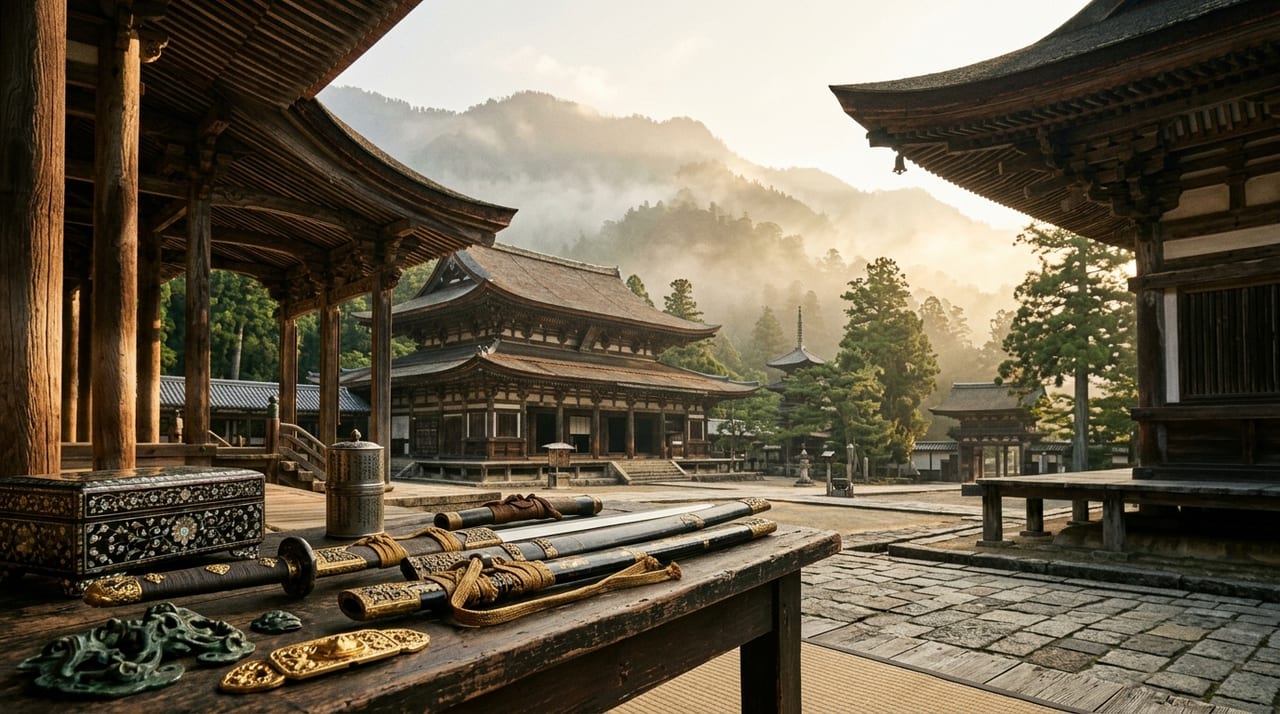
 * Image is for illustrative purposes only.
Nara Period Swords
奈良時代の刀剣
The Nara-period ritsuryō state actively absorbed advanced ironworking culture from China and the Korean Peninsula and institutionalized the straight sword (chokutō) as its principal weapon. The great swords (tachi) still preserved in the Shōsōin show the highest level of sword technology of the time, and the technical and aesthetic foundations that would lead to the nihontō were established.
Description
The Ritsuryō System and Swords
The Nara period (710–794) was the era in which the ritsuryō state system was established, based on the Taihō Code (701) and the Yōrō Code (718). Under this system military institutions were also organized, and swords were institutionalized as equipment for the official army. The principal swords of the time were straight swords (chokutō) transmitted from the continent, single-edged blades with no curvature, mainly in the hira-zukuri and kiriha-zukuri forms. Soldiers of the ritsuryō provincial regiments (gundan) carried a great sword (tachi, here the chokutō) alongside their bows and arrows, and it spread throughout the country as the standard equipment of the regular army.
The Technical Level of Swords in the Shōsōin
The Shōsōin (Tōdai-ji, Nara) holds several dozen swords, including those that belonged to Emperor Shōmu, which convey to the present day the highest standard of Nara-period sword craftsmanship. Among them, the Kingin-sō no Yokotachi makes a vivid impression with its finely worked gold and silver mountings, and its blade has a dense jigane produced by folded forging. The Gold-Mounted Tachi is a typical ceremonial great sword in which gold ornamentation displays the authority of the court, and the refinement of its patterns shows the peak of metalworking of the period. These works established the sword as more than a weapon, as a symbol of authority and a sacred object, and they also became the prototype of later koshirae culture.
Continental Technology: Adoption and Domestic Production
Nara-period sword production was established through the fusion of technology transferred from the continent (Tang, Baekje, and Silla) with indigenous techniques. Immigrant craftsmen (toraijin) transmitted the techniques of smelting, forging, and heat treatment to Japan, and smithing groups formed in advanced regions such as Yamato (Nara), Yamashiro (Kyoto), and Kawachi (Osaka). Raw materials came from iron sand (satetsu) and iron ore from various regions, and the early form of tatara smelting began to spread.
The Seven-Branched Sword and Ritual Swords
In the Nara period, separate from practical straight swords, special swords for ritual and ceremonial purposes were also made. The Shichishitō (Seven-Branched Sword) transmitted to Isonokami Jingū is an iron seven-branched sword gifted from Baekje in the 4th century, and it was dedicated at the shrine as a symbol of royal authority. In the Nara period this tradition of sacred swords was inherited and strengthened, and the idea became established that the sword rises beyond a mere weapon to become a sacred object, a vessel in which spiritual power dwells. This concept of the sacredness of the sword led directly to the tachi worship and divine-sword culture of the Heian period and after, and it is the source of the spiritual and religious dimension of the nihontō that continues to the present.
Development of Sword Fittings
A notable feature of Nara-period swords is that, alongside blade technology, the design of sword fittings (habaki, scabbard, pommel, and so on) developed remarkably. The fittings of the great swords surviving in the Shōsōin are decorated with rayskin (samegawa), lacquer, and gold and silver metal fittings, showing the highest level of craft of the time. A division of labor was established in which metalworkers, lacquerers, leatherworkers, and braid makers worked together to complete a single sword. This is the starting point of the sword-fitting culture that would be completed in the Edo period. Metal inlay (zōgan) technique also came from the continent, and examples survive in the Shōsōin in which birds, beasts, and arabesque scrolls are inlaid on pommels, tsuba, and scabbard fittings.
From Chokutō to Nihontō
In the late Nara to early Heian period, a gradual shift began from straight swords to curved swords (wantō) with a curvature. This arose from changing functional demands with the spread of mounted combat tactics, and it came to be recognized that curving the blade was advantageous for increasing the efficiency of cutting from horseback. Without the accumulated advanced forging and heat-treatment technology of the Nara period, the birth of the curved sword and the nihontō would not have been possible. In that sense, Nara-period sword technology was an indispensable run-up period to the nihontō, a world-class cutting-edge culture, and the swords of the Shōsōin are precious physical evidence that testifies to that technical continuity today.
Characteristics of This Era
- Chokutō as the mainstream: single-edged great swords based on the straight-sword forms of Tang and the Korean states were the standard equipment of the official army. The straight blade embodies a continental view of the sword
- Refined fittings of the Shōsōin great swords: koshirae using gold and silver inlay, rayskin, and lacquer decoration demonstrate the aesthetic sense and craft level of the Nara court. They are the prototype of later nihontō koshirae culture
- Technology transfer by immigrant craftsmen: metalworkers from Baekje, Silla, and Tang settled in Yamato, Yamashiro, and other regions and formed smithing groups
- Establishment of the sacredness of swords: the custom of dedicating swords as divine swords and offering swords took root, and a uniquely Japanese concept took hold in which swords are revered as spiritual objects beyond weapons
- Spread of tatara smelting: early tatara smelting using iron sand as raw material spread across the regions, laying the foundation of the iron-making infrastructure that later led to tamahagane production