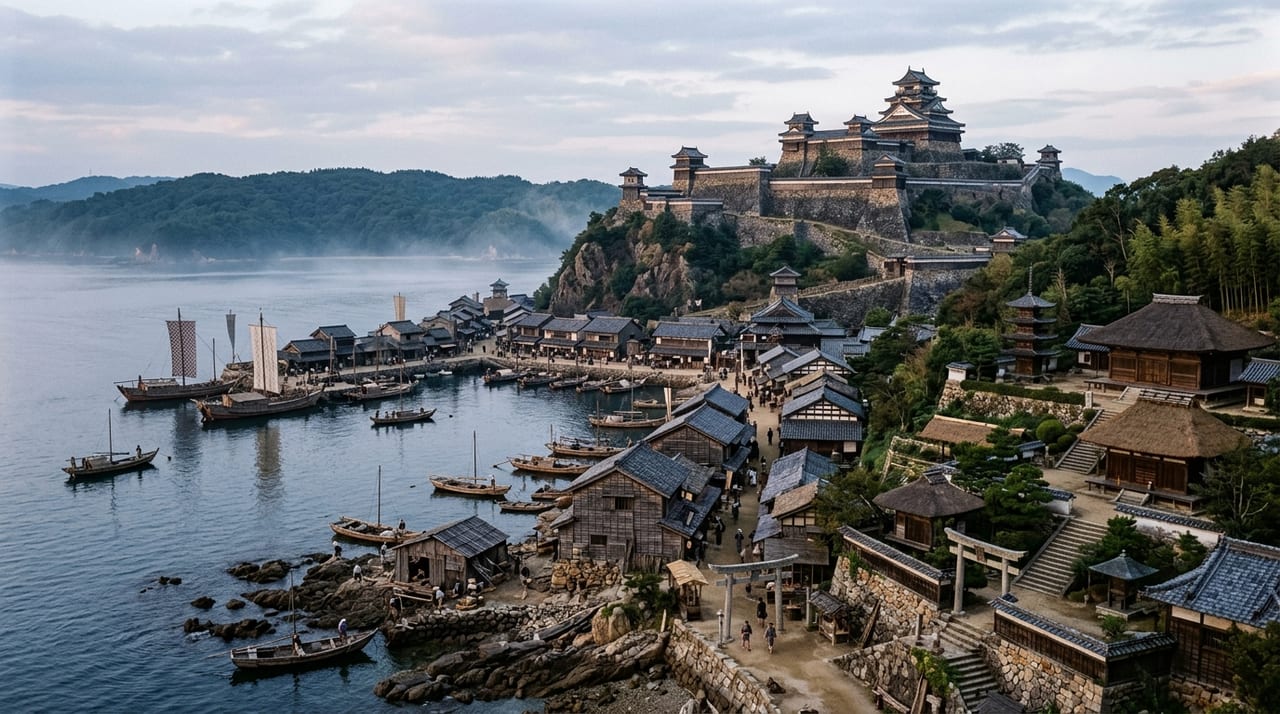
 * Image is for illustrative purposes only.
Ko-Mihara Tradition
古三原伝
The Ko-Mihara tradition, originating in the Mihara region of Bingo Province (present-day eastern Hiroshima Prefecture), flourished from the Nanboku-chō to the Muromachi period as an important sword-producing center along the Setonaikai coast. The Mihara school, founded by Masaie, is known for its simple style, centered on jigane with masame-hada and suguha blades influenced by the Yamato tradition. Mihara blades maintained a distinctive aesthetic sensibility despite lying west of Bizen, a major production center, and are a valuable example of the diversity of regional sword culture.
Description
Geographical Location of Mihara
Mihara in Bingo Province (present-day Mihara City, Hiroshima Prefecture) is a port town facing the Seto Inland Sea. Although it lies west of Bizen and Bitchū, Mihara swordsmiths were strongly influenced by the technical traditions of the Yamato tradition, and they established a unique style distinct from Bizen-tō. This is said to have been rooted in the fact that Bingo Province had long been a shōen of the great Yamato temples. Its proximity to the Chūgoku Mountains, rich in satetsu (iron sand), also supported the development of swordsmithing.
Masaie and the Founding of the Mihara School
Masaie, said to be the founder of the Mihara school, is thought to have lived in the late Kamakura period, around the Shōchū era (1324–1326). He is said to have laid the foundations of the Mihara school by bringing techniques influenced by the Yamato tradition to Bingo. Masaie's works are in the Yamato tradition manner, with suguha hamon on masame-hada jigane, and they have a clean expression entirely different from the chōji-midare of Bizen. Masaie and his son Masahiro are said to be the most excellent among Mihara-mono. After the Muromachi period, swordsmiths who inherited the name Masaie carried on across generations, and the school became the largest sword school in Bingo. Works from the Kamakura to Nanboku-chō periods are called Ko-Mihara, those from the early to middle Muromachi period are called Mihara (Naka-Mihara), and those after that are called Sue-Mihara.
Technical Characteristics of Mihara-tō
The first technical characteristic by which Mihara-tō can be identified is itame-hada mixed with masame. Unlike the ko-itame-hada of Bizen-tō and also unlike the complex mixed hada of the Sōshū tradition, this jigane leans somewhat toward masame. It reflects the influence of the Yamato tradition and has fine ji-nie appearing finely, giving a clean appearance. The hamon are mainly suguha or chū-suguha. Suguha nie-deki, in which fine nie appears uniformly along the edge of the hamon, is the most typical expression of Mihara-tō. However, there are also examples with variation in which ko-midare or gunome are mixed in, so it cannot be asserted that "Mihara-tō are suguha" in every case. The kissaki are mostly ko-kissaki to chū-kissaki, and overall the neat taihai with a practical focus is characteristic.
Demand and Distribution of Mihara-tō
Around the time of the Ōnin War (1467–1477), Mihara-mono were reportedly well known for their cutting ability, and the name of Mihara is said to have become known throughout the country. In the wazamono-hyō of the Kaihō Kenshaku, written in the Edo period by Yamada Asaemon in 1797 (Kansei 9), Masaie of around the Ōei era is listed as saijō ō-wazamono. Compared with the overwhelming name recognition of Bizen-tō, both the number of surviving Mihara-tō and their name recognition are low. Their unadorned beauty, however, embodies a different beauty of the sword from the splendor of Bizen.
Characteristics for Collectors
Authentic works of Ko-Mihara survive in small numbers, and when it comes to certainly signed pieces, they are extremely rare. The characteristics of masame-mixed jigane and suguha are clear to those who know them. However, because of their low name recognition, market valuations are sometimes cheaper than their actual quality. For collectors who appreciate the appeal of regional swords, they offer a valuable opportunity to appraise Japanese swords with an aesthetic sense different from the standards of Bizen and Sōshū. The serene beauty of Mihara-tō is often described as "jimi da ga oku ga fukai," meaning plain yet profound, and it can be said to be indispensable for understanding the diverse beauty of Japanese swords.
Characteristics of This Era
- Itame-hada mixed with masame: a forging texture of the jigane reflecting the influence of the Yamato tradition. Unlike the ko-itame of Bizen or the complex mixed hada of Sōshū, its slightly masame-leaning, clean appearance serves as the jigane identification marker for Mihara blades
- Suguha nie-deki: a clean suguha with fine, uniform nie is the typical hamon expression of Mihara blades. It reflects a straightforward and dignified aesthetic, in contrast to the lavish chōji-midare of Bizen
- A regional school from the late Kamakura to Muromachi period, founded by Masaie. Around the time of the Ōnin War (1467–1477), it became known nationwide for the sharpness of its blades
- Influence of Yamato-kaji: because Bingo Province was a shōen of the major temples of Yamato, it was strongly influenced by Yamato-kaji, and many works have high shinogi and suguha-deki
- Affordability due to low recognition: compared with the standard Bizen and Sōshū blades, market valuation may be lower, and collectors with knowledgeable connoisseurship may find authentic works that are inexpensive relative to their actual quality
- Rarity of extant signed pieces: Ko-Mihara works bearing a verified signature (mei) are among the rarest in the country. The masame-mixed jigane and suguha features serve as practical indicators for judging authenticity