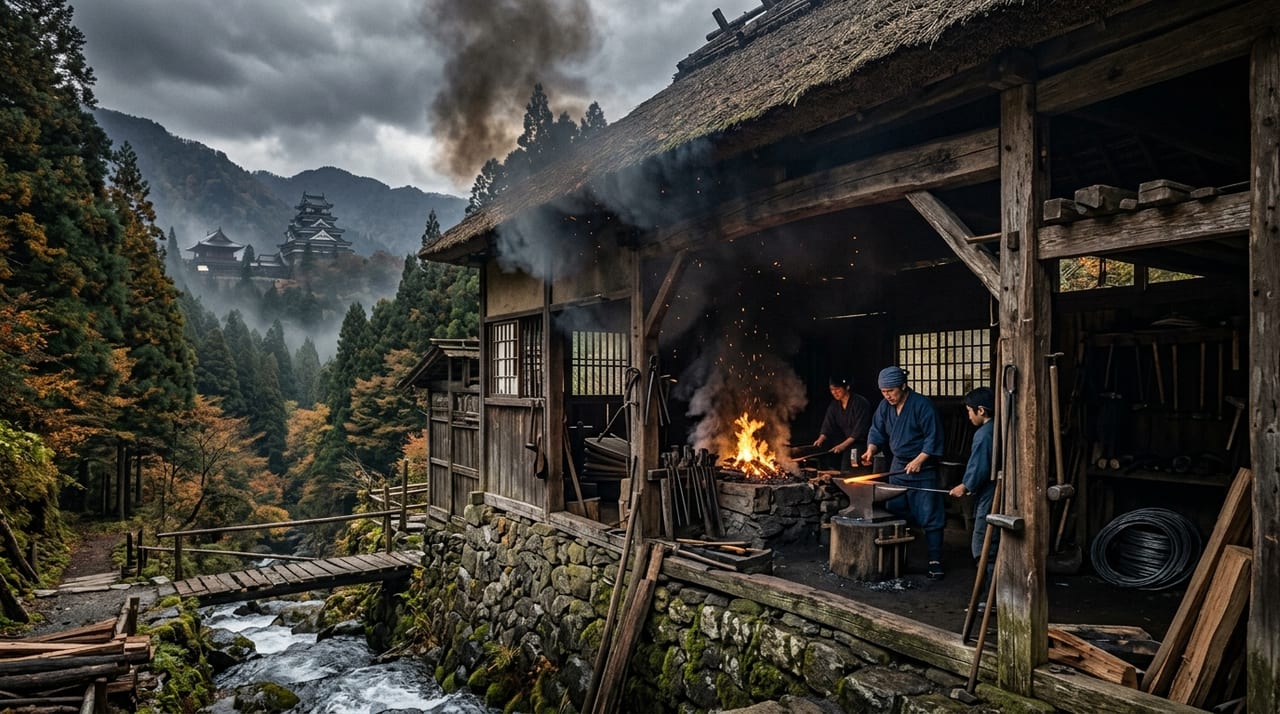
 * Image is for illustrative purposes only.
Echizen Tradition
越前伝
The sword tradition of Echizen Province (present-day Fukui Prefecture) was established by Yasutsugu, who was invited from Ōmi Province to the Echizen Matsudaira han (Fukui han) during the Keichō era. Echizen Yasutsugu, who received permission to carve the Tokugawa shogunal "aoi" crest, served as a shogunal goyō kaji and held an honor noted in the history of Japanese swords. He became known nationwide under the name "Aoi Shimosaka." Echizen blades, also known for their use of nanban-tetsu, were a representative example of dignified Shintō valued as gifts to the shogunate and to daimyō.
Description
Echizen Yasutsugu and the Tokugawa Shogunal House
Echizen Yasutsugu came from a family of swordsmiths who called themselves "Shimosaka" and were based in Ōmi Province (present-day Shimosaka, Nagahama, Shiga Prefecture). He was invited to Echizen Province (present-day Fukui Prefecture) during the Keichō era (1596–1615). He became a smith in the service of Yūki Hideyasu, lord of Kita-no-shō in Echizen and second son of Tokugawa Ieyasu. On Hideyasu's recommendation, Yasutsugu was summoned by Ieyasu and Tokugawa Hidetada around 1605–06 (Keichō 10 or 11; some say around Keichō 18) and forged swords in Edo. Ieyasu bestowed upon him the character "Yasu," and he changed his name to "Yasutsugu." He was also permitted to carve the hollyhock (aoi) crest, the Tokugawa family crest, into his nakago (tang). Thereafter, he carried on activities based in two locations, Echizen and Edo, serving in each alternately every other year. As a result, Yasutsugu's works, known as "Echizen Yasutsugu," "Shimosaka Yasutsugu," and "Aoi Shimosaka," held a distinguished position as swords associated with the shogunal house, carrying the highest prestige.
Significance of the Hollyhock Crest
Permission to inscribe the hollyhock crest on the nakago was one of the highest honors a swordsmith could receive. The hollyhock crest (three-leaf hollyhock) was the family crest of the Tokugawa, and Yasutsugu's family carved it into their nakago generation after generation. Later, during the Kyōhō era, Mondo no Shō Masakiyo of Satsuma and others were also permitted to use the single-leaf hollyhock crest. Yasutsugu blades bearing the hollyhock crest were used as gifts to the Tokugawa shogunal house and to daimyō across the country. Because of their high prestige, the name "Aoi Shimosaka" functioned as a brand certifying the quality of the swords. In the sword world today, signed "Yasutsugu" blades bearing the hollyhock crest are also valued as high-ranking Shintō.
Yasutsugu's Style
The original style of the first Yasutsugu is a hamon of notare with gunome-midare mixed in and sunagashi appearing on an itame-hada texture in the style of the Seki smiths. In 1615 (Genna 1), when he was commissioned to search for famous swords burned in the fall of Osaka Castle and to re-temper them, he began also making copies (utsushi) of famous swords, including those of Sōshū Sadamune. Many of his blades bear fine carvings (horimono), which were the work of Kinai and his lineage of carvers in Echizen. The second-generation Yasutsugu was also skilled, and his style is nearly the same as the first's, but few blades were made from the fourth generation onward. The nakago bears a signature (mei) indicating location, reading "made at ...," along with the hollyhock crest, which provides important information for judging signed works.
Nanban-tetsu and Two-Base Activities
Yasutsugu is said to have been the first smith to use nanban-tetsu (imported "southern barbarian" steel), and many of his works bear the inscription "made with nanban steel" on the nakago. By maintaining bases in both Echizen and Edo, the Yasutsugu family overcame the geographic marginality of the Hokuriku region.
Lineage of Echizen Blades and Later Smiths
After the death of the second-generation Yasutsugu, the family split into the Edo Shimosaka house and the Echizen Shimosaka house following a succession dispute. The Edo house continued until the twelfth generation around the Meiji period, and the Echizen house until the ninth generation at the end of the Edo period (bakumatsu). The reputation of the second-generation Yasutsugu, said to rank just below the first in prestige, is especially high. In addition, Echizen had smiths of the Shimosaka school beyond the Yasutsugu family, adding diversity and depth to the Shintō culture of Hokuriku. The continued service of these Echizen smiths to the Echizen Matsudaira family's demand established a firm foundation for sword culture in the region of Echizen.
Characteristics of This Era
- Aoi crest carving: The carving of the hollyhock (aoi) crest (three-leaf hollyhock) on the tang (nakago), permitted by Tokugawa Ieyasu, was one of the highest honors for a swordsmith. The name "Aoi Shimosaka," as a brand proving a direct connection to the shogunal house, still carries special prestige today.
- Highest patronage as shogunal goyō kaji: Yasutsugu's position as a sword smith serving the Tokugawa shogunal house, receiving financial and authoritative patronage from the bakufu, signifies an institutional peak that no other smith reached throughout the Shintō period.
- Style of the first-generation Yasutsugu: a hamon of notare mixed with gunome-midare and sunagashi, over itame-hada in the Seki smiths' style. Triggered by the reforging of famous swords burned in the Osaka campaigns, he also made copies of works such as Sōshū Sadamune.
- Two-base activity in Echizen and Edo: a distinctive production system in which a special position serving both the Fukui han and the bakufu overcame the geographic marginality of Hokuriku and enabled nationwide supply and appraisal.
- "Made at Echizen" and "Made at Edo" inscriptions: the signatures on the tang, which state the place of manufacture, together with the aoi crest, function as important physical indicators in the appraisal of signed works and the determination of zokudai (generation).
- Lineage continuing through Bakumatsu and Meiji: after the death of the second generation, the line split into the Edo house and the Echizen house. The Edo house continued to the twelfth generation around the Meiji period, and the Echizen house to the ninth generation in the late Edo period.