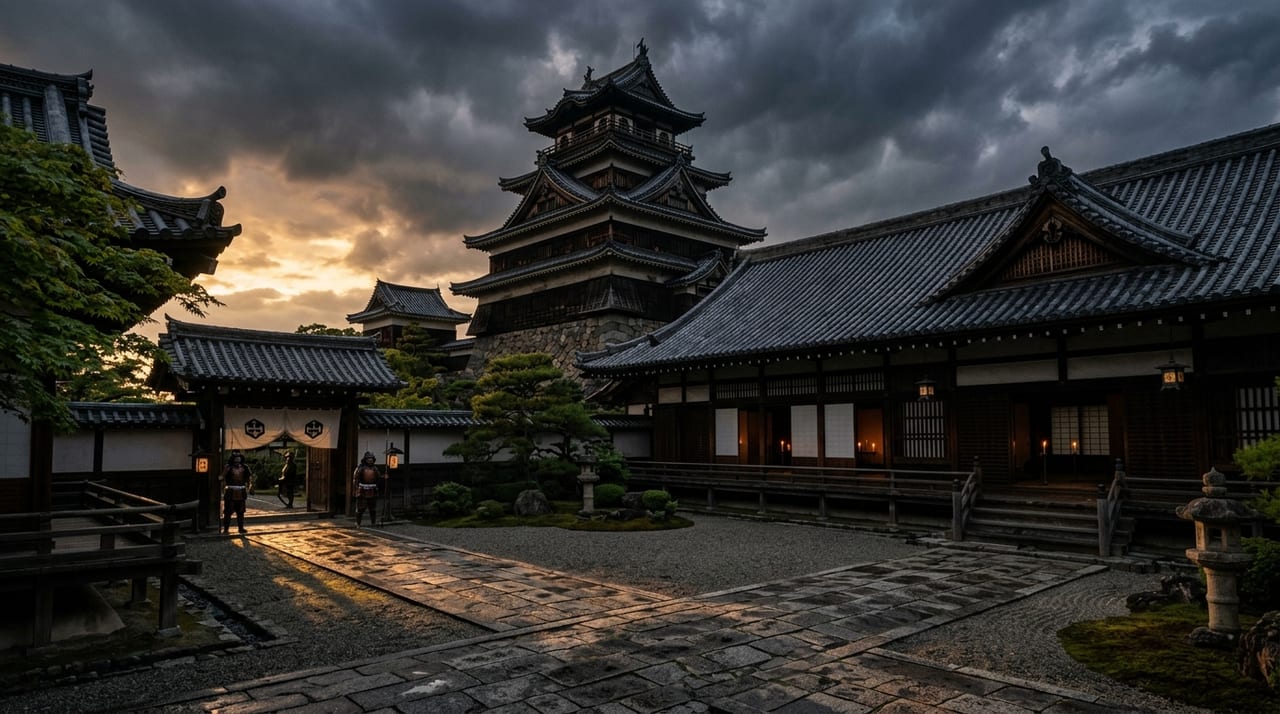
 * Image is for illustrative purposes only.
Kakitsu Era — The Kakitsu Disturbance and the Muromachi Sword Crisis
嘉吉(かきつ)
The significance of the Kakitsu era (1441–1444) in Japanese sword history, centered on the Kakitsu Disturbance (1441) — the assassination of Shogun Ashikaga Yoshinori by Akamatsu Mitsusuke. An exploration of how the disruption of shogunal authority affected sword demand, distribution, and social meaning, and how this political instability foreshadowed the coming upheaval of the Ōnin War.
Description
In the sixth month of Kakitsu 1 (1441), Akamatsu Mitsusuke, the shugo lord of Harima Province, perpetrated an unprecedented incident: he invited Shogun Ashikaga Yoshinori to his residence and had him assassinated during a banquet. This was the Kakitsu Disturbance. The shocking event of the shogun being slain at a retainer's residence dealt a fundamental blow to the authority of the Muromachi shogunate and determined the subsequent destabilization of the political order.
From the perspective of sword history, the greatest significance of the Kakitsu Disturbance lies in the social impact of the fact that "the sword was used as a direct instrument for the shogun's assassination." Following the era of Yoshimitsu, Yoshimochi, and Yoshikazu—when the Muromachi shogunate enjoyed its greatest stability—the assassination that occurred at the conclusion of Yoshinori's reign of terror, known as the "terror of all people," brought renewed visibility to the inseparable relationship between authority and the sword. The method by which armored Akamatsu warriors burst into the banquet room during a sarugaku performance and cut down the shogun demonstrated the dual nature of the sword: in a peaceful setting, it serves simultaneously as the foundation of order and as the means of destroying that order.
After the Kakitsu Disturbance, the shogunate elevated Yoshinori's legitimate son, Ashikaga Yoshikatsu, as the seventh shogun, but Yoshikatsu died in Kakitsu 3 (1443) at barely ten years of age. The shogunate remained unstable until the accession of his successor Ashikaga Yoshimasa (1449), and the tendency toward independence among provincial shugo lords intensified. This political vacuum held important significance for the sword industry—as central patronage and control weakened, regional sword makers began constructing autonomous production and distribution systems.
Although brief, the Kakitsu era was a period in which notable changes in sword style began. While the stable Ōei Bizen style continued, trends toward further shortening of blade length, changes in curvature, and diversification of hamon began to be attempted across various production centers. This was not merely technical evolution but also a response by sword makers to the destabilizing social situation. In the transitional circumstances where the demand for swords as preparation for actual combat intersected with demand for swords as peaceful appreciation and gifts, sword makers repeatedly conducted stylistic experiments.
The Kakitsu era is positioned as the beginning of approximately twenty-five years of political instability preceding the Ōnin War (1467). From this point onward, the Muromachi shogunate's cultural gravitational force in the world of swords was gradually lost, and in its place, provincial shugo lords, kokujin lords, and religious institutions emerged as independent subjects of sword patronage and collection. The historical experience of the Kakitsu era holds important significance as the starting point of the decentralization of sword culture—which also became a condition for the diverse flourishing of regional sword makers in the subsequent Sengoku era.
Characteristics of This Era
- The Kakitsu Disturbance (1441) — an unprecedented shogunal assassination that shook shogunal authority and the sword's social meaning
- The sword's dual nature made visible — the sword as both symbol of order and instrument of its violent destruction
- Weakening of central patronage — declining shogunal control accelerating regional smith autonomy and sword-trade decentralization
- Stylistic transition period before the Ōnin War — an experimental era bridging the stable Ōei Bizen period and late-Kotō mass production
- Rise of provincial lord sword patronage — dispersal of sword-cultural authority from the Ashikaga to regional daimyo and kokujin