Storage Forms for tantō — Practical Conservation of Museum-Grade Swords in shirasaya Mounting
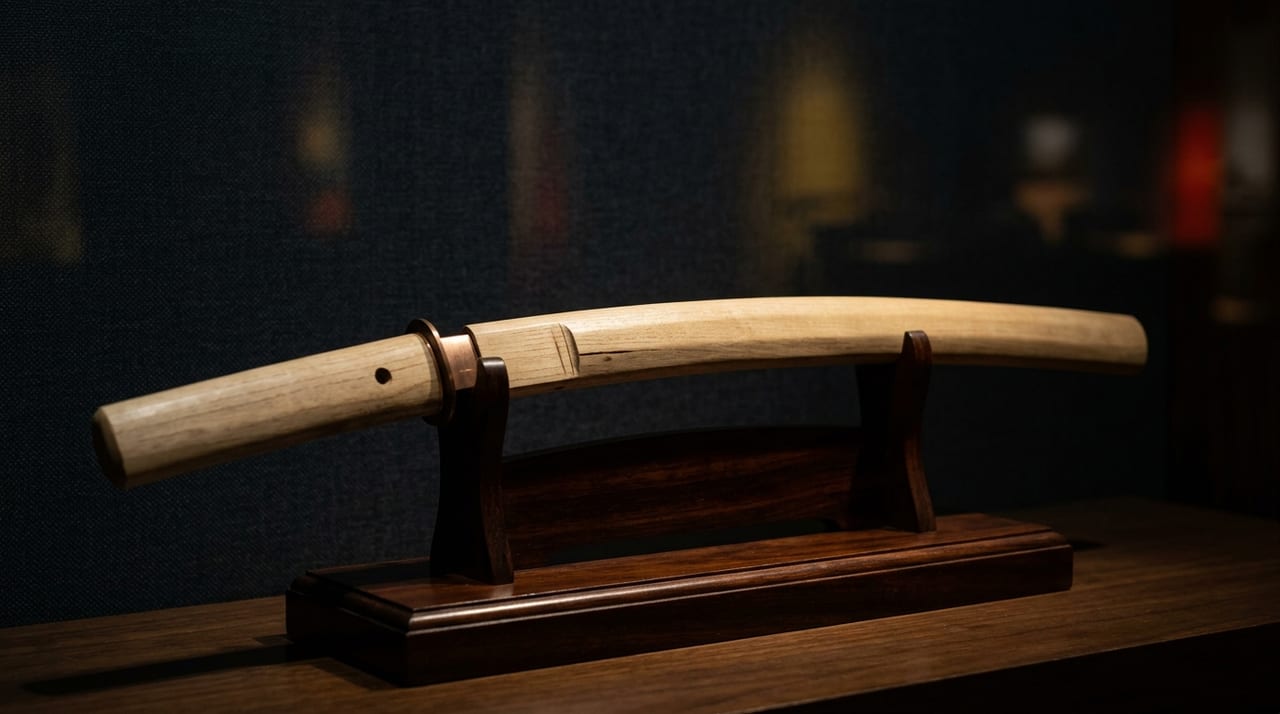 * Image is for illustrative purposes only.
Table of Contents
Preserving the tantō and the shirasaya — Why the "Plain-Wood Scabbard" Is the Optimal Solution
The tantō is a Japanese sword with a nagasa of less than one shaku (approximately 30.3 cm), and the element that plays the most important role in its preservation is the shirasaya. The shirasaya is a storage-only scabbard made from unfinished plain wood (shiraki) — principally honoki (Japanese white magnolia) — to which no lacquer has been applied; it was devised as a form for keeping swords safely over long periods.
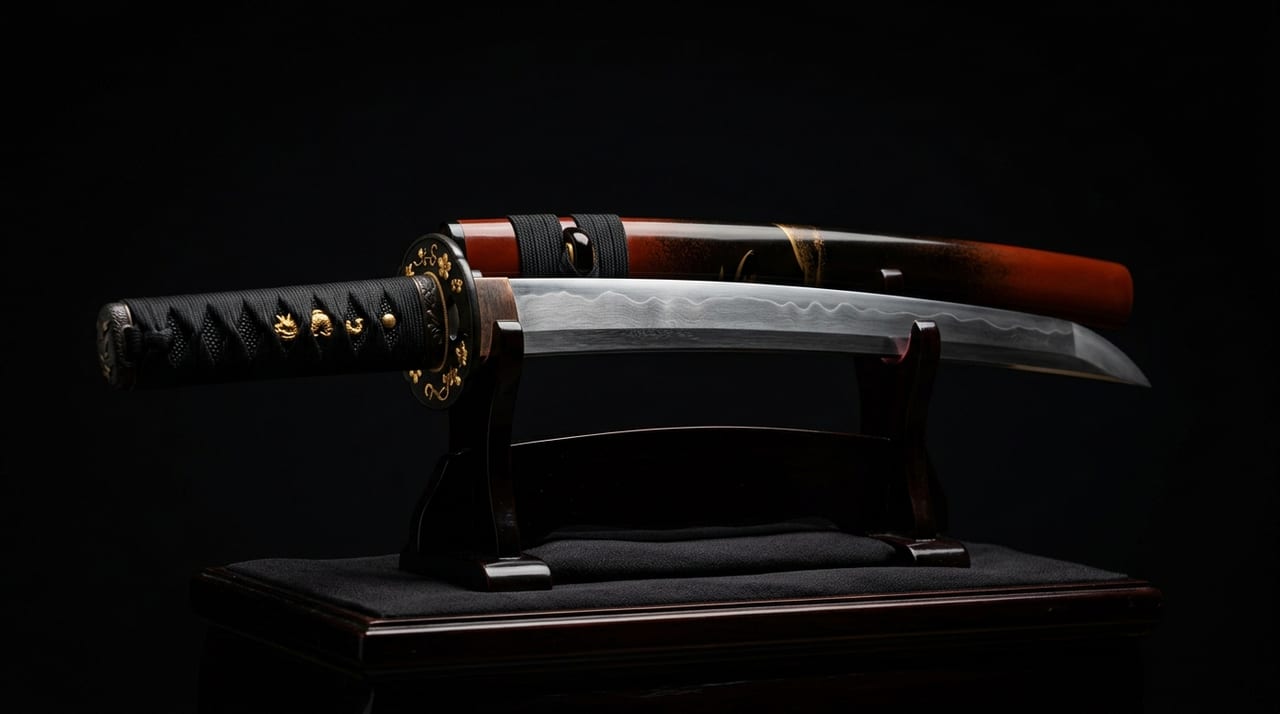
The elaborate koshirae adorned with lacquer and maki-e (sprinkled lacquer decoration) was the formal mounting of a samurai's sword in use, but it has aspects that make it unsuitable for preservation purposes. Lacquer is sensitive to changes in temperature and humidity, and stress on the blade caused by contraction and expansion tends to accumulate. Moreover, because the fittings — tsuba, menuki, tsuka, and fuchi-kashira — are in direct contact with the blade, reactions between materials can become a cause of rust over extended periods.
The shirasaya makes long-term preservation possible by exploiting the moderate moisture-absorbing and air-permeable properties of wood to keep the humidity around the blade stable, while minimizing contact with metal. The fact that many of the masterworks held by national public institutions such as the Tokyo National Museum and the Kyoto National Museum are housed in shirasaya is a consequence of this preservation rationale.
The Shirasaya Craftsman's Techniques — From Material Selection to Finishing
The production of a shirasaya is the work of a specialized craftsman known as a shirasayashi. Both advanced woodworking skill and knowledge of swords are required to create a scabbard that conforms perfectly to the dimensions and form of the blade.
- Material selection: Honoki (Japanese white magnolia) is the primary wood used for shirasaya. Honoki is soft and easy to work, yet possesses moderate hardness and resilience; it contains few components that corrode iron, its grain is relatively uniform, and it is unlikely to warp or split. High-quality shirasaya stock that has been sufficiently seasoned (timber moisture content of approximately 12–15%) is preferred, and using material that has undergone a drying period is a fundamental principle for craftsmen.
- Split construction of the scabbard: A shirasaya is constructed in a "two-piece joined" structure. Two planks are hollowed out to match the cross-sectional profile of the blade, creating a space that holds the blade snugly, and then joined together. Rice paste (komenori) — rice starch that has been cooked — is traditionally used as the adhesive; woodworking synthetic adhesives are not used because they may adversely affect the blade.
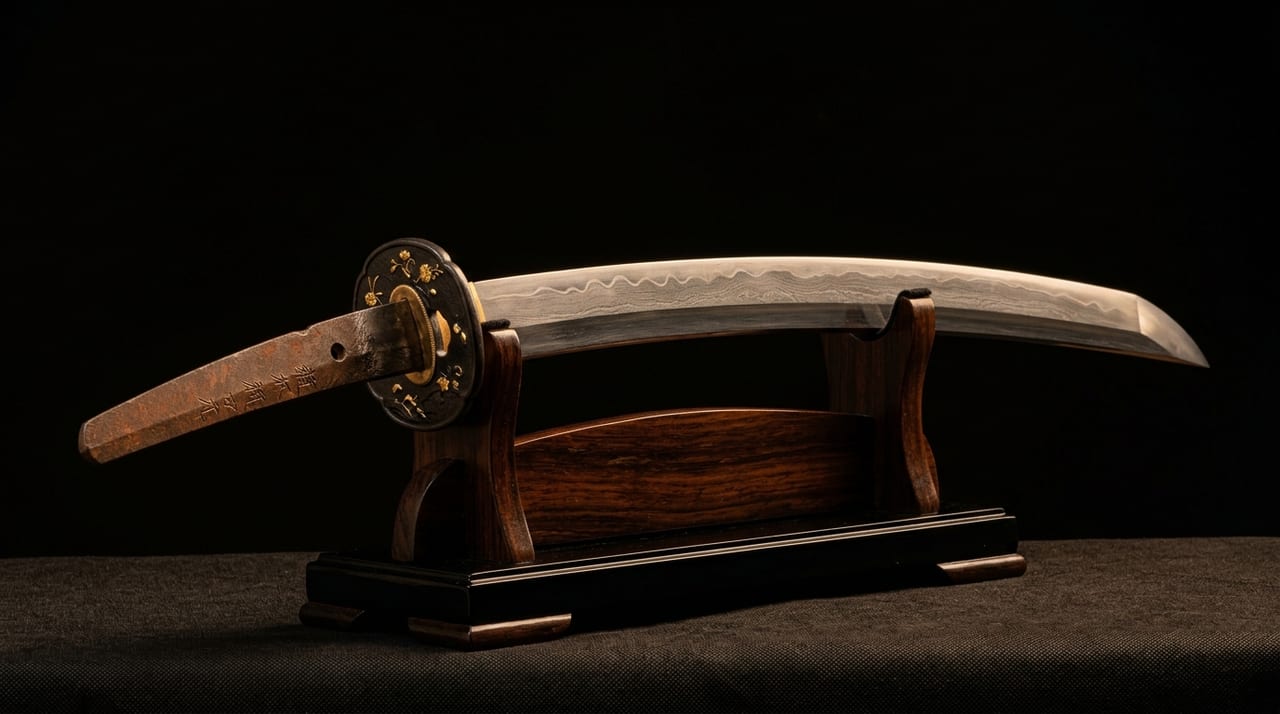
- Fit with the habaki: The form of the koiguchi (scabbard mouth) fitted to the habaki — the collar that secures the blade near the hamachi (blade notch) — is critical. Because looseness between the habaki and the koiguchi undermines the rust-prevention effect, a precise fit is required. A skilled shirasayashi develops the discernment to grasp the form and dimensions of a habaki at a glance and shape an appropriate koiguchi accordingly.
The Science of Humidity and Temperature Management — The Physics of Rust and Wood
The greatest enemy in preserving the tantō is rust, and the primary cause of rust is the coexistence of excess humidity and oxygen. The oxidation reaction of iron (rusting) progresses rapidly when humidity exceeds 60%, and repeated sudden fluctuations in humidity in particular tend to destroy the protective film (passive film) on the surface of the blade.
The ideal environmental conditions for preservation are considered to be a stable state of 15–20°C and 45–60% relative humidity. Museums and art galleries install precision air-conditioning systems in their storage rooms and maintain these conditions throughout the year. For private collectors, sword-dedicated cases with humidity-control functions, or storage methods combining silica gel (desiccant) and anti-rust paper, are practical options.
From a timber perspective, temperature and humidity management is equally important. The wood of the shirasaya expands and contracts as it repeatedly absorbs and releases moisture, and this movement can cause minute abrasion on the blade. In winter, when desiccation is severe in particular, the shirasaya may shrink and the blade can shift inside the scabbard, causing scratches from repeated drawing and resheathing. Maintaining appropriate humidity is indispensable for keeping the movement of the wood to a minimum as well.
Uchiko and Clove Oil — Practical Care Procedure
The care carried out before and after housing the blade in shirasaya is the most fundamental task in the practical management of tantō preservation.
- Cleaning with uchiko: Uchiko is the fine powder of a whetstone — primarily natural whetstones from Kyoto such as uchigumori-to — wrapped in a thin silk pouch. Holding the blade horizontally, lightly tap the uchiko across the entire cutting surface and jihada, then carefully wipe it away with a soft nugui-gami (oil-free Japanese paper or a dedicated cloth). This step removes the old oil applied on the previous occasion along with minute dirt.
- Application of chōji oil: Apply a thin, uniform coat of chōji oil — a plant-based oil containing the essential oil of chōji (cloves) — to the cleaned blade. Chōji oil has a rust-preventive effect and forms a thin protective film over the blade surface. Because oil applied too thickly adheres to the inside of the scabbard and accelerates deterioration of the wood, the principle is "thin and uniform."
- Frequency of care: When the storage environment is stable, care approximately once every three to six months is the general guideline. During the rainy season of high humidity, increasing the frequency is recommended, and in the dry winter season, careful observation after care is advised.
Comparison with Museum and Art Gallery Long-Term Conservation Systems
The tantō held by national public museums such as the Tokyo National Museum, the Kyoto National Museum, and the Nara National Museum are managed on a scale incomparable to that of private collectors.
Storage rooms employ a two-stage temperature and humidity management structure (an outer storage room and an inner preservation box), and blades are placed in their shirasaya, inserted into dedicated cloth storage bags (katana-bukuro), and kept in paulownia boxes (kiribako). Paulownia possesses moderate moisture-absorbing and -releasing properties and insect-repelling effects, and has been used since ancient times as a material outstanding for long-term preservation.
During periodic condition checks, specialist conservation-restoration staff open the shirasaya to visually inspect the blade for rust, scratches, and edge chipping, and decide as necessary whether to commission a togishi. Because polishing once carried out irreversibly alters the jihada and hamon of a blade, museums adopt a policy of "minimum necessary polishing."
When a private collector houses a tantō, drawing on this museum-style approach to management leads to long-term protection of the cultural property. The foundation for handing down cultural heritage to the next generation lies in observing the following four fundamentals.
- Shirasaya
- Paulownia box
- Appropriate temperature and humidity environment
- Regular care