Procurement Practices of Japanese Sword Retailers — Trade Customs and Trust-Building with Wholesalers and Distributors
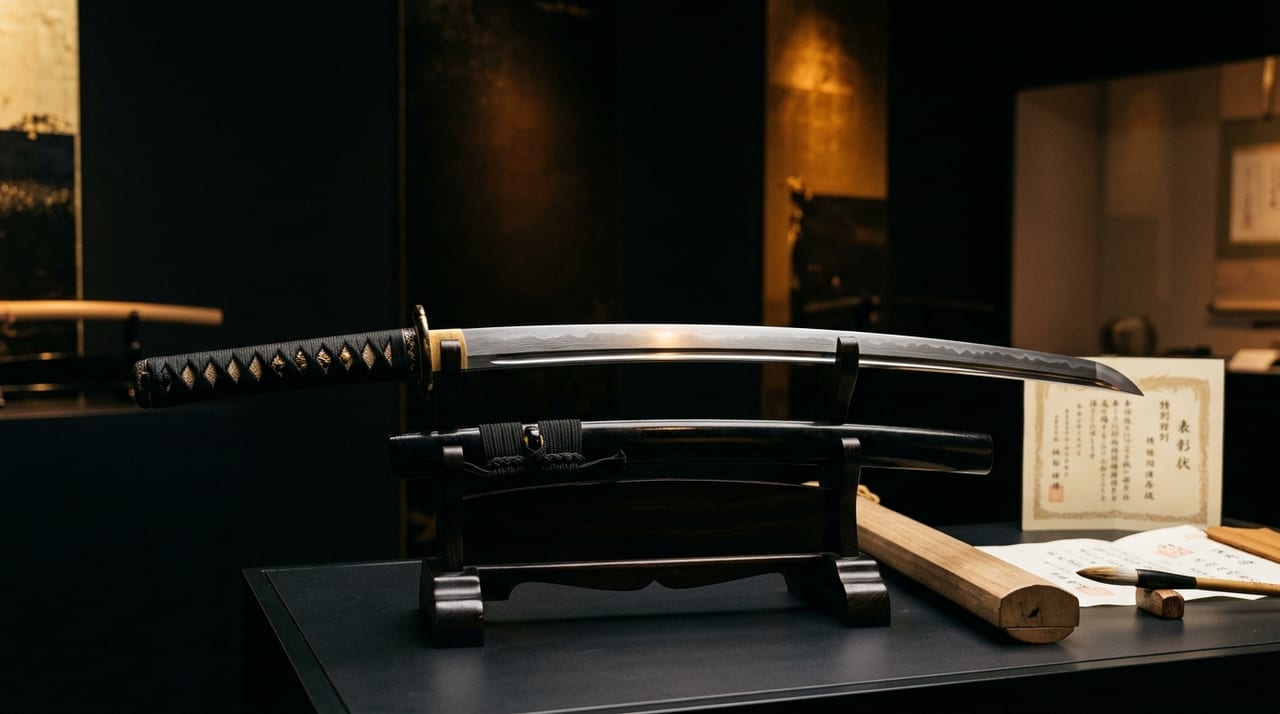 * Image is for illustrative purposes only.
Table of Contents
The Distinctive Nature of Japanese Sword Retailing as a Business
Running a retail shop dealing in Japanese swords operates within a set of trade customs that differs greatly from those of ordinary antique dealers or art dealers. Although these are high-value items with unit prices ranging from several hundred thousand yen to tens of millions of yen, every single piece differs from another — unlike mass-produced goods — in its provenance, condition, and whether or not it comes with a registration certificate under the Firearms and Swords Control Act (Jūtōhō). A sword purchased for stock may sell within a few months, or it may not move at all for several years, and this difficulty in forecasting cash flow is the fundamental challenge of this type of business.
Moreover, the legal procedures required to handle these items are entirely different from those for industrial products. The registration certificate issued under the Act for Controlling the Possession of Firearms or Swords and Other Such Weapons (Jūtōhō) is obtained by the sword's owner through an application to the prefectural Board of Education, and a notification of change of ownership must be filed every time the title transfers. Retailers stand in the position of verifying that these procedures have been properly completed, though the procedures themselves are carried out by the parties — seller and buyer — involved. Understanding this legal background before entering into transactions is the first hurdle for anyone starting out in Japanese sword retailing.
The Structure of Procurement Channels
Procurement channels for Japanese sword retailers can be broadly divided into three categories.
- Purchasing from wholesalers and distributors: This has the advantage of sharing part of the authentication verification, but because a wholesale margin is added on, the retail margin tends to be thin.
- Direct purchasing from private owners: While margins are easier to secure, the accuracy of authentication judgments and market price awareness translates directly into business risk.
- Trade auctions and bidding events: These offer exposure to a wide variety of pieces through a competitive format among fellow dealers, but competition is fierce and acquisition prices tend to rise.
Purchasing through wholesalers is an accessible entry route for retailers who are new to the industry. Wholesalers aggregate items from multiple owners and provide them to retailers after a degree of vetting for authenticity and condition, thereby reducing the investigative burden that a retailer would otherwise have to handle alone. However, because acquisition prices rise by the amount of the wholesale margin, many shops gradually increase the proportion of direct purchases as their years in the trade accumulate.
Trust Relationships with Wholesalers and Terms of Trade
In the Japanese sword industry, the relationship with wholesalers is built not on one-off purchase contracts but on the accumulation of long-term trust. Retailers with a track record of ongoing transactions may receive priority notification from wholesalers when new stock arrives, and the opportunity to acquire quality pieces at an early stage is a direct economic benefit of that trust relationship.
Among the terms of trade, two are especially important: buyback guarantees and consignment sales (consignment).
A buyback guarantee is an arrangement in which the wholesaler agrees to take back a sword under certain conditions if it fails to sell within a specified period. For the retailer, it functions as a safety valve that limits inventory risk and plays a significant role in particular when deciding whether to purchase high-value items. Whether such a guarantee is offered, and on what terms, varies from wholesaler to wholesaler, and the ease with which favorable conditions can be obtained is influenced by the retailer's trading track record and personal relationships.
Consignment sales are an arrangement in which the retailer takes custody of a sword and receives a commission once the sale is concluded. While this reduces the retailer's financial burden, the retailer bears responsibility for the safekeeping of the consigned piece and for explaining its authenticity to the buyer. For this reason, the decision of whether to accept a consignment requires both trust in the consignor and the retailer's own appraisal ability. The finer details of the terms — such as payment periods and whether returns are permitted — are often negotiated individually over the course of a long relationship, and it is difficult for those who have just entered the industry to obtain favorable conditions.
Practical Aspects of Authentication and Price Formation
The price of a sword is formed through the complex interplay of multiple factors: whether a mei (signature) is present and its authenticity, the quality of the hamon (temper line) and jihada (grain pattern of the steel), the condition of preservation, the state of polishing, and the quality of any accompanying koshirae (mounting) and tōsōgu (sword fittings). Retailers need to assess all of these comprehensively at the point of purchase, but few shops are capable of making specialist judgments on their own across every school, period, and region.
For this reason, a custom has taken root in the industry whereby retailers and wholesalers with different areas of expertise exchange information, and opinions are sought from fellow dealers when a judgment is uncertain. Consulting a fellow dealer who is well versed in a particular school, or giving preference to purchasing pieces that have been examined by a public body that conducts sword appraisals, are practical measures for keeping business risk in check.
In price formation, the accumulated sense of market value — an understanding of the price ranges at which swords sharing the same mei and condition have traded in the past — forms the basis of judgment. This market sense can only be acquired through continuous participation in the market and the accumulation of trading experience, and it is supported by the daily exchange of information with wholesalers and fellow dealers.
Inventory Strategy and Cash Flow Management
Demand in the Japanese sword market is not constant, and the timing at which swords come onto the market through inheritances or estate clearances is difficult to predict. Because swords held as stock for long periods also incur the cost of maintaining appropriate storage conditions, the decisions about what kind of pieces to purchase and at what price points directly affect the stability of the business.
An inventory composition skewed toward particular tōkō (swordsmiths), periods, or price ranges increases the risk of tying up capital for extended periods when demand in that area thins. Maintaining a balanced mix of pieces spanning a wide range of price points and periods is considered the basic principle of an inventory composition that can accommodate fluctuations in demand. When holding high-value inventory for long periods, it is also necessary to allow for a considerably long time before the sword sells when planning working capital. Procurement decisions must always be made in conjunction with an outlook on when the piece can be sold; without this, the risk of cash flow difficulties increases.
The Shift to Online Sales and the Transformation of Trade Customs
As online trading in Japanese swords has expanded, information about procurement and sales that previously depended on local and personal connections has come to circulate across a much wider area. An environment in which listing information can be viewed at a glance online makes it easier for prospective buyers to compare and evaluate options, while for retailers it is also a factor that increases transparency in market prices.
However, the importance of expert appraisal — authentication and verification of provenance — does not change with the shift to online. There is much that cannot be judged from photographs and written descriptions alone, and the accumulated experience of physically handling swords supports the accuracy of procurement decisions. The long-established trade customs with wholesalers and the information-exchange networks within the industry continue to function as the foundation of procurement even now, as distribution channels have expanded online. There is no shortcut to building trust, and the personal relationships formed through the accumulation of transactions are themselves the greatest business asset in Japanese sword retailing.