A Roadmap for Entering the Sword Industry: A Complete Explanation of the Licensing System and Legal Regulations
 * Image is for illustrative purposes only.
Table of Contents
The Dual Legal Environment Surrounding Sword Dealers
To engage in the buying and selling of Japanese swords, one must meet a dual layer of legal regulations that differs from ordinary retail sales. The first is the secondhand dealer permit based on the Secondhand Articles Dealer Act, and the second is the registration system for swords defined by the Act for Controlling the Possession of Firearms or Swords and Other Such Weapons (Jūtōhō). Accurately understanding these two legal frameworks is the first step toward entering the sword industry.
The Secondhand Articles Dealer Act was enacted in 1949 and is a law that obliges those who engage in the buying and selling of used goods as a business to obtain a permit. Swords and bladed weapons are explicitly listed as one of the 13 categories of secondhand goods under this law, and a secondhand dealer permit is always required to engage in the buying and selling of Japanese swords, wakizashi, tantō, and similar items as a business.
The Firearms and Swords Control Act (Jūtōhō), on the other hand, was enacted in 1958 and strictly regulates the possession, sale, and carrying of swords and bladed weapons. Under this Act, a "registration" system has been established for art swords with cultural property value, and only swords accompanied by a registration certificate issued by each prefectural Board of Education may be legally possessed and traded. Dealers must always keep this dual structure in mind when conducting business.
Requirements and Application Procedures for a Secondhand Dealer Permit
A secondhand dealer permit application is submitted to the prefectural Public Safety Commission having jurisdiction over the location of the business premises. The Community Safety Division of each police station serves as the point of contact.
The main requirements for obtaining a permit are as follows.
- The applicant must be an adult.
- Five years must have passed since the completion (or similar) of a sentence of imprisonment or heavier punishment.
- Five years must have passed since the completion (or similar) of a fine for offenses such as operating without a permit under the Secondhand Articles Dealer Act, or offenses such as theft, breach of trust, embezzlement of lost property, or paid acquisition of stolen goods.
- The applicant must have a fixed place of residence.
- Five years must have passed since any prior revocation of a secondhand dealer permit.
The permit standards are set out in Article 4 of the Secondhand Articles Dealer Act (e-Gov Legal Search).
| Item | Details |
|---|---|
| Required documents (individual) | Application form, certificate of residence, identity document, sworn statement, brief personal history |
| Required documents (additional for corporations) | Articles of incorporation, certificate of registered matters |
| Permit fee | 19,000 yen nationwide (revenue stamp) |
| Review period | Approximately 40 days as standard |
Once the permit is granted, a "secondhand dealer permit certificate" is issued. There is no "swords and bladed weapons" category among the 13 categories of secondhand goods, and Japanese swords are often handled as craft items under the "works of art (paintings, sculptures, craft items, etc.)" category (simultaneous application for multiple categories is also possible, Enforcement Regulations of the Secondhand Articles Dealer Act (e-Gov Legal Search), Article 2).
The following continuing obligations after obtaining a permit are stipulated by law.
- Identity verification of the counterparty at the time of purchase or sale
- Retention of transaction records in a ledger or electronic records for three years (Secondhand Articles Dealer Act (e-Gov Legal Search), Article 18)
- Reporting to the police when there is suspicion of stolen goods, etc.
Neglecting these obligations may result in permit revocation or criminal penalties.
The Registration System under the Firearms and Swords Control Act (Jūtōhō): Dealing Only in Properly Registered Swords
The most distinctive feature of the sword industry is that there are restrictions on the goods that can be handled. The "registered sword" system based on Article 14 of the Firearms and Swords Control Act (Jūtōhō) is the heart of this.
Following postwar sword confiscation and the Sword Abolishment Edict (Haitōrei), the only Japanese swords currently circulating in the market are those that have received registration as items "having value as works of art." Registration is carried out at a registration review board held by each prefectural Board of Education, where registration review examiners for firearms and swords conduct an actual appraisal of the sword; if artistic value is recognized, a registration certificate is issued.
The registration certificate records the following information.
- Type of sword (tachi, katana, wakizashi, tantō, etc.)
- Nagasa
- Sori
- Number of mekugi holes
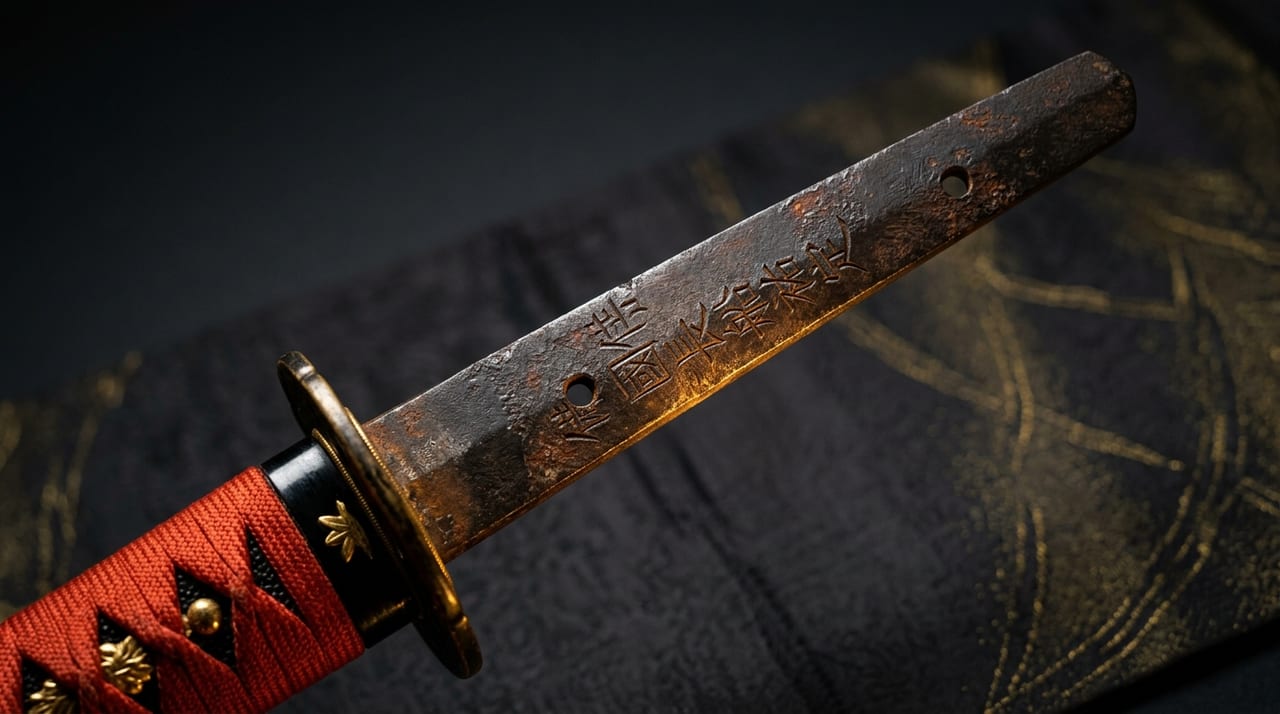
- Mei inscription
The registration certificate is treated as inseparable from the sword; whenever a sale or transfer is made, the registration certificate must always accompany the sword. An obligation also arises to notify the prefectural Board of Education listed on the registration certificate of the change of ownership within 20 days of acquisition (this notification is to the prefectural Board of Education that issued the registration certificate, not the police station that receives notifications under the secondhand dealer permit).
Swords and bladed weapons that have not been registered cannot in principle be possessed even if they have historical value (Act for Controlling the Possession of Firearms or Swords and Other Such Weapons (e-Gov Legal Search), Article 3, Paragraph 1). When one is found, a report of discovery must be made to the police (Article 23 of the same Act) and the sword must undergo Board of Education registration review; if the sword cannot be registered, it cannot be possessed, so a report must be made to the police and the sword must be disposed of or otherwise processed (Tokyo Metropolitan Board of Education, "When Firearms or Swords Are Found"). Sword dealers should always keep in mind that they cannot acquire and possess swords that have not been registered.
The Role of Sword Dealer Associations and Their Practical Benefits
The Japanese sword trade industry has organizations aimed at mutual assistance among dealers and the sound development of the industry. The most notable of these is the Zenkoku Tōken Shōgyō Kyōdō Kumiai, which sword dealers from across the country join.
The cooperative's main activities are as follows.
- Providing a forum for inter-dealer trading. The tōkenichi (inter-dealer auction) hosted by the cooperative is a closed trading venue that only members may participate in; superior pieces that are difficult to obtain on the general market often circulate there, making it an indispensable opportunity for building inventory.
- Activities to enhance the credibility of the entire industry, including sharing information on forgeries and stolen goods and responding to changes in laws and regulations.
- Holding training sessions and study meetings for new entrants.
- Functioning as a liaison with the National Police Agency and the Agency for Cultural Affairs, and lobbying to convey industry opinions to government authorities.
The authoritative institution for authenticating the genuineness of swords is the Kōeki Zaidan Hōjin Nihon Bijutsu Tōken Hozon Kyōkai (NBTHK). The kanteisho issued by the NBTHK (with grades of Hozon, Tokubetsu Hozon, Jūyō, and Tokubetsu Jūyō) are directly linked to price valuation in the market and have become indispensable certificates for sword dealers when explaining value to customers. Membership in the association is voluntary, but many sword dealers become members to enhance their credibility within the industry.
Special Obligations of Auction Organizers
Separate from ordinary sword trading (as a secondhand dealer), anyone who organizes an auction (secondhand goods market) to mediate sales between third parties requires a "secondhand goods market operator permit" in addition to a secondhand dealer permit. The prefectural Public Safety Commission is also the permitting authority for the secondhand goods market operator permit, and the requirements for obtaining it are similar to those for a secondhand dealer permit, but appropriate facility requirements for establishing a market are added.
The main legal obligations of auction organizers are as follows.
- Obligation to verify participants. Only dealers holding a secondhand dealer permit may participate in a secondhand goods market, and the organizer must verify the permit of every participant.
- Obligation to retain transaction records. The item, amount, seller, and buyer of each transaction must be recorded and retained for three years.
- Obligation to immediately report to the police if an item suspected of being stolen is brought in.
- When dealing in swords and bladed weapons, the obligation to confirm the existence of a registration certificate for each sword.
In recent years, the spread of internet auctions has led to an increase in online sword trading. Transactions conducted through online platforms remain subject to the Secondhand Articles Dealer Act, and it is required to establish a lawful system for identity verification and record retention. As of 2026, the National Police Agency is developing guidelines on the digitization of identity verification procedures, and dealers are recommended to periodically check the latest operational guidelines.
Practical Checklist for Entering the Industry
The following is a summary of practical steps for those considering entering the sword industry.
- As a matter of legal understanding, read the provisions of the Secondhand Articles Dealer Act and the Firearms and Swords Control Act (Jūtōhō), and verify the latest operational guidelines through official information from the National Police Agency and the Agency for Cultural Affairs.
- To apply for a secondhand dealer permit, consult with the Community Safety Division of the police station having jurisdiction over your business premises, then prepare the required documents and submit your application.
- When considering joining dealer associations and preservation associations, consider joining the Zenkoku Tōken Shōgyō Kyōdō Kumiai and the NBTHK. This will be of great help in securing initial sourcing routes and acquiring appraisal knowledge.
- As a step of establishing a registration certificate management system, build a ledger system to reliably manage the registration certificates of the swords you handle.
- To build the habit of ledger and record management, be thorough in creating and retaining legally required transaction records in preparation for police inspections.
The sale and purchase of Japanese swords is an industry bearing the noble mission of passing on historical and cultural heritage. Correctly understanding the laws and conducting business with integrity forms the foundation that protects the credibility of the entire industry and supports the transmission of culture to the next generation.