Inventory Turnover Management for Sword Dealers — The Art of Sword Shop Inventory Management Where Purchasing, Consignment, and Restoration Costs Intertwine
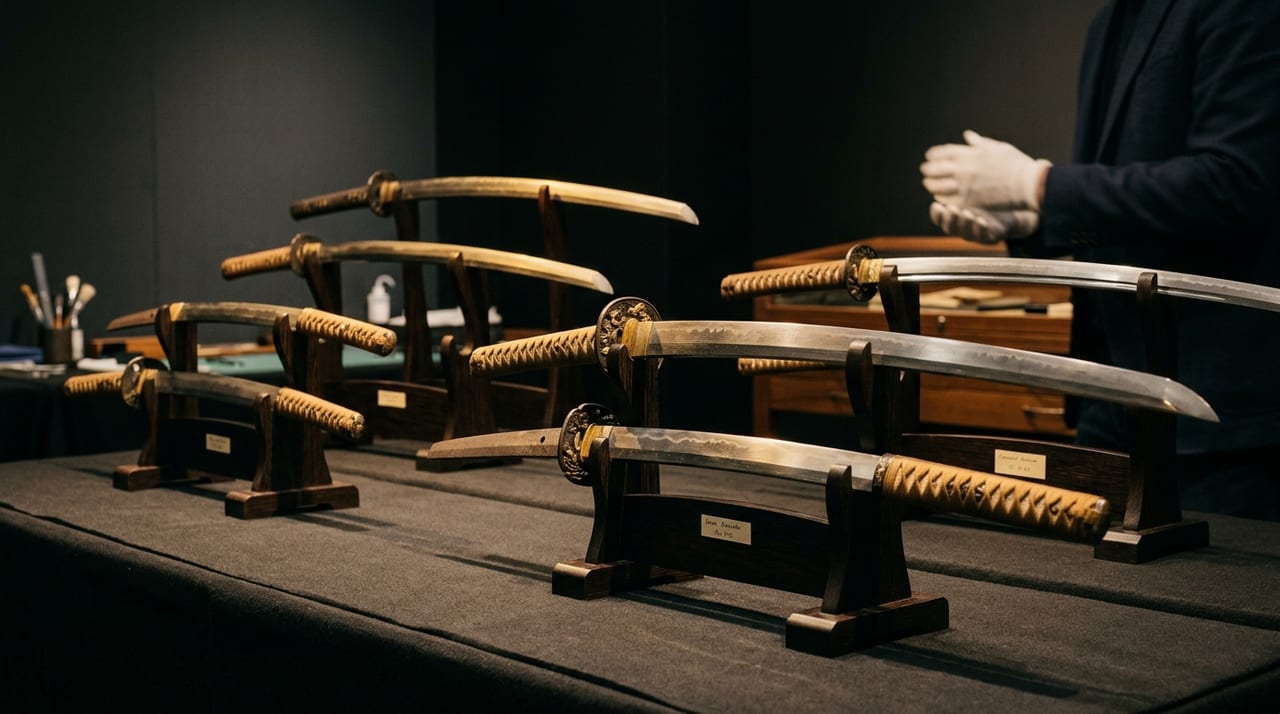 * Image is for illustrative purposes only.
Table of Contents
What Is a Sword Dealer's Inventory? — A Fundamental Difference from General Retail
Inventory in general retail operates on the premise of a fast-turnover model in which identical goods are procured in bulk and sold within a fixed period. The inventory of a Japanese sword specialty shop, however, is a special world where that conventional wisdom does not apply.
A Japanese sword is a one-of-a-kind work of art in which each individual piece differs, making bulk procurement of identical items impossible. Buyers are also limited, and it is not unusual for a single sword to remain on the shop floor for several years. Unit prices range from hundreds of thousands to tens of millions of yen, and simply holding the item as inventory causes storage costs, insurance fees, and opportunity costs to accumulate.
These characteristics complicate inventory management for sword dealers. While sharing challenges with other art dealers (antique dealers, jewelers), what makes sword dealing difficult is that unique challenges — legal regulations (the Firearms and Swords Control Act (Jūtōhō)), preservation conditions (humidity and temperature control), and the need for restoration — are layered on top.
The Logic Behind Determining Purchase Prices — Procurement Determines Profit
In sword dealer management, controlling inventory acquisition costs has the most direct impact on profit margins. The purchase price for a sword brought in for sale is determined through a composite evaluation of several factors.
The basic evaluation criteria are as follows.
- The tōkō's standing (ranging from Living National Treasure and jūyō bunkazai (Important Cultural Property) class down to mumei (unsigned))
- Condition (degree of rust, edge chipping, need for polishing)
- Accessories (presence or absence of a kanteisho (appraisal certificate), type and condition of the koshirae (mounting))
- Period (kotō, shintō, shinshintō, gendaitō)
What must be noted is that the purchase price is calculated as "selling price minus necessary costs." For a sword requiring polishing, for instance, an estimate of restoration costs is made before the purchase, and that amount is deducted from the purchase price. Even for a sword with a market value of 500,000 yen, if polishing costs 150,000 yen and obtaining a kanteisho costs 30,000 yen, the ceiling purchase price to secure a profit works out to roughly 300,000–350,000 yen.
This "reverse calculation of restoration costs" is the foundation of purchase appraisal, but in practice additional problems may be discovered after restoration has begun, so sword dealers build in a certain buffer when making their assessments.
The Mechanics of Consignment Sales — A Method for Distributing Inventory Risk
Consignment sales (itaku hanbai) are an effective means of enriching product selection while keeping one's own capital risk in check. It is a model in which the sword's owner consigns the sale, and the sword dealer receives a commission when the sword sells.
Commission rates vary by sword dealer and also change through negotiation. For expensive swords, agreement may be reached at a lower rate. When the consignor is in a stronger position (such as when they can place competing consignments with multiple sword dealers), commissions tend to fall as well.
The challenge of consignment sales is "controlling the quality of inventory." With direct purchase, a sword dealer can take full responsibility for understanding the quality and condition of every sword procured. With consignment items, however, since they are brought in by numerous owners, the appropriateness of pricing, the reliability of kanteisho, and the uniformity of preservation conditions must each be managed individually.
The handling of consignments when the period extends over a long time also becomes a problem. Generally, "six months to one year" is used as a guideline for the consignment period, and if the sword does not sell beyond that, negotiations are held for return or a price revision.
Managing Restoration Costs — The Trap of Maximizing Inventory Costs
When a sword procured by a sword dealer requires restoration, the restoration costs are recorded as part of the inventory cost. Failure to manage these costs is the greatest factor that compresses inventory profitability.
The main types of restoration costs and their going rates are as follows.
| Restoration Item | Going Rate | Notes |
|---|---|---|
| Polishing (re-polish) | 150,000–250,000 yen for an uchigatana with a nagasa (blade length) of approximately 2 shaku (60 cm) | The amount varies by degree of rust, nagasa, and delicacy of the hamon (temper line). If a skilled togishi (polisher) is commissioned to restore the delicate hamon of a celebrated piece, it can exceed 500,000 yen |
| New shirasaya (plain storage scabbard) | Roughly 30,000–80,000 yen | Replacement of the storage saya (scabbard). An essential item for storage; if a sword with a shirasaya in poor condition is procured, this expense is nearly unavoidable |
| Obtaining a kanteisho (appraisal certificate) | Roughly 20,000–50,000 yen | The combined amount for registration fee, examination fee, and issuance fee when applying to NBTHK (Society for the Preservation of Japanese Art Swords). Since a sword without a kanteisho loses significant market value, the cost of obtaining one must be factored in for any sword acquired without one |
| Metalwork restoration (cracked tsuba (hand guard), missing menuki, damaged habaki (blade collar)) | Tens of thousands to hundreds of thousands of yen | Involves outsourcing to a metalworking craftsman; the range varies by scale |
Whether these costs can be accurately estimated is the core of a sword dealer's appraisal capability.
Controlling Inventory Turnover Period — The Technique for Preventing "Dead Stock"
Managing long-term inventory (so-called "dead stock") is one of the management challenges for sword dealers. When a single sword fails to sell for an extended period, the triple pressure of storage costs, insurance fees, and capital immobilization continues.
There are several strategies for preventing dead stock.
- Staged price reviews: Six months after procurement, regular price reviews are conducted based on market response. For online shops, data such as page view counts and the number of times an item has been saved to favorites serve as reference.
- Diversifying sales channels: In addition to in-store sales, multiple channels are pursued, including listing in sword-specialist auctions (domestic and overseas) and reaching out to potential customers through SNS-based information dissemination.
- Segment management by buyer profile: Customer segments such as domestic sword enthusiasts, corporate collectors, overseas buyers, museums, and Shinto shrines and Buddhist temples are identified, and inventory plans are drawn up with appropriate buyers for each sword type determined in advance.
In recent years in particular, overseas demand has been increasing, and there are reported cases of sword dealers who have organized their operations to serve collectors in Europe, North America, and East Asia seeing improvements in inventory turnover. Proficiency in English-language product descriptions, legal procedures for international shipping, and export procedures (such as the Certificate of Export Inspection for Antique Art Objects) has become a new weapon in inventory management.
The Reality of Business Operations — Conditions for Sword Shops to Survive Through Inventory Management
For modern sword dealers to sustain their businesses over the long term, management acumen to simultaneously control the quality, quantity, cost, and turnover speed of inventory is required.
For newcomer sword dealers with limited capital, the realistic policy is to actively utilize consignment sales to minimize their own inventory risk while selectively procuring swords in good condition that require less restoration. Established sword dealers, on the other hand, can leverage their long-standing customer networks and relationships with restoration craftsmen as a strength, and use the "polishing profit" model of procuring swords with latent value — pre-restoration — cheaply, then adding value.
Regardless of which strategy is taken, the fact that "sword discernment (the ability to grasp a sword's condition and value at a glance)" and "the ability to accurately estimate restoration costs" remain the foundation of inventory management does not change. Possessing both technical appraisal ability and business acumen is an indispensable condition for future sword dealers to operate a sustainable business.